The polyphagous shot hole borer has been recorded on well over a hundred tree species in South Africa, which makes for an alarming headline and useless advice. What matters in your garden is narrower: does this beetle actually breed in the tree you're worried about, or does it just have a poke and move on? Those two groups have completely different outcomes. This guide takes FABI's current host list, updated on 1 April 2026, and sorts it into what it means for the trees people actually have in Cape Town.
Key takeaways
- FABI splits hosts into three groups: highly susceptible reproductive hosts, reproductive hosts, and non-reproductive hosts. Only the first two breed beetles.
- Six species sit in the highly susceptible group, including box elder, English oak and weeping willow. These typically die within a few years of attack.
- Species matters, not the common name. London plane is a reproductive host; American and Californian plane are not. English oak is highly susceptible; net leaf oak is a non-reproductive host.
- Plenty of indigenous trees are on the reproductive list too, keurboom, Cape chestnut, coral tree and wild peach among them.
- Non-reproductive hosts are attacked but the beetles don't establish breeding galleries, and those trees are generally not expected to die.
- The entry hole is about 1 mm across, perfectly round, roughly a ballpoint pen tip. What comes out of it differs from species to species.
The three groups, and why the middle one confuses everyone
FABI at the University of Pretoria maintains the official South African host list, and a species only gets added once the identity of the beetle or its symbiotic fungus has been confirmed by DNA sequencing. That's a high bar, and it's why the list is worth reading rather than a garden centre rumour.
Highly susceptible reproductive
Beetle and fungus both establish, the beetle breeds successfully, and the tree typically dies within a few years. These amplify the population and put every tree around them at risk.
Reproductive
The beetle breeds here too, and some of these trees are killed. This is the long, awkward middle list where the outcome depends on the individual tree.
Non-reproductive
Attacked, but the beetles don't establish breeding galleries. The fungus may or may not cause disease, and these trees are generally not expected to die.
The practical consequence is that a heavily infested tree from the first group is a problem for your whole street, while a few holes in a tree from the third group is mostly something to keep an eye on. Everything about the decision that follows flows from which group you're in, which is why what can actually be done about it starts with the same question.
The six that die: highly susceptible reproductive hosts
Version 7 of the host list puts just six species in the top category. Four of them are common in older Cape Town suburbs, and one is a weed most people don't think of as a tree at all.
| Common name | Species | Where you'll find it in Cape Town |
|---|---|---|
| Boxelder | Acer negundo | Street plantings and old gardens across the southern suburbs. The species that emptied Newlands. |
| English oak | Quercus robur | Everywhere from Constantia to Rondebosch, often the largest tree on the property. |
| Weeping willow | Salix babylonica | Pond edges, wet corners, older suburban gardens. |
| Lombardy poplar | Populus nigra | Windbreak rows and boundary screens. |
| Chinese cottonwood | Populus simonii | Less common, same screening role. |
| Castor-oil plant | Ricinus communis | A weed on vacant ground and river banks. Easy to ignore, and a beetle nursery. |
The castor-oil plant deserves a line on its own. It's an invasive weed, it grows fast on disturbed ground, nobody plants it and nobody misses it, and it breeds this beetle beautifully. If there's a stand of it on the vacant erf behind you, clearing it is one of the cheapest things anyone in the street can do.
The long middle list: reproductive hosts in Cape Town gardens
This is where most people find their tree. The beetle breeds in these species, and some of them are killed, but the outcome varies. Reading through Version 7, these are the ones that turn up most often in gardens on this side of the mountain.
Street and garden exotics
London plane (Platanus x acerifolia), Japanese maple, sycamore maple, silver maple, trident maple, pin oak, cork oak, liquidambar, honey locust, black locust, Chinese elm, European linden, tulip tree, southern magnolia and Chinese wisteria.
Fruit and nut trees
Avocado, apple, pear, apricot, almond, pecan, macadamia, persimmon, cherry plum and black plum. The backyard avo is the one people are most surprised by.
Indigenous trees
Keurboom, Cape chestnut, wild peach, wild plum, coral tree, white pear, cabbage tree, tree fuchsia, Kei apple, bladdernut, cross berry, Outeniqua yellowwood, Cape willow and water blossom pea.
Invasive aliens
Black wattle, blackwood, long-leaved wattle, white poplar, grey poplar, beefwood and orchid tree. Removing these is a win twice over.
Indigenous does not mean safe
A large share of the reproductive host list is made up of South African species. Keurboom, Cape chestnut, coral tree and wild peach are all on it. That matters twice over, because some indigenous trees are protected and removing one without the right licence is a separate offence, even when the tree is dying.
Trees you can mostly relax about
The non-reproductive host list is the good news, and almost nobody reads it. These trees get attacked, but the beetles fail to establish breeding galleries in them, and FABI notes that they're generally not expected to die. A handful of old holes and no further activity is the typical picture.
| Group | Species on the non-reproductive list |
|---|---|
| Cape indigenous | Silvertree, white stinkwood, Cape holly, Cape beech, Cape ash, forest elder, hard pear, red stinkwood, karee, bietou, wild pomegranate, spike thorn, sweet thorn |
| Garden exotics | Jacaranda, silver birch, English elm, American plane, Californian plane, frangipani, pepper tree, camellia, hibiscus, bougainvillea, dawn redwood, swamp cypress |
| Fruit and vines | Lemon, orange, common fig, guava, loquat, peach, sweet cherry, black mulberry, cultivated olive, grape vine |
| Invasive aliens | Port Jackson willow, syringa, camphor, bugweed, river red gum, willow-leaved hakea |
Two Cape Town-specific notes. The silvertree, Leucadendron argenteum, sits on the non-reproductive list, which is a genuine relief for anyone with one on the mountain side of the city. And the common name traps are real: London plane is a reproductive host while American and Californian plane are not, and English oak is in the top category while net leaf oak is non-reproductive. If someone tells you "oaks are fine" or "planes always go", they're working from a common name, not a species.
The list is live, not settled. Wild olive appears in more than one section of Version 7, and species keep getting added as new records are confirmed. Check FABI's current host list rather than a copy on any blog, this one included.
What the beetle looks like, and how it gets around
Knowing the biology makes the inspection make sense. The beetle is only about 2 mm long, and it's the females that leave the gallery they hatched in to start new colonies; FABI notes the males rarely venture outside the tree. Females mate with their brothers inside the gallery before they emerge, and under good conditions the life cycle completes in 22 days. A single female, mated or not, can start a whole new infestation.
That combination explains the two things people find hardest to believe. First, why numbers explode so fast in a susceptible tree. Second, why moving a single log matters so much: one female in one piece of firewood is a complete founding population, and she doesn't need to find a mate at the other end.
Every other tree pest asks you to worry about a population. This one asks you to worry about an individual beetle in an individual log.
How to inspect your tree in ten minutes
You don't need equipment. You need decent light, a bit of patience and a willingness to look at the trunk properly instead of glancing at the canopy from the stoep.
1. Walk the trunk
Start at the base and work up as high as you can see, all the way round. PSHB usually attacks the main stem first, so the trunk is where a real infestation shows up before anything else does.
2. Look for the hole, not the damage
About 1 mm across and perfectly round, roughly the tip of a ballpoint pen. Perfectly round is the giveaway. Ragged, oval or larger holes are usually a different borer entirely.
3. Read what's coming out
Wet patches, resin, sugar fountains, streaks of white powder or fine sawdust. What you see depends on the species, so don't rule it out because your tree isn't doing the thing in the photo you saw.
4. Check the canopy last
Thinning, dieback starting at the tips, branches bare in a season they should be full. By the time the canopy is telling you, the trunk has usually been telling you for a while.
The symptoms differ by species, which trips people up
The national invasive species fact sheet makes the point bluntly: symptoms are unique to each tree species. The University of California's shot hole borer programme, which has been dealing with these beetles since 2012, sets the differences out most clearly, and the patterns match what's being seen here.
| What you see | Typical on | Looks like |
|---|---|---|
| Sugar volcanoes | Avocado | White powdery exudate crusting into a small crystalline cone around the hole |
| Thick gumming | Golden raintree and silk tree | Heavy resin, sometimes visibly pushing beetles back out of the gallery |
| Staining | Plane and oak | A dark wet patch, or a dry pale one, spreading down the bark from the hole |
| Frass "matchsticks" | Box elder, coral tree, willow | Long thin sticks of compacted sawdust protruding from the holes, mostly at heavy infestation |
If you want to be more certain, shaving a thin layer of bark away around a hole will show either a clean round gallery running into the wood, surrounded by dark brown to black staining, or nothing much at all. FABI describes the internal stain from the fungus as brown to pinkish. Do this on one or two holes, not twenty, and wipe the blade with 70% alcohol before you go anywhere near another tree, so you aren't the one carrying the fungus across the garden.
You've found it. Now what?
Three steps, in order, and none of them is "start cutting".
1. Report it
City of Cape Town on 021 444 2357, [email protected], or the online form. Trees in CapeNature reserves go to [email protected]. Sightings feed the City's monitoring.
2. Identify the species
Get the actual species, not the common name, and check it against the current host list. This decides whether you're watching a tree or removing one.
3. Don't move anything
No pruning off the affected limbs and dropping them at a green-waste site, no logs into the firewood pile. Infested material has to be destroyed on the property.
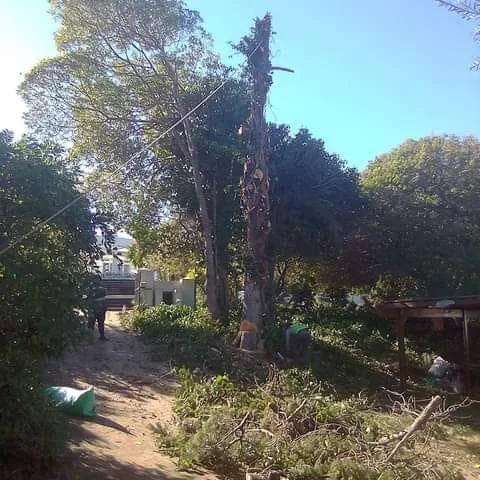
The City's confirmed-infestation list already runs from Bellville and Brackenfell through Durbanville and Kraaifontein down to Claremont, Constantia, Newlands, Rondebosch, Wynberg, Hout Bay, Somerset West and the Strand. If you're anywhere in that arc with a box elder or an English oak, an inspection this weekend is not paranoia. If it does turn out to be a breeding host that has to come out, a crew that fells and chips on site is the whole point, because the wood must not leave the property.
Frequently asked questions
Which trees does the shot hole borer kill fastest?
The six highly susceptible reproductive hosts: boxelder, English oak, weeping willow, Lombardy poplar, Chinese cottonwood and castor-oil plant. FABI notes these typically die within a few years of attack.
Are indigenous South African trees affected?
Yes. Keurboom, Cape chestnut, coral tree, wild peach, wild plum and Outeniqua yellowwood are all on the reproductive host list. Others, like silvertree and white stinkwood, are non-reproductive hosts.
Is my avocado tree at risk?
Avocado is a confirmed reproductive host in South Africa. Sugar volcanoes, a white powdery crust around a round hole, are the classic sign on avocado. Check the main stem first.
How big are the entry holes?
About 1 mm across and perfectly round, roughly the tip of a ballpoint pen. If the hole is ragged, oval or noticeably bigger, it's more likely a different borer.
Which trees are safe to plant instead?
The City of Cape Town publishes a list of recommended replacement species, indigenous trees and non-invasive exotics. Whatever you choose, check it against the current FABI host list first, and don't replant the species that just died.
My tree has a few holes but looks healthy. Do I fell it?
Not automatically. A few holes with no further activity usually points to a non-reproductive host, which is generally not expected to die. Confirm the species, then decide.
The point of all this is to stop two expensive mistakes: felling a tree that was never going to die, and nursing one that was always going to. Get the species right, look at the trunk properly, and the decision usually makes itself. If you'd rather have someone stand under it with you and say what they see, book a free look at it and we'll give you a straight answer either way.
Keep reading
Tree Roots Damaging Your House, Paving or Drains? What to Do
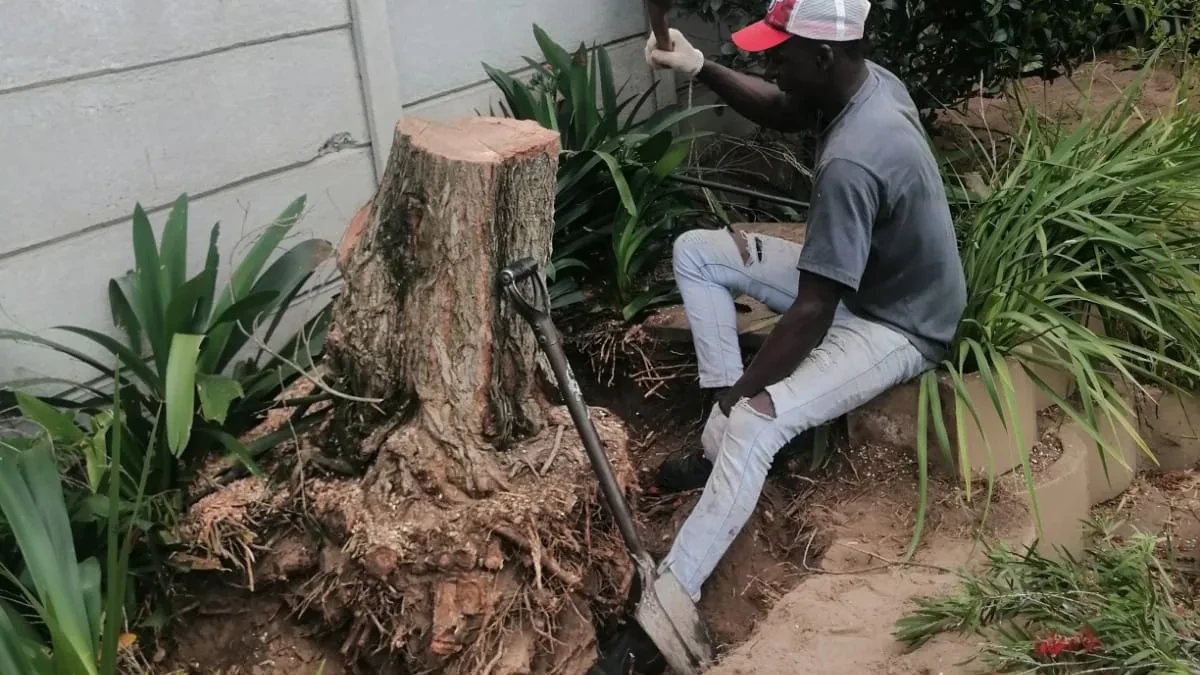
Lifted paving, a blocked drain or a crack in the boundary wall, and a big tree nearby. Here is what tree roots actually do to a property, what they almost never do, what the law says when the tree is your neighbour's or the City's, and how to decide between cutting a root, fixing a pipe and taking the tree out.
How to Cut Down a Tree Safely (And When to Stop)
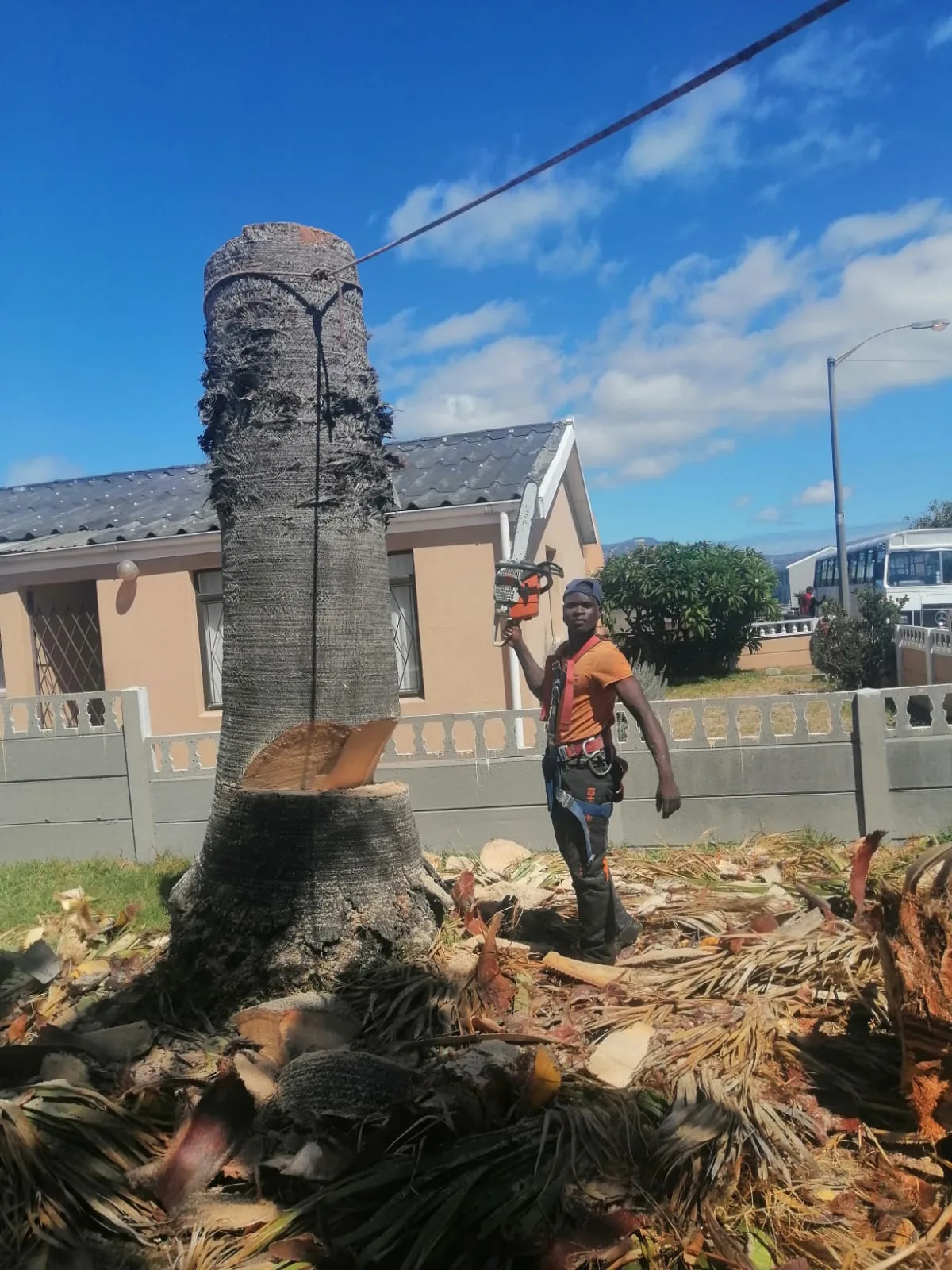
Most people searching for how to cut down a tree are really asking a different question: can I do this one myself? Here is the sequence a trained feller works through, what the hinge actually does, and the situations where the honest answer is to put the saw down and phone someone.
Blue Gum Tree Removal in Cape Town
A mature blue gum in a Cape Town garden sits in an odd legal spot: the species is listed as an invasive, but a big urban trunk is often specifically exempt from the duty to remove it. Here is which gums are actually listed, the tape-measure test that decides it, why cutting one down never finishes the job, and what a safe take-down in a suburb actually involves.