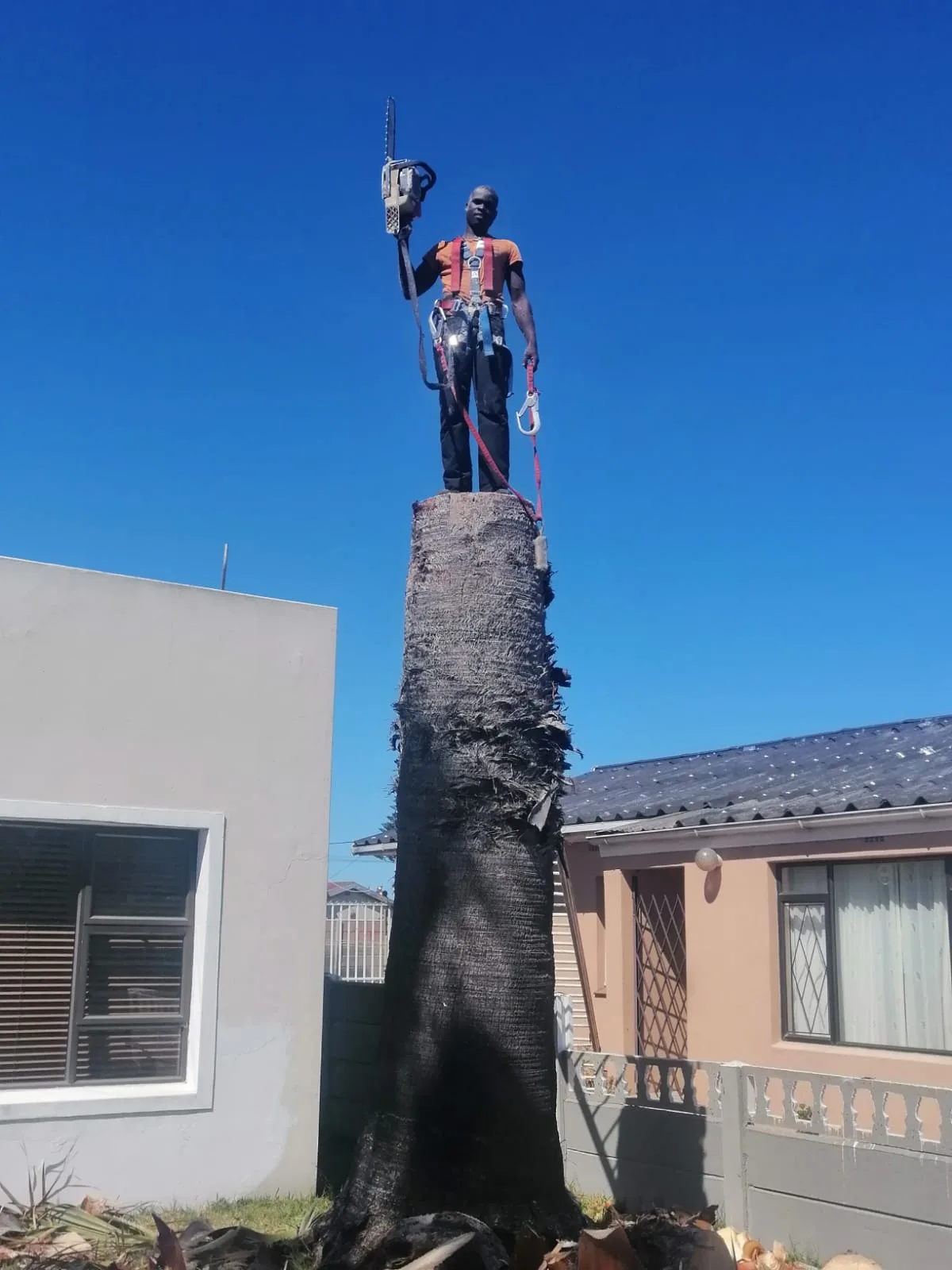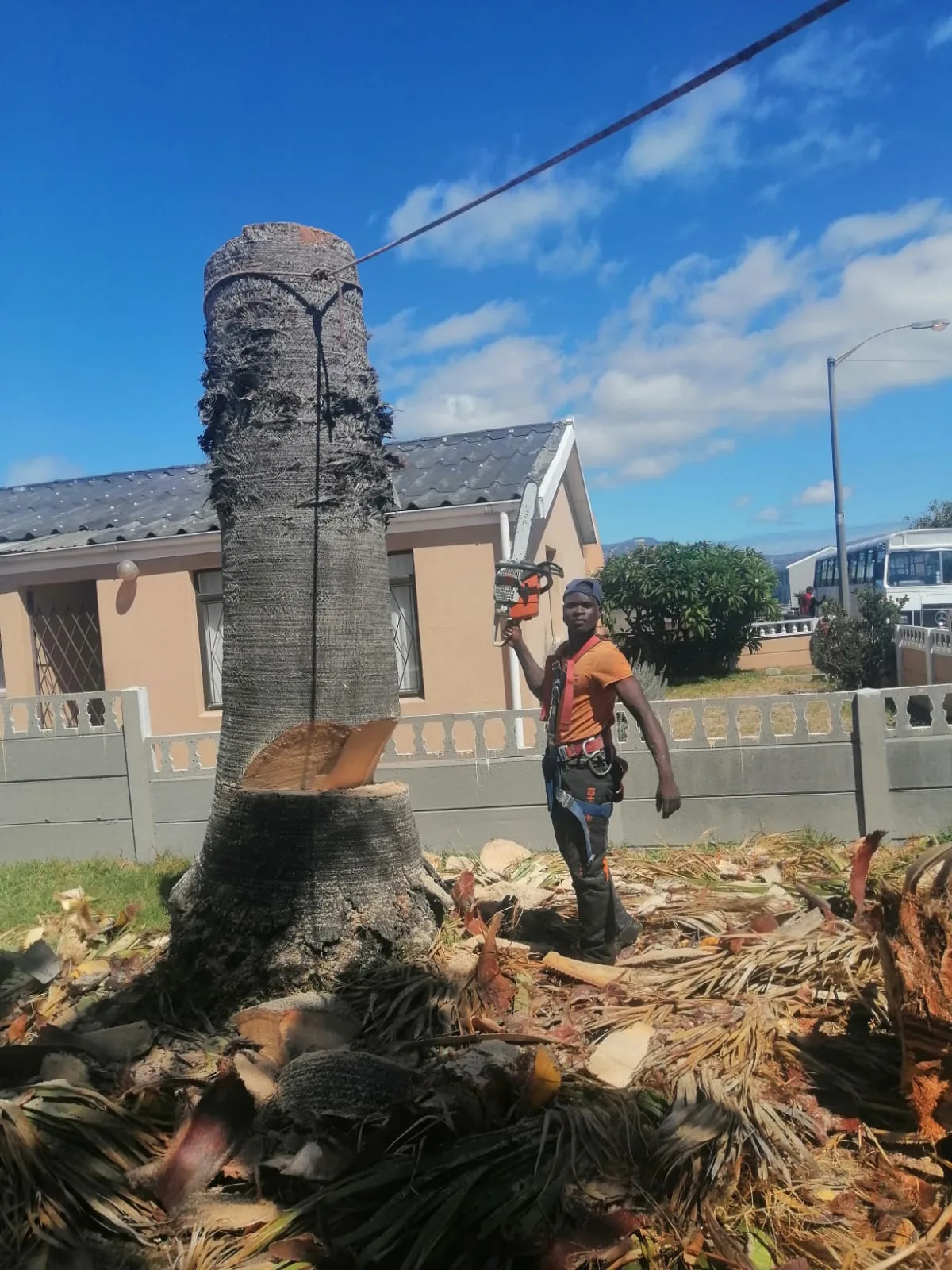
If you are working out how to cut down a tree in a Cape Town garden, the cutting is the last thing to think about and the smallest part of the job. A tree falls where its weight, its lean and your cuts tell it to go, and by the time the saw touches wood every one of those has already been decided. This is the sequence a trained feller works through, what the hinge is actually doing, and the situations where the right move is to stop.
Key takeaways
- Check the tree's legal status before anything else. Felling a protected species without a licence is a criminal offence in South Africa, not a municipal technicality.
- The hinge — the strip of uncut wood between the notch and the back cut — is what steers the fall. Cut through it and you have no control left.
- A retreat path gets planned and cleared before the first cut, not worked out while several tonnes of timber is moving.
- Overhead power lines are an absolute stop. That is a City of Cape Town or Eskom job, and no felling technique makes it safe to work around a live conductor.
- If the tree can reach a structure, is dead or hollow, or would need you to leave the ground, it is a rigging job rather than a felling job.
First question: is this tree yours to cut?
This one catches people out, because it has nothing to do with the tree being on your property. Certain species are protected nationally. The Department of Forestry, Fisheries and the Environment publishes the list of protected tree species under the National Forests Act, and the notice published on 13 March 2024 (Government Notice 4496, Gazette No. 50291) sets out the effect in the Act's own words: "No person may — (a) cut, disturb, damage or destroy any protected tree".
The same notice spells out what happens if you do. Contravening section 15(1) is a first category offence, and a person guilty of one "may be sentenced to a fine or imprisonment for a period of up to three years, or to a fine and such imprisonment". That is worth knowing before a Saturday morning starts with a chainsaw rather than a phone call.
Which of those actually turn up in a Cape Town garden? The City of Cape Town's Urban Forest Policy names these as the protected species commonly occurring in the city.
Protected species you may actually meet in Cape Town
- White Milkwood (Sideroxylon inerme)
- Silvertree (Leucadendron argenteum)
- Stinkwood (Ocotea bullata)
- Real Yellowwood (Podocarpus latifolius)
- Outeniqua Yellowwood (Afrocarpus falcatus)
- Breede River Yellowwood (Podocarpus elongatus)
- Henkel's Yellowwood (Podocarpus henkelii)
Milkwood and Silvertree are the two worth learning to recognise on sight.
Species is not the only thing that makes a tree an exception
- A heritage protection overlay zone, where "no-one may destroy or remove a tree(s), hedge or plantings" without special consent
- A designated heritage area, which is treated as carrying that overlay zoning
- A title deed, planning approval condition or town planning condition attached to your property
- Street and verge trees, which belong to the City and are a separate matter again
That is a lot of "it depends", and guessing from the leaf shape is not a plan. Work through whether you need a permit first — that guide covers the species, the overlay zones and the application route in one place.
The four checks that decide where it lands
Felling is almost entirely preparation. The United States Occupational Safety and Health Administration's logging standard is the most specific written guidance on the mechanics in the public domain. It is a US workplace rule rather than South African law, but the physics does not change at the border, and it requires that before each tree comes down, conditions including "the wind, the lean of tree, dead limbs, and the location of other trees" are evaluated and precautions taken. That list is a decent summary of what you are standing there looking for.
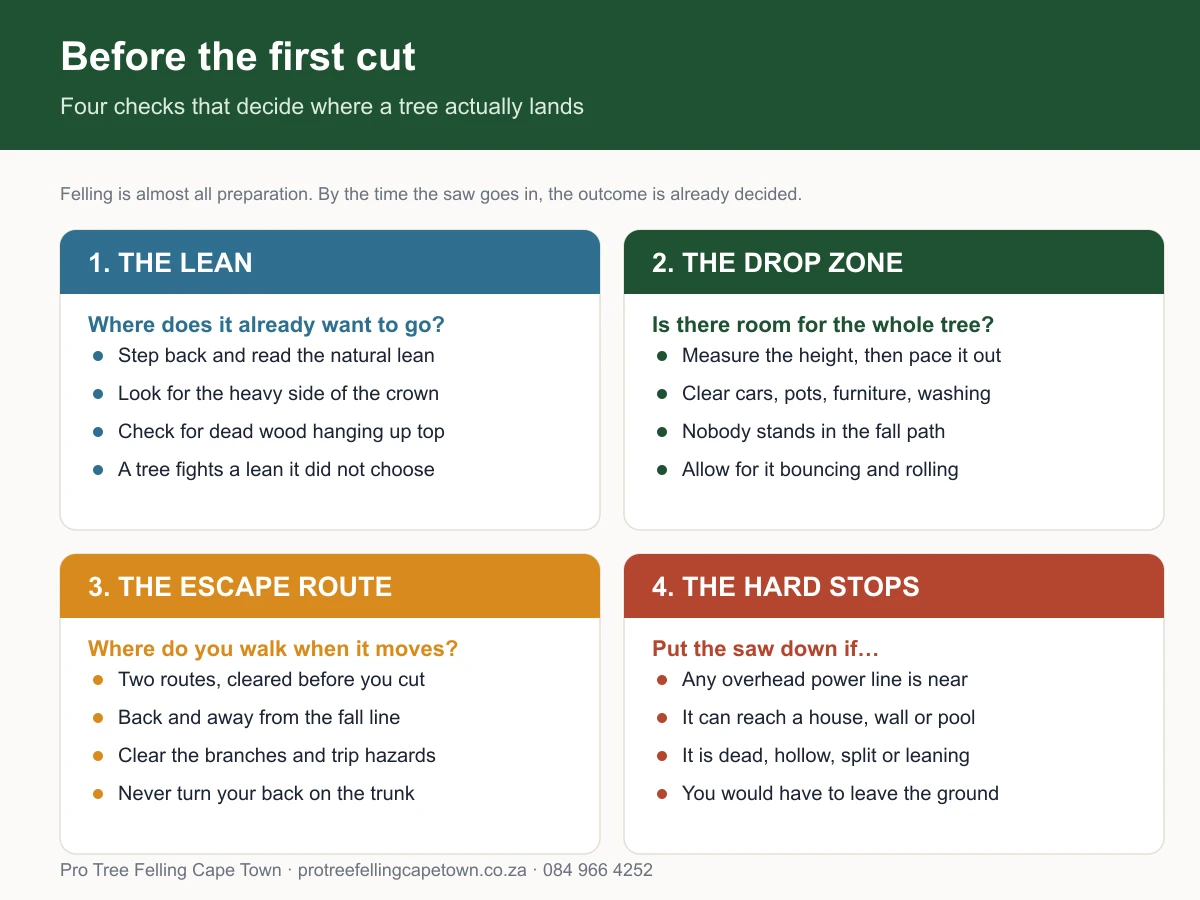
The lean is the honest one
A tree that already leans has made most of the decision for you. Persuading it to fall the other way is specialist work with wedges or a pull line, not something to improvise on the day.
Pace out the drop zone
Walk the height of the tree along the intended fall line and look at what is standing in it — then allow more, because a trunk bounces and a crown spreads sideways when it lands.
The three cuts, and what the hinge actually does
A controlled fall uses three cuts, and the wood you deliberately leave uncut matters more than the wood you remove. The regulation defines the undercut plainly as "a notch cut in a tree to guide the direction of the tree fall and to prevent splitting or kickback", and requires that it "be of a size so the tree will not split and will fall in the intended direction".
| Cut | Where it goes | What it is for |
|---|---|---|
| The notch (undercut) | On the side facing the intended fall | Aims the tree and stops the trunk splitting |
| The hinge | Left uncut between notch and back cut | Holds the tree to the stump and steers the fall |
| The back cut | Opposite side, above the horizontal face cut | Releases the tree; the step prevents kickback |
The hinge is the part most people get wrong, because it looks like unfinished work. The standard requires that the back cut "leave sufficient hinge wood to hold the tree to the stump during most of its fall so that the hinge is able to guide the tree's fall in the intended direction". Saw straight through and the tree is simply loose — free to sit back on the bar, twist off the stump, or drop somewhere nobody planned for. The standard also requires the back cut to be "above the level of the horizontal facecut in order to provide an adequate platform to prevent kickback".
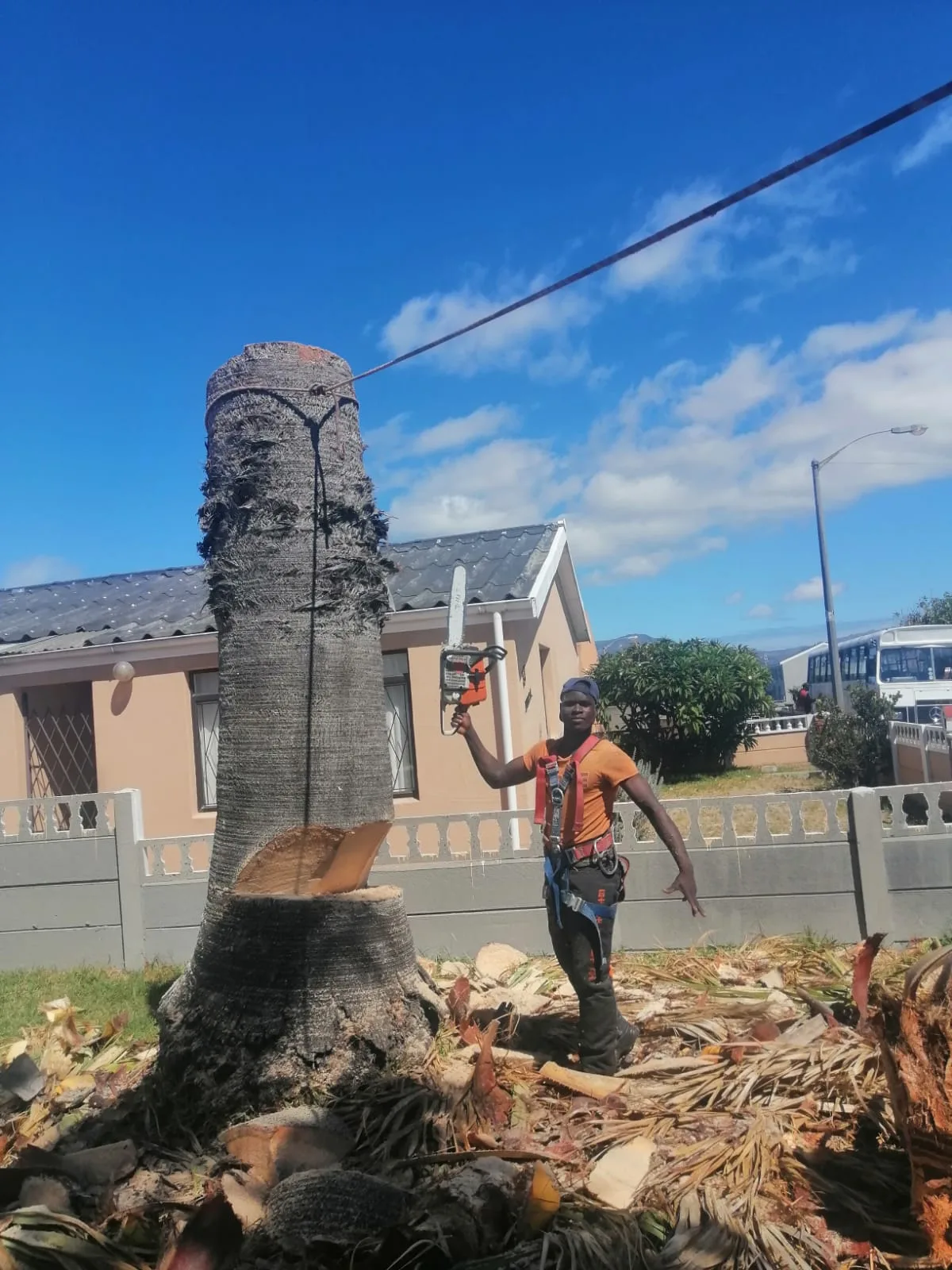
We have deliberately not published hinge dimensions here as a rule of thumb. They vary with species, trunk diameter and how sound the wood is, and a number copied off the internet and applied to a hollow gum is worse than no number at all.
The retreat path is not optional
The single most-skipped step is the one that protects you rather than the garden. The regulation is unambiguous: "Before felling is started, the feller shall plan and clear a retreat path. The retreat path shall extend diagonally away from the expected felling line", and "once the backcut has been made the feller shall immediately move a safe distance away from the tree on the retreat path".
Two details in the same standard that almost everyone skips
- Brush and obstacles that "might interfere with cutting the tree or using the retreat path" get cleared beforehand — nobody successfully hurdles a branch while looking upward.
- The saw "shall be shut off or the throttle released before the feller starts his retreat". Walking backwards over uneven ground with a running chain is its own accident.
The retreat path is the step that protects you rather than the garden, which is exactly why it gets skipped. Clear two of them, in opposite directions, before the saw starts.
Power lines: the one with no clever workaround
If any overhead line runs near the tree, stop reading about notches. This is not a confidence question. Under the US electrical safety rules referenced by that same logging standard, an unqualified person must keep themselves and the longest conductive object they might touch at least 10 ft (305 cm) away from an unguarded, energised overhead line at the voltages found on ordinary distribution lines — and a branch or a wet rope counts as conductive. That is a US figure, quoted because it is written down; we have not found a published South African clearance aimed at homeowners.
The Cape Town answer is simpler
A tree touching or growing through the overhead supply is a City of Cape Town or Eskom matter, and the line has to be dealt with before anyone goes near the tree. Any contractor willing to work around a live conductor to save you that phone call has told you something useful about how they work.
The hard stops: when to put the saw down
There is a real line between a small tree in an open garden and a job that needs a crew, and it is not about bravery. The International Society of Arboriculture puts it flatly: "Trees are an investment that require proper tree care; however, pruning or removing trees, especially large trees, can be dangerous work. Tree work should be done only by those trained and equipped to work safely in trees."
Reasonable to handle yourself
- Short enough that the whole tree fits in open ground
- Sound, living wood with no split or cavity
- No lean towards anything that matters
- Both feet on the ground, start to finish
- No line, fence, wall or roof within reach
Stop and call someone
- Any overhead power line nearby
- It can reach a house, wall, pool or neighbour
- Dead, hollow, split, burnt or storm-damaged
- You would need a ladder, rope or harness
- You are not certain which way it will go
"Removing or pruning storm-damaged trees can be dangerous, but a professional arborist can perform the job safely while reducing further risk of damage to people and property."
That is worth dwelling on after a Cape Town winter. A wind-damaged tree carries stored tension in places you cannot see from the ground, which is exactly the situation where a textbook notch does not behave like the textbook.
What a crew does differently
On a tight Cape Town plot, most trees never get felled in one piece at all. They get dismantled instead, and the difference is worth understanding before you compare quotes.
Felling — room to fall
The tree comes down in one piece along a planned line. Fast, cheap, and only possible when the fall path is genuinely longer than the tree.
Rigging — no room to fall
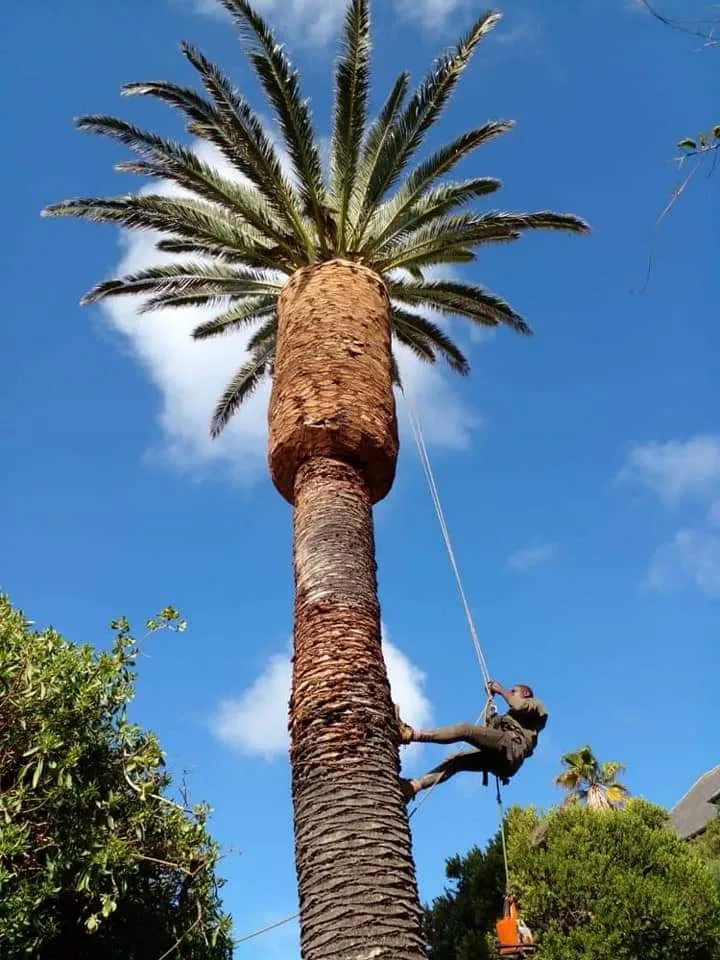
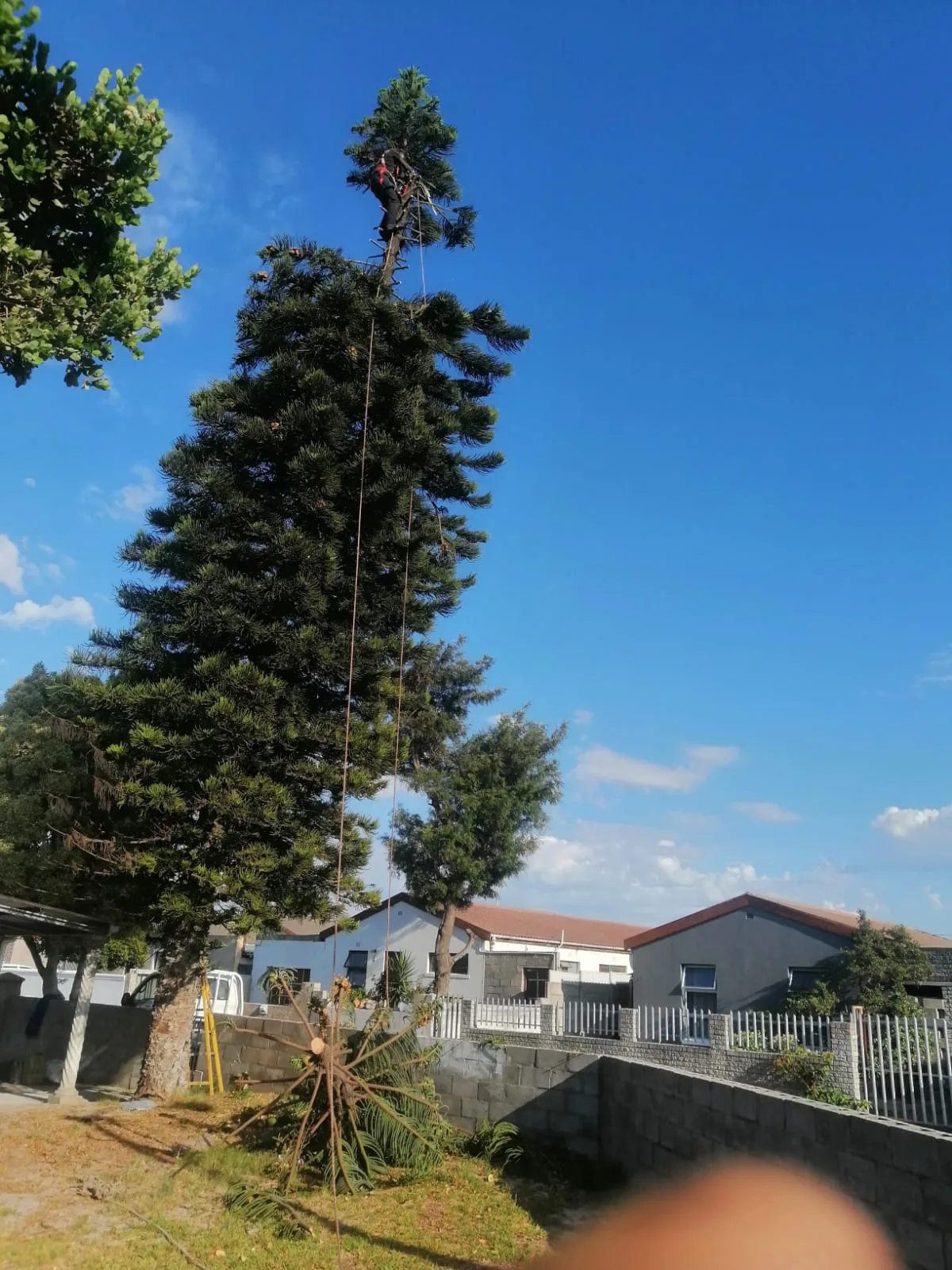
A climber works up the stem on rope, takes the crown off in sections and lowers each piece on a line so nothing drops uncontrolled. Slower, and the only thing that works in a confined garden.
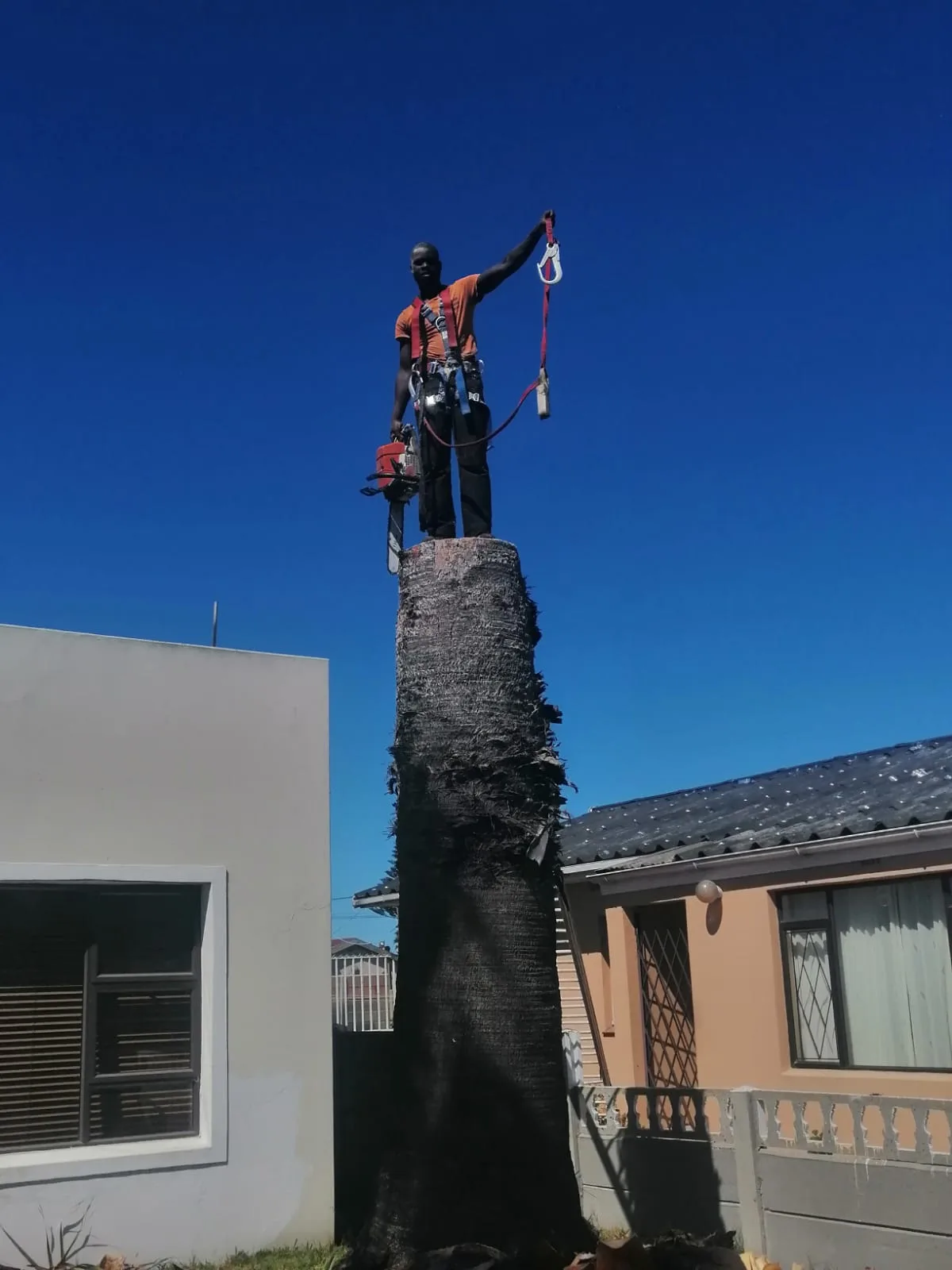
That is the practical dividing line. A tree with room to fall is a felling job. A tree without room is a rigging job, and rigging is where the equipment, the training and the insurance actually earn their keep. If you are weighing it up, our crew does controlled tree felling across the southern suburbs and the Atlantic seaboard, and we would far rather look at a tree for free than quote on repairing a roof. You can book a free on-site quote and we will tell you honestly if it is a job you could do yourself.
Frequently asked questions
What are the 5 steps of tree felling?
Assess the tree and its lean, clear the drop zone, plan and clear a retreat path, cut the notch on the falling side, then make the back cut above it and retreat. The preparation is four of the five steps.
Are you allowed to cut your own tree?
Not in every case. A protected species needs a licence under the National Forests Act, and heritage overlay zones, heritage areas, title deed conditions and City-owned street trees each carry their own restriction. Check the species and the zoning before you cut.
How close is too close for a tree next to a house?
For felling purposes, if the distance to the house is less than the height of the tree, it cannot be dropped in one piece safely. That tree needs sectional dismantling, whatever its condition.
What are the safety precautions for felling?
Read the lean and the wind, clear the fall zone of people and property, plan and clear a retreat path diagonally away from the fall line, keep well clear of power lines, and shut the saw off before retreating.
How do you cut down a tree for beginners?
Honestly: by starting with a tree small enough that a mistake costs nothing. If the tree can reach a structure, a fence or a line, a first attempt is the wrong place to learn the hinge.
What are the risks associated with tree felling?
A trunk sitting back on the saw, a tree twisting off a cut hinge, dead limbs dropping from the crown, kickback, and contact with overhead lines. Most of them are decided before the first cut, not during it.
Tree work rewards patience far more than nerve. If any part of the assessment leaves you unsure which way a tree will go, our Cape Town tree crew will come and look at it, and that visit costs you nothing either way.
Keep reading
Blue Gum Tree Removal in Cape Town
A mature blue gum in a Cape Town garden sits in an odd legal spot: the species is listed as an invasive, but a big urban trunk is often specifically exempt from the duty to remove it. Here is which gums are actually listed, the tape-measure test that decides it, why cutting one down never finishes the job, and what a safe take-down in a suburb actually involves.
10 Signs a Tree Needs to Be Removed (And When It Doesn't)
Most of the trees people ask us to remove don't need removing. This is the honest diagnostic list — what a lean, a bracket fungus, a hollow trunk, a crack or a cut root really tells you, which signs mean act today, and which ones a prune will settle.
PSHB Treatment Options in Cape Town: What Works
You've found the holes. Now what? An honest look at every PSHB treatment on offer in Cape Town, what the research actually shows about injections and sprays, the three legal ways to destroy infested wood, and how to tell when felling is the only option left.