Tree Felling in Cape Town
When a tree has outgrown its spot, become unsafe, or simply has to go, our climbing crew takes it down in controlled sections, so nothing lands on your roof, your walls or next door. Free quotes, across the Cape.
When a tree has to come down — and when we'd tell you to keep it
Felling is permanent. A tree that took forty years to reach the height it's at now takes an afternoon to remove and can't be put back, so it's worth being clear about which problem you're actually solving first. These are the reasons a tree genuinely needs to go, roughly in the order we're called out for them.
It's failing, not just untidy
Fungal brackets at the base, a split in the main stem, or soil lifting on one side of the root plate. Those are structural signs rather than cosmetic ones, and they don't improve on their own — we walk through the full list in our guide to the signs a tree needs removing.
It's in the wrong place
A pine planted two metres from a boundary wall in 1980 is a different tree today. No amount of pruning fixes a trunk that has run out of room, and cutting back hard every year to hold it there just makes a weaker tree with denser regrowth.
The wind has already had a go
After a hard south-easter or a winter front, a tree that has lost a major limb or is leaning further than it was is usually past saving. Half a canopy left on one side is a lever, and the next storm uses it.
You're building, paving or clearing
Foundations, a new driveway, a pool or a plot that has to be cleared before the builders arrive. Here the tree's health isn't the question at all — access and the order of work are.
The other half of the job is saying no. A fair number of the trees we're asked to fell shouldn't be: a thin crown caused by overcrowding, one branch hanging over a roof, a tree that's just too dense and dark. Those are pruning problems with a pruning price, and we'll say so on the day even though it's the smaller job — the line between the two is set out on our pruning and trimming page. If a tree can be kept, you'll hear that before you hear a felling quote.
The Cape Town trees we fell most, and what makes each one awkward
Species isn't a detail — it changes the method, the time on site and the price. Four groups make up most of our felling work across the city.
Pines (Pinus pinaster, Pinus radiata)
The cluster and Monterey pines planted all over the Peninsula and the Southern Suburbs. On thin, sandy Cape soils they tend to hold on with a wide, shallow root plate rather than a deep anchor, which is why whole pines go over in a gale while the trunk itself is sound. The side limbs are brittle and snap rather than bend, so the risk on a pine is as much about what comes loose above the climber as about the felling cut. Tall, straight and heavy: usually a full-day sectional take-down.
Bluegums and eucalypts
The biggest thing in most Cape gardens that has one. Green eucalypt timber is enormously heavy for its size, which decides the rigging: sections stay small and every one gets lowered, because a piece that looks manageable from the ground will shock-load a rope hard. They also coppice fiercely — fell a gum, leave the stump, and you'll have a multi-stemmed thicket in its place by the next summer. If you want it gone for good, the stump has to go in the same job.
Port Jackson and rooikrans (Acacia saligna, Acacia cyclops)
The scrubby acacias that take over vacant plots, dune edges and back boundaries across the Cape Flats and the coast. Both are listed Category 1b on the 2020 national alien and invasive species list, so controlling them is a legal duty on the landowner rather than a gardening choice, and no permit is needed to remove them. Individually they're small, so this is usually priced as clearing rather than felling — but like the gums they resprout hard from a cut stump.
Oaks and camphors
The big Southern Suburbs trees. Both throw long, heavy lateral limbs far out over walls and roofs instead of growing straight up, so the rigging happens sideways and slowly, and old oak is dense timber that blunts chains. Two things to check before you commit: mature oaks and camphors in the older suburbs are often inside a heritage overlay area, and English oak (Quercus robur) is one of the species most susceptible to polyphagous shot hole borer here.
Not sure what you've got? Send us one photo with the whole tree in frame and one of the trunk at chest height — that's usually enough to name it and give you a rough band. The firm number still comes after we've seen the access and what's underneath.
What tree felling costs in Cape Town, and what moves the price
Hardly anyone in this trade publishes prices. We do, because the alternative is you phoning five companies to work out whether the number you've been given is fair. These are the bands most residential jobs in Cape Town land in.
| Tree size | Typical Cape Town range | Time on site |
|---|---|---|
| Small — under 6 m | R1,200 – R3,500 | Half a morning |
| Medium — 6 to 12 m | R3,000 – R8,000 | Most of a day |
| Large — 12 to 20 m | R7,000 – R15,000 | A full day or more |
| Very large — over 20 m | R15,000 – R30,000+ | Two days or more |
| Stump grinding (add-on) | R800 – R4,500 | 20 to 60 minutes |
A small garden tree with an open drop zone and the truck at the gate sits right at the bottom of that first band, around R1,200 to R2,500. The bands are wide on purpose, because the same tree can honestly be two different jobs. What decides which end you land on:
- Height and spread. Volume grows much faster than height, so a 15 m tree is far more than double the work of a 7 m one.
- Species and wood density. A fast-grown gum cuts quickly, old oak is slow going, and density decides how much can be chipped rather than loaded whole.
- What's underneath. Open lawn is the cheapest job there is. Put a roof, a pool or a boundary wall under the crown and every piece gets roped down.
- Access. Truck and chipper at the tree, or everything carried through a narrow side gate — the most common single reason a quote lands at the top of its range.
- Slope. A steep garden with steps up to the road adds hours of carrying that a flat plot doesn't.
- Whether the stump goes too. Worth deciding up front rather than booking a second visit later.
Anything unusual — crane or cherry-picker access, a road closure, several trees at once — is quoted on site rather than guessed at over the phone. The full breakdown, including how disposal is costed, is in our Cape Town tree felling price guide.
Every tree is quoted at one fixed written price before we start. No day rate, no call-out fee, no "we'll see how it goes".
Get my felling quoteStraight felling or sectional dismantling?
"Tree felling" covers two methods that share nothing except the outcome, and which one your tree needs is the biggest single thing behind the price.
A straight directional fell is the tree coming down in one piece. It needs a drop zone at least as long as the tree is tall, with room either side for the canopy and for the butt to kick. The feller reads the lean and the weight, cuts a notch on the side it's going, then a back cut that leaves a hinge of uncut wood to steer it; ropes or a wedge do the rest. In the right place it's quick, cheap and completely controlled — the method for open plots, smallholdings and site clearing, and the wrong answer in most Cape Town gardens.
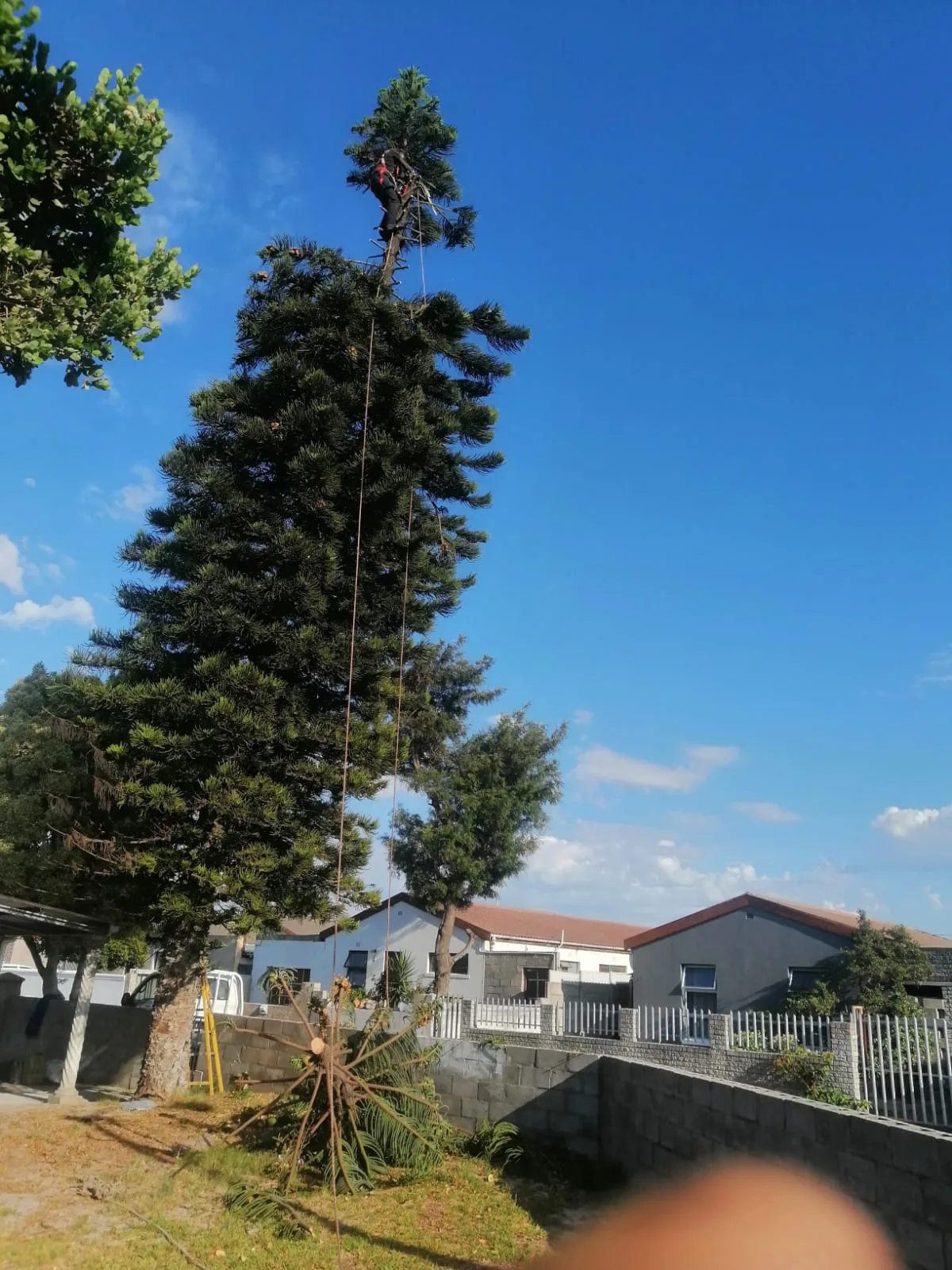
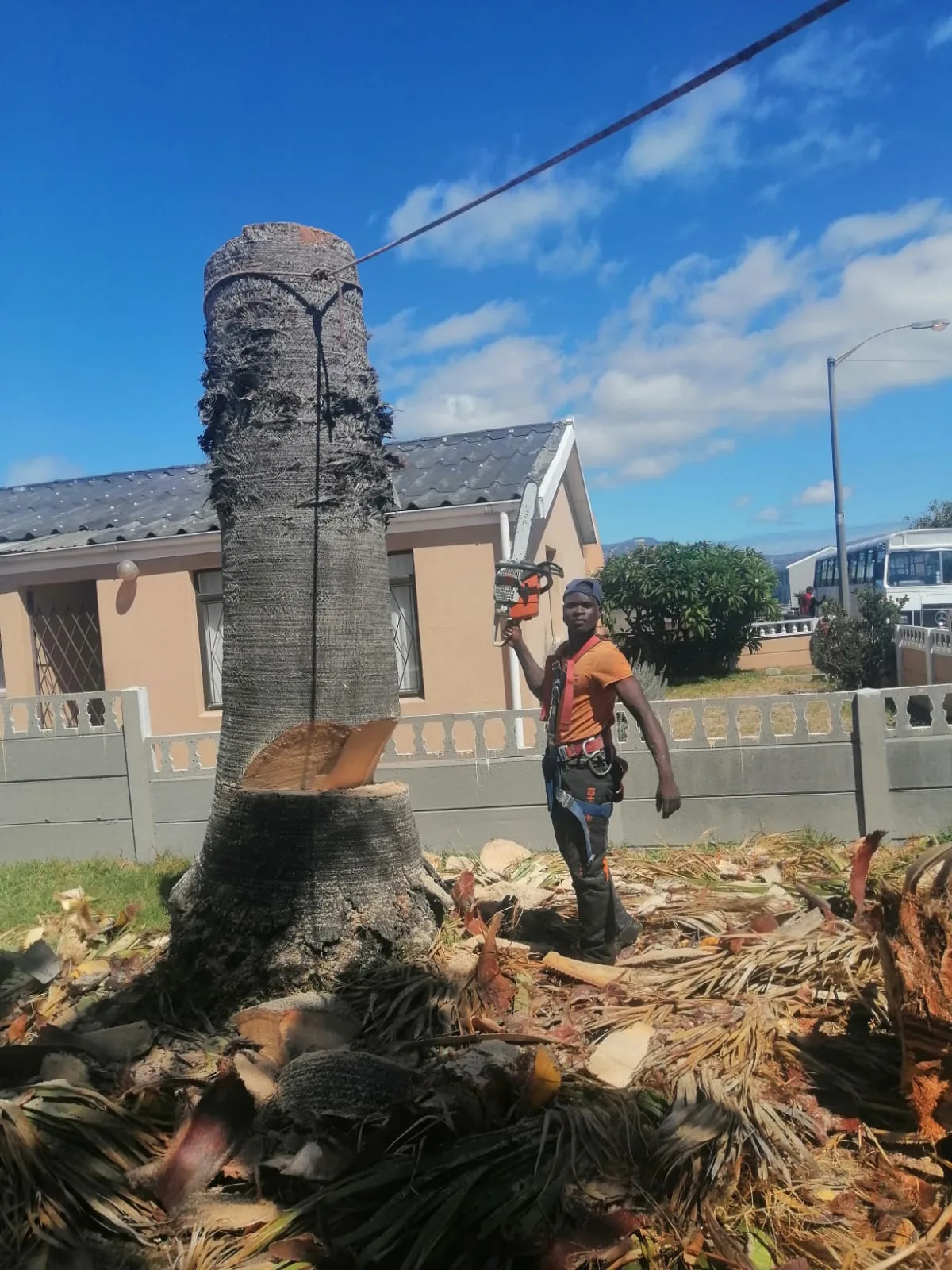
Sectional dismantling is what almost every suburban plot here gets. A climber goes up on rope and harness and takes the tree apart from the top down. Side limbs come off first, tied on and lowered through a rigging point instead of falling. With the stem bare it's cut down in short lengths, each one lowered or dropped into a small cleared patch. Nothing heavy ever moves unless it's under control.
That's slower and it takes real skill, which is why it costs more. But where a 20 m pine has four metres of clear ground beside it and a neighbour's roof over the wall, it isn't the premium option — it's the only one. A suspiciously cheap price on a big tree in a tight garden is usually this corner being cut.
Do you need permission to fell a tree in Cape Town?
For an ordinary garden tree inside your own boundary — a pine, a cypress, a gum, a fruit tree — usually not. Most private-property felling in Cape Town needs no paperwork at all. Three exceptions catch people out.
The tree on the verge isn't yours. A tree growing in the road reserve outside your wall belongs to the City of Cape Town, even though you're the one raking up after it. It needs Council approval before anyone touches it, and taking one out without that is an offence. We check which side of the line your tree sits on at the quote stage and tell you straight — we won't cut a Council tree on your say-so.
Some indigenous species are protected nationally. Under the National Forests Act 84 of 1998, the Minister declares protected species in a list published under section 12, and section 15(1) then makes it an offence to cut, disturb, damage or destroy one without a licence, wherever it grows — including in your own garden. The current list was published in Government Notice 4496, Government Gazette 50291, on 13 March 2024. A handful on it turn up around Cape Town: white milkwood, real and Breede River yellowwood, stinkwood and assegai among them.
Heritage overlays and individually protected trees. Inside a Heritage Protection Overlay Zone or a declared conservation area a mature tree can be protected whatever its species, and individual trees can be listed on their own for age or size.
Invasives run the other way — with a Category 1b species like Port Jackson or rooikrans there's nothing to apply for, because you're already obliged to control it. If you're not sure where your tree falls, the full rules and how to apply are in our guide to tree felling permits in Cape Town. Approvals take time, so it's worth starting that before you book a crew.
What customers say about the work
Very professional, safe, respectful, lovely guys. Second time using Peter's team. Very pleased with the result. These guys are going far. I recommend them.
Peter is such a friendly guy and his work really impressed me. Great work and great clean-up. Highly recommend.
I had a great experience with Peter. They were very efficient, arrived on time, and trimmed my palm tree beautifully. They also cleaned up everything afterwards and removed all the rubble, leaving the area neat and tidy.
Safety, and what "done properly" looks like on site
Most of the damage we get called out to wasn't caused by the tree. It was caused by someone with a chainsaw and no plan for where the weight was going. Felling is almost entirely preparation — by the time the first cut goes in, the outcome should already be decided.
Before anything comes off we set a drop zone: the patch of ground everything lands in, cleared and cordoned, with nobody standing in it. We agree signals up front, because a climber twelve metres up hears nothing over a saw. Then we work out the cut sequence — what comes off first so the tree stays balanced, where the rigging point goes, and which limbs are carrying weight for others.
On power lines we'll be blunt: we do not work on live municipal lines. If a tree is touching or growing through the overhead supply, that's a City of Cape Town or Eskom job and the line has to be dealt with before we go up. Any contractor willing to work around a live conductor to save you a phone call is one to walk away from. What we will do is tell you who to call and book the work for once it's sorted.
The rest is protecting what's already there: pool covered, irrigation heads and lighting located before rigging starts, boards over paving that would crack under a falling log, and the neighbour warned when anything is coming down near a shared wall. Twenty minutes covering a pool beats a morning fishing branches out of it.
What happens to the wood and the mess
People underestimate this part every time. A mature tree that looked like one object in the garden becomes several cubic metres of timber, brush and sawdust across your lawn, and clearing it is a decent share of the day. It's in our quote and it should be in anyone's — if a price looks low, check whether green waste removal is in it or whether the pile stays where it falls.
Branches and leafy material go through the chipper on site, which cuts a bakkie-load of brush down to a fraction of the volume; say the word and we'll leave you the chip for mulching beds instead of taking it. Trunk and heavy limbs are cut into liftable lengths and loaded out. If you'd rather keep the wood, tell us before we start and we'll cut it to firewood lengths and stack it where you want it — free, and it saves us the disposal. Gum, oak and rooikrans all burn well once seasoned; pine is soft, resinous and burns fast. Everything else is raked, swept and taken away, driveway and pavement included.
That leaves the stump. Standard felling takes the tree down to a low stump at ground level, which is fine if you're happy to plant around it. If you want to pave, build, re-lawn or plant in the same spot — or the tree was a gum or an acacia that will simply resprout — the roots need to come out. Grinding it out below ground level in the same visit costs far less than bringing a machine back later, and it shows on the quote as a separate line so you can decide with the number in front of you. Our stump grinding page is one click away in the services block below.
We fell trees right across greater Cape Town — the Atlantic Seaboard, the Southern Suburbs, the Peninsula, the Northern Suburbs and out to the West Coast. Call 084 966 4252 and describe the tree — we'll tell you on the phone whether it needs a site visit.
Our tree felling process
Free on-site assessment
We come out, look at the tree, the lean, the surrounding structures and access, and give you an honest fixed quote — no obligation.
Plan the drop or sectional take-down
Open gardens get a controlled directional fell; tight Cape Town plots get a piece-by-piece rope-and-climb take-down so nothing below gets touched.
Fell, lower and process
Our crew fells in sections, lowers each piece under control, then cuts everything down to manageable lengths on the ground.
Clear, clean and tidy up
We haul away the timber and brush, rake the site, and leave your garden cleaner than we found it. Stump grinding available if you want the stump gone too.
Every tree felling job is quoted up front in writing, and cleaned up afterwards.
Get my free quoteTree Felling jobs in Cape Town
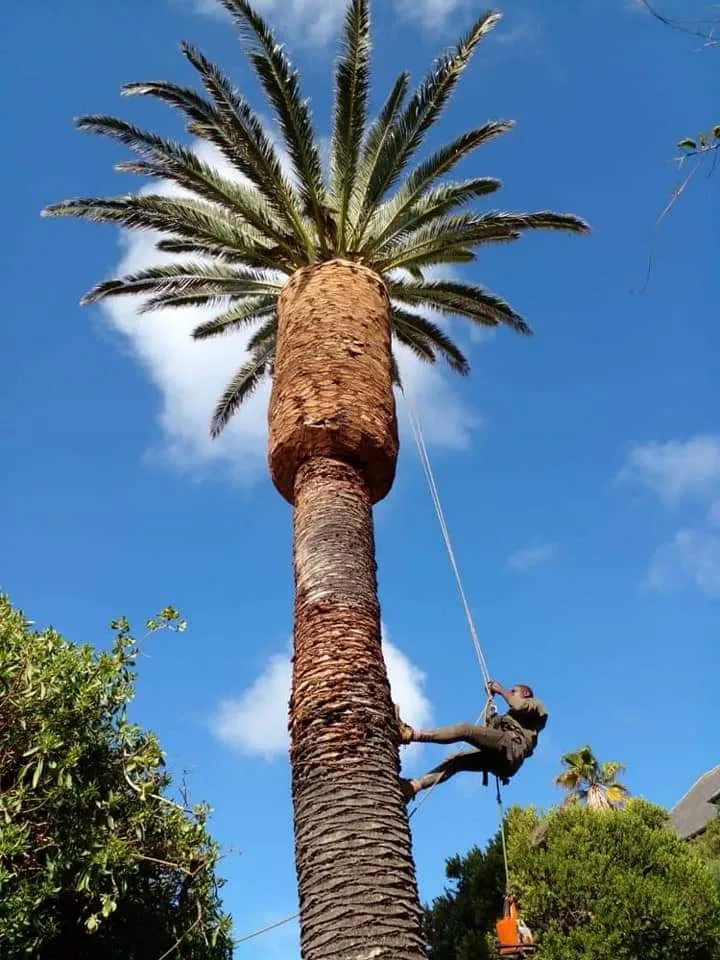
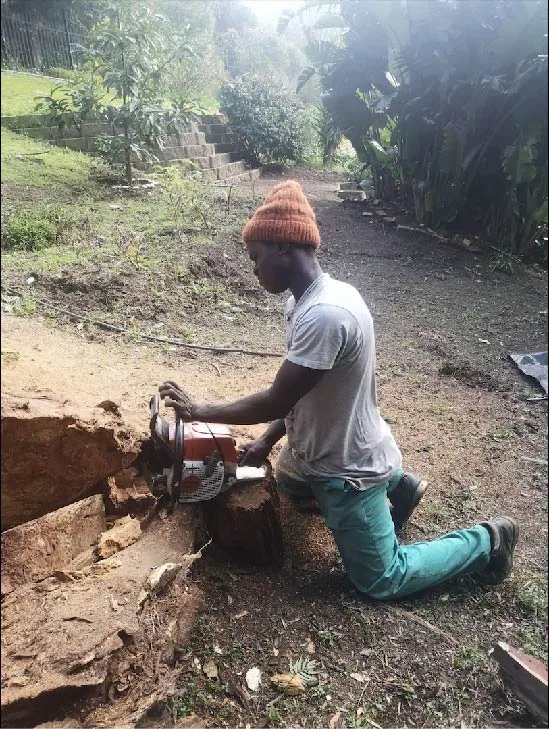
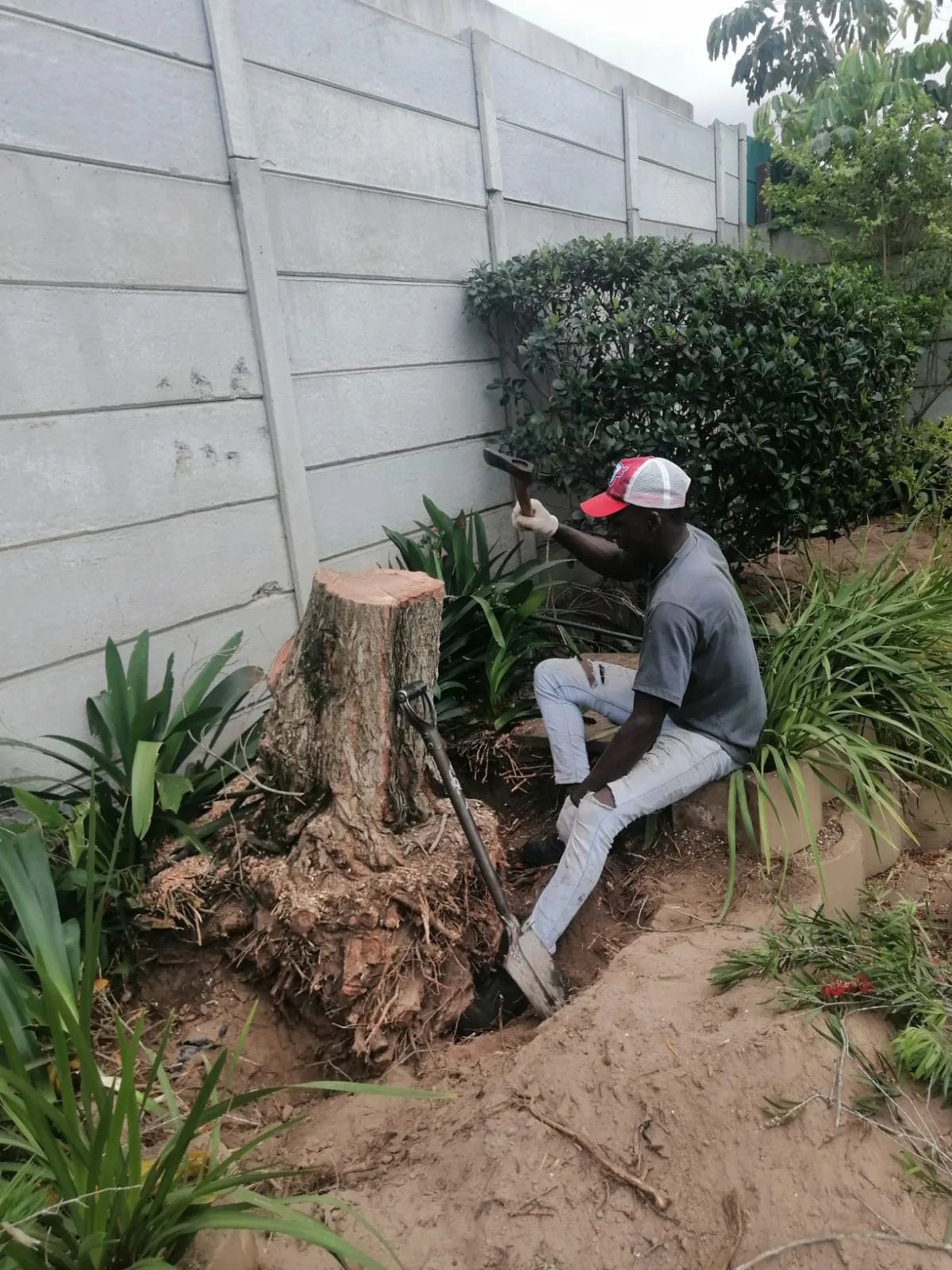
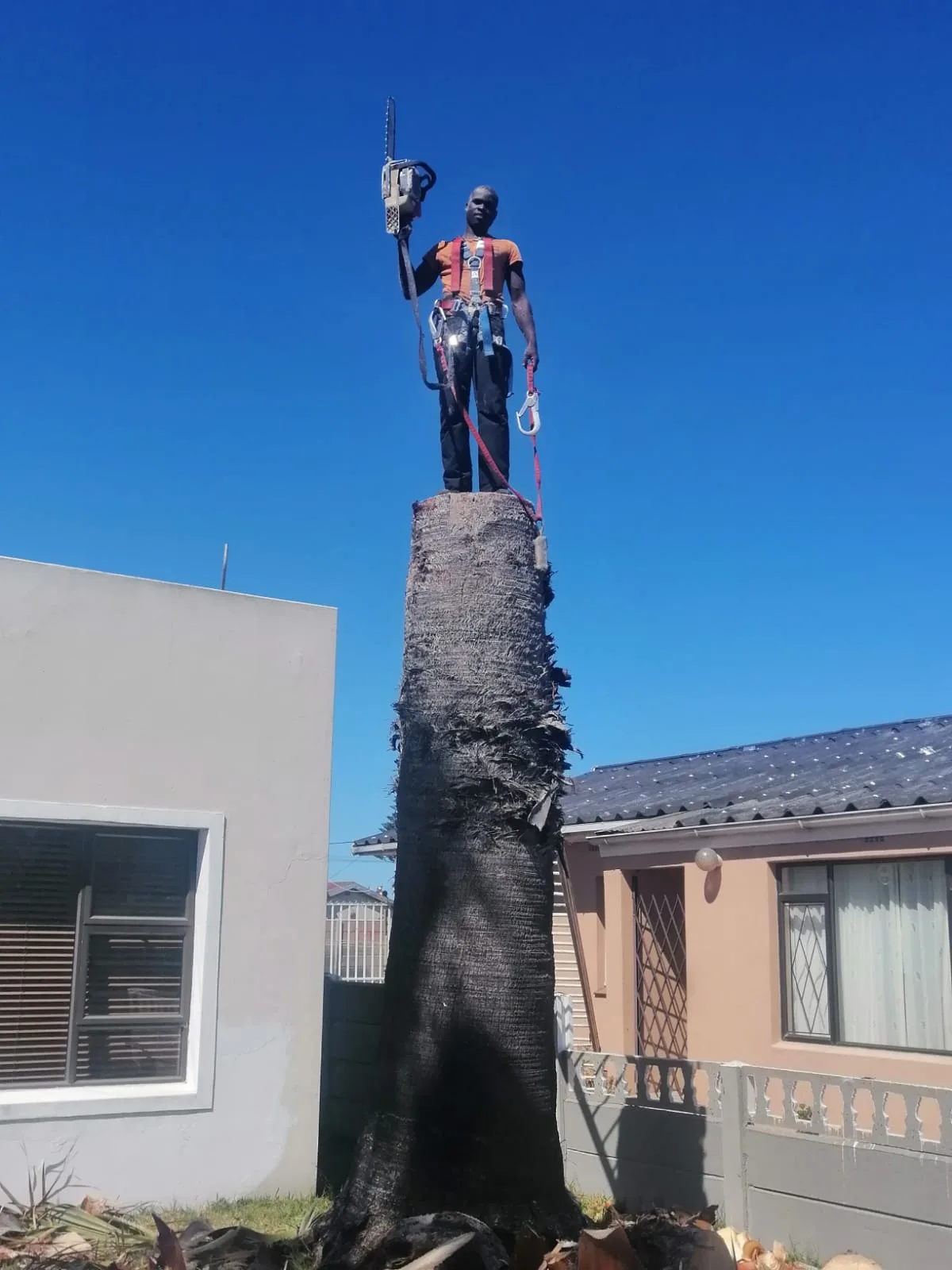
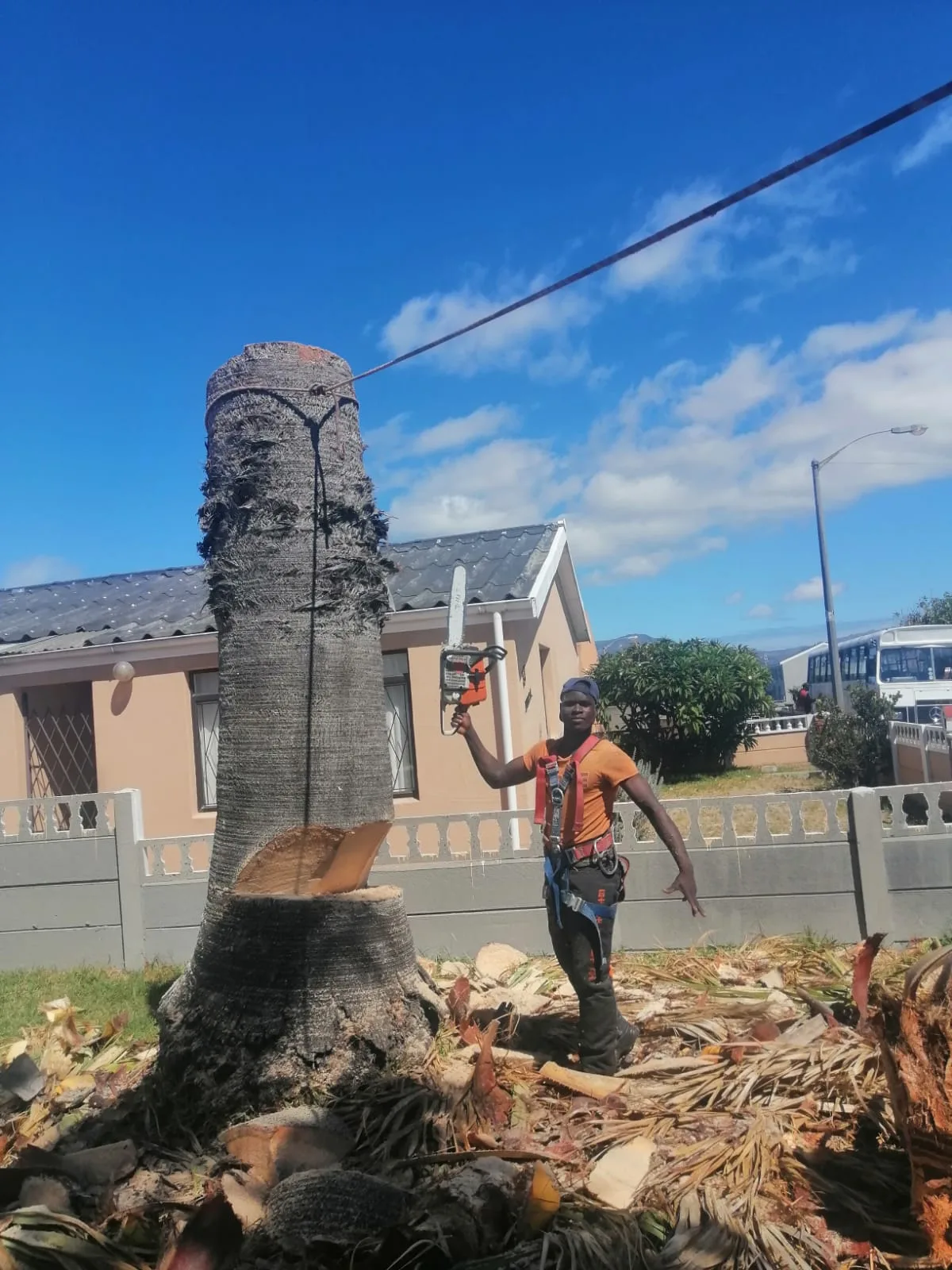
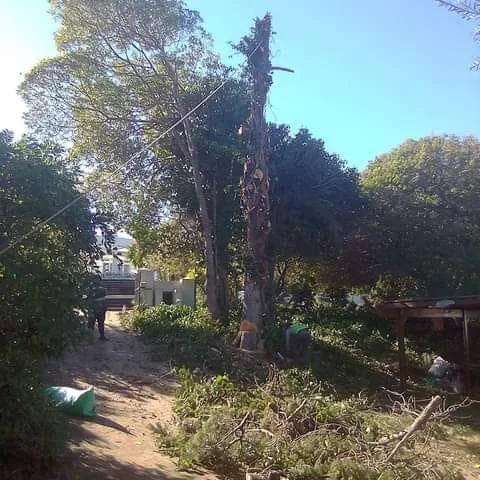
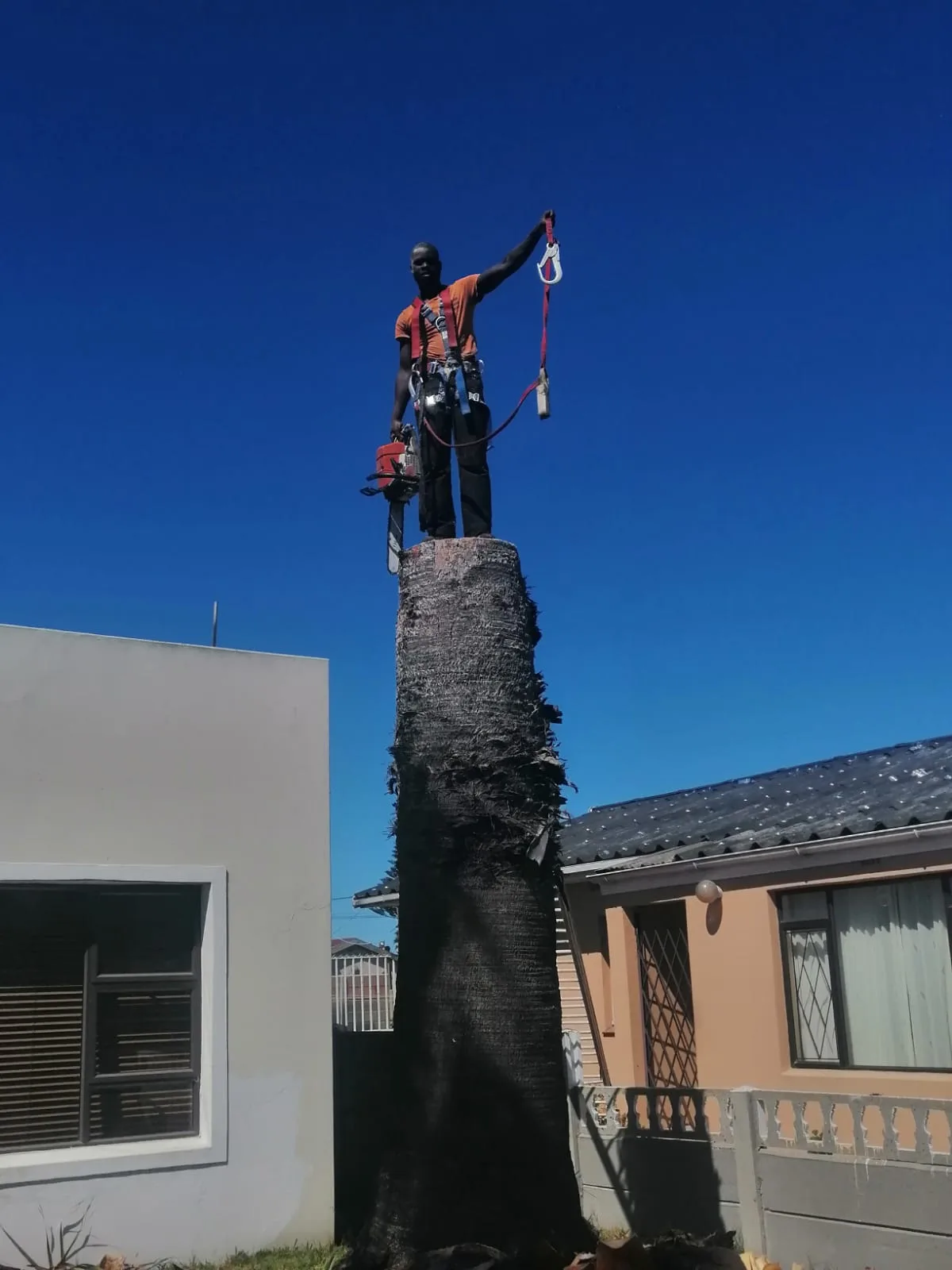
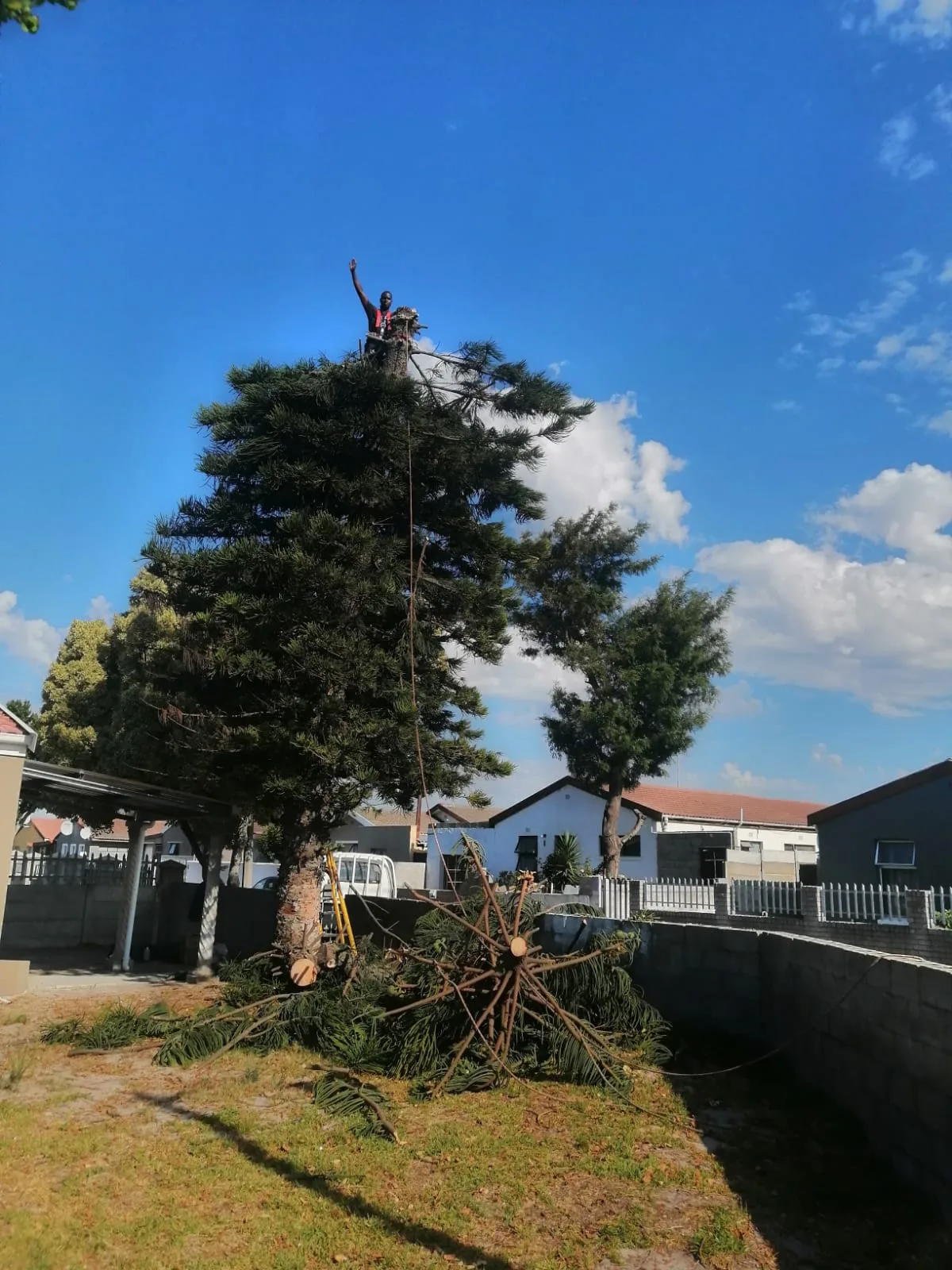
These are our crew on real jobs — no stock photography. More of them are in the job photo gallery.
Get a free tree felling quote
Fill this in and we'll come and look, then give you one fixed written price. No call-out fee.
Tree Felling FAQs
Common questions about this service in Cape Town.
Tree Felling across Cape Town
We provide tree felling right across the city — including Camps Bay, Sea Point, Constantia, Newlands, Durbanville and Table View. Not on the list? We cover the whole of greater Cape Town.
Other tree services we offer
All across greater Cape Town.
Tree Removal
Complete tree removal — felled, cleared, hauled away and the site left tidy.
Learn more
Stump Removal & Grinding
Grind out unsightly stumps below ground level so you can pave, build or replant.
Learn more
Tree Pruning & Trimming
Shape, thin and lift your trees for health, light and a tidy garden.
Learn more
Palm Tree Removal & Cleaning
Remove, trim or clean tall palms — our specialty across the Cape.
Learn more