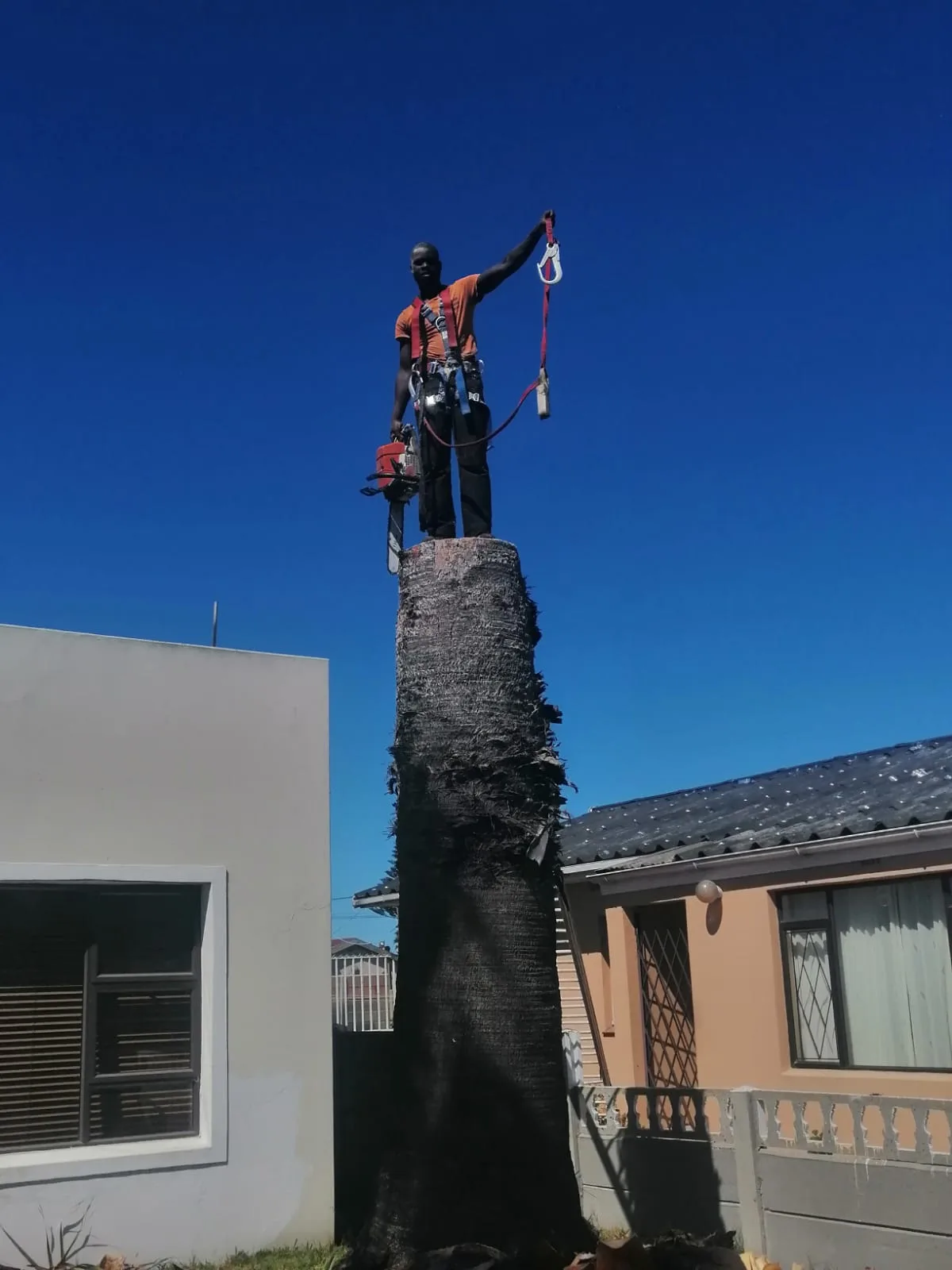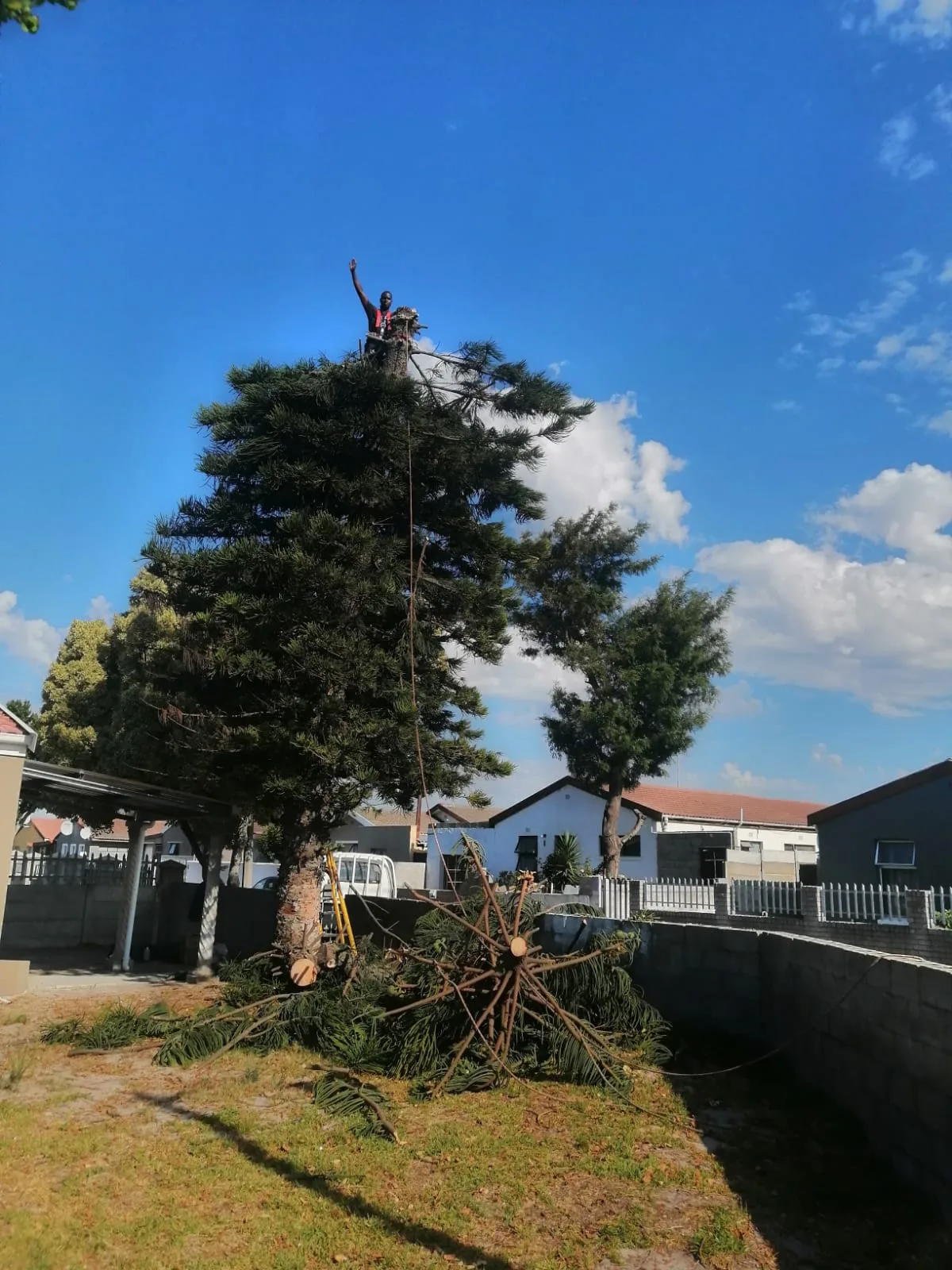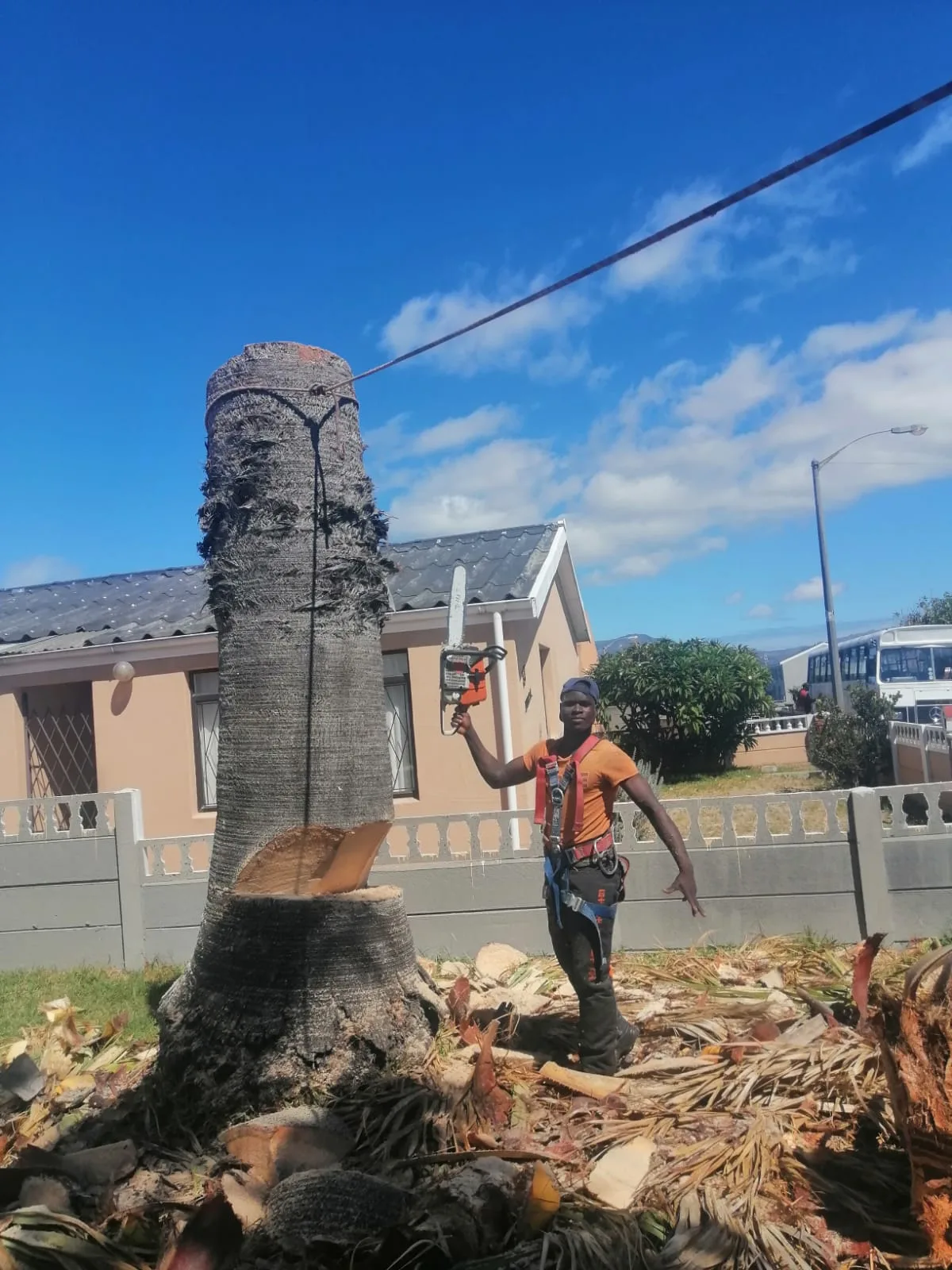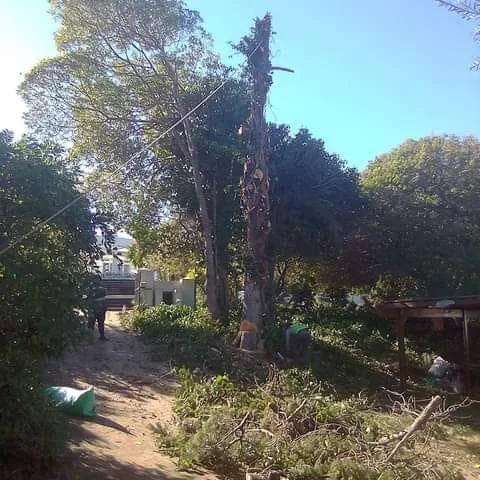
Try to find a tree felling price in Cape Town and you'll come up empty. Almost every company in this city will tell you a tree "depends on too many factors" and ask you to phone. That's true as far as it goes, but it's also unhelpful when all you want to know is whether you're looking at two thousand rand or twelve. So here are the actual numbers. This guide sets out what Cape Town crews charge in 2026, why the ranges are as wide as they are, and how to work out where your tree sits in them before anyone sets foot on your property.
Key takeaways
- A small garden tree runs roughly R1,200–R3,500. A big pine or gum next to a house is R7,000–R15,000. Trees over 20 m can pass R30,000.
- Stump grinding is priced on the stump's diameter, not the tree's height — about R800 for a small one, R3,000–R5,000 for a metre-plus root plate.
- Palms are priced on height, not girth. Under 3 m is around R1,500–R2,500; a 12 m Canary date palm can hit R15,000 once a crane is involved.
- Storm and after-hours work carries a real premium — call-out fees of R450–R650 and labour at 1.5–2× the normal rate are standard across South Africa.
- Access, not saw work, is what pushes a quote to the top of its range. Narrow Atlantic Seaboard streets and long Peninsula travel both cost money.
- Two quotes are only comparable once you know whether each one includes VAT, the stump, and hauling the timber away. Very often one doesn't.
Tree felling prices in Cape Town, 2026
The table below is a planning guide for standard residential work: felling or sectional take-down, cutting up, hauling the material away, and raking the site clean. The bands line up with what South African quote-comparison platforms are recording this year. Procompare puts a tree under 5 m at R1,000–R3,100 and a tree over 10 m at R8,100–R19,000 with an average around R11,000, while ServiceLink SA lists Cape Town slightly above the national average for a medium tree.
| Tree | Typical example | Cape Town range | Time on site |
|---|---|---|---|
| Small — under ~6 m | Garden tree, open drop zone, truck at the gate | R1,200 – R3,500 | Half a morning |
| Medium — 6–12 m | Suburban tree needing a climb, clear space below | R3,000 – R8,000 | Most of a day |
| Large — 12–20 m | Pine or gum lowered in sections beside a roof | R7,000 – R15,000 | A full day or more |
| Very large — 20 m+ | Mature gum over a house, often crane-assisted | R15,000 – R30,000+ | Two days or more |
| Tall palm | Climbed, fronds stripped, trunk sectioned down | R1,500 – R8,000 | Half a day to a day |
| Stump grinding | Add-on once the tree is down | R800 – R4,500 | 20–60 minutes |
Notice how wide each band is. That isn't vagueness for its own sake. The same 10 m cypress can be a R3,000 job in an open Durbanville garden and a R7,500 job in a Fresnaye courtyard, because in the second one every log gets carried by hand up a flight of steps to a truck parked two houses down the road. Everything below is about working out which end of the range your tree lands on.
The five things that actually move the price
Every quote we write comes down to some combination of the same five inputs.
- Size. Height, trunk diameter and canopy spread together decide how much material has to be cut, rigged, carried and disposed of. Volume grows far faster than height does, which is why a 15 m tree costs much more than double a 7 m one rather than exactly double.
- Species. A fast-grown bluegum cuts like butter. A dense old oak blunts chains, and a fibrous palm trunk is heavier per metre than almost anything else in a Cape Town garden. Species also decides how much of the tree can be chipped versus how much has to be loaded whole.
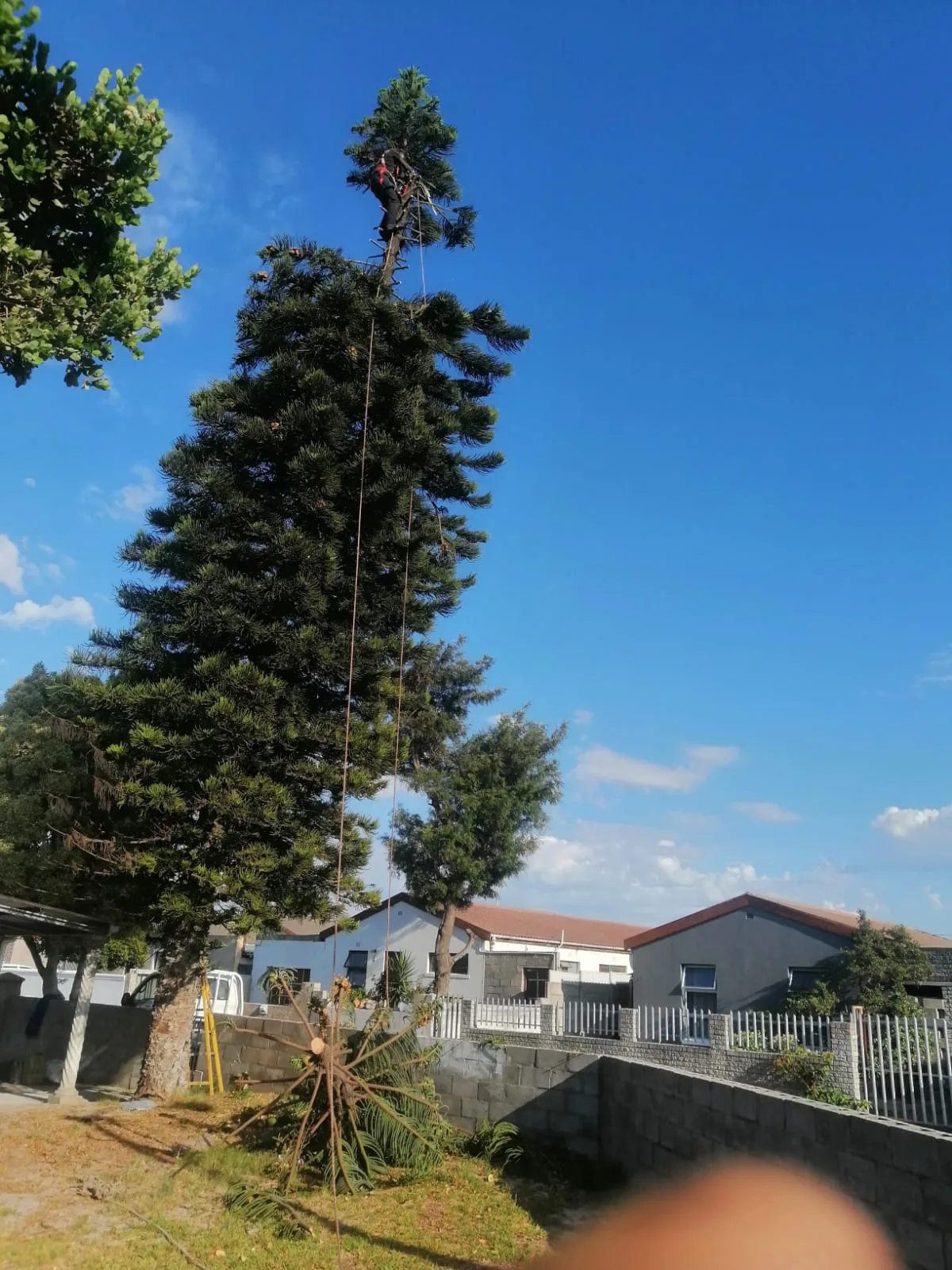
- Proximity to structures. A tree that can be felled in one piece into open ground is the cheapest job there is. Put a roof, a pool, a boundary wall or a neighbour's conservatory under the canopy and the same tree has to be climbed and dismantled piece by piece, with every section roped down under control. That's slower and it needs more skill, so it costs more.
- Access. Can the truck and chipper reach the tree, or does everything travel through a 900 mm side gate by hand? Access is the single most common reason a quote lands at the top of its range instead of the middle.
- Disposal. A felled tree becomes several cubic metres of material that has to go somewhere. Kandua's landscaping cost guide puts green-waste disposal at R200 to R4,500 per load depending on volume. On a big tree that's a meaningful slice of the quote, and it's the line most often quietly left out.
Stump grinding is priced on diameter, not tree height
This catches people out constantly. A stump's price has almost nothing to do with how tall the tree was and everything to do with how wide the cut face is and how far the root plate spreads. A grinder has to chew out a volume of wood, and that volume roughly quadruples every time the diameter doubles. So a 1 m stump isn't twice the price of a 500 mm one, it's closer to three times.
| Stump diameter | Typical price | What it usually is |
|---|---|---|
| Up to ~300 mm | R800 – R1,500 | Ornamental, small fruit tree, young conifer |
| Around 500 mm | R1,100 – R2,000 | The average suburban garden tree |
| Around 1 m | R1,700 – R3,000 | Mature oak, gum, big pine |
| 2 m or a cluster | R3,300 – R5,000+ | Old bluegum, multi-stem, several at once |
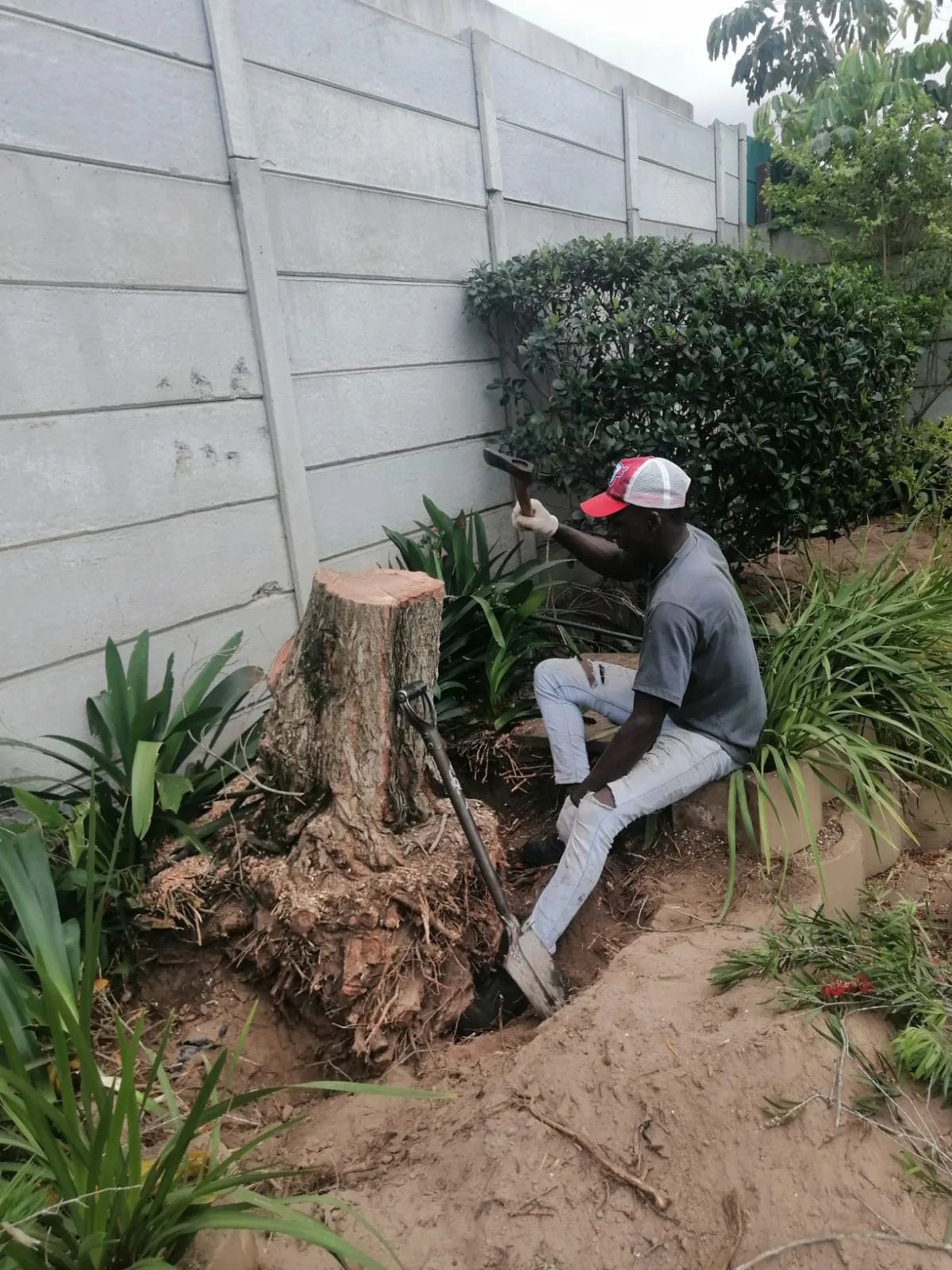
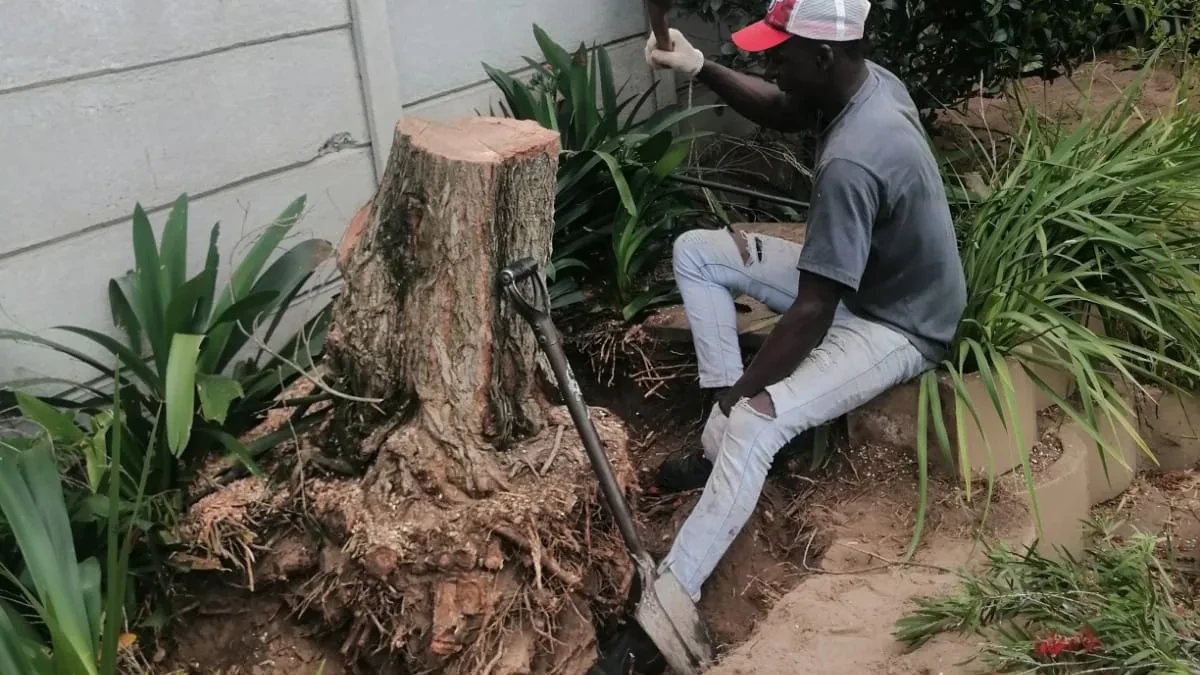
Three things push a stump above those numbers. Buried rubble or old builder's sand blunts grinder teeth fast, so anywhere near a driveway or a demolished wall gets a surcharge. Stumps tight against a boundary wall or paving often can't be reached by the machine at all and have to be dug and levered out by hand. And a grinder that won't fit through your side gate means either a smaller, slower machine or hand work.
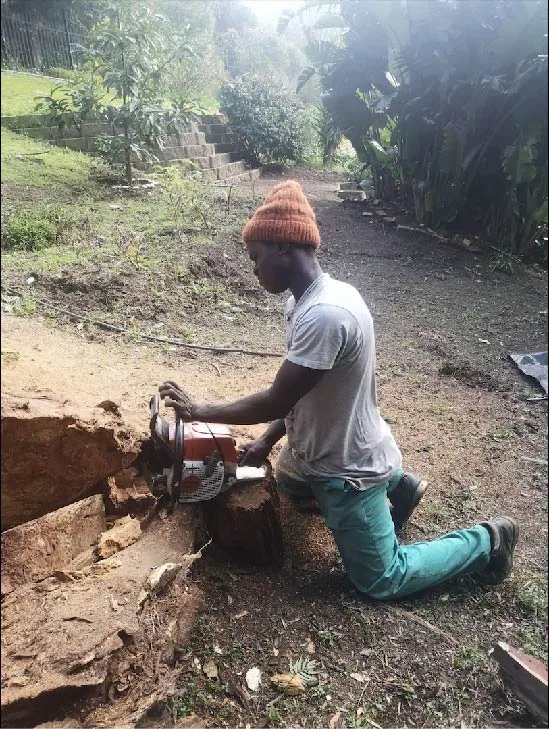
The cheapest stump you'll ever buy is the one done on the same visit as the felling, while the crew and machine are already on site and set up. Booking stump grinding as a separate call-out weeks later means paying twice for the same travel and setup.
Palms are priced by height, not by trunk width
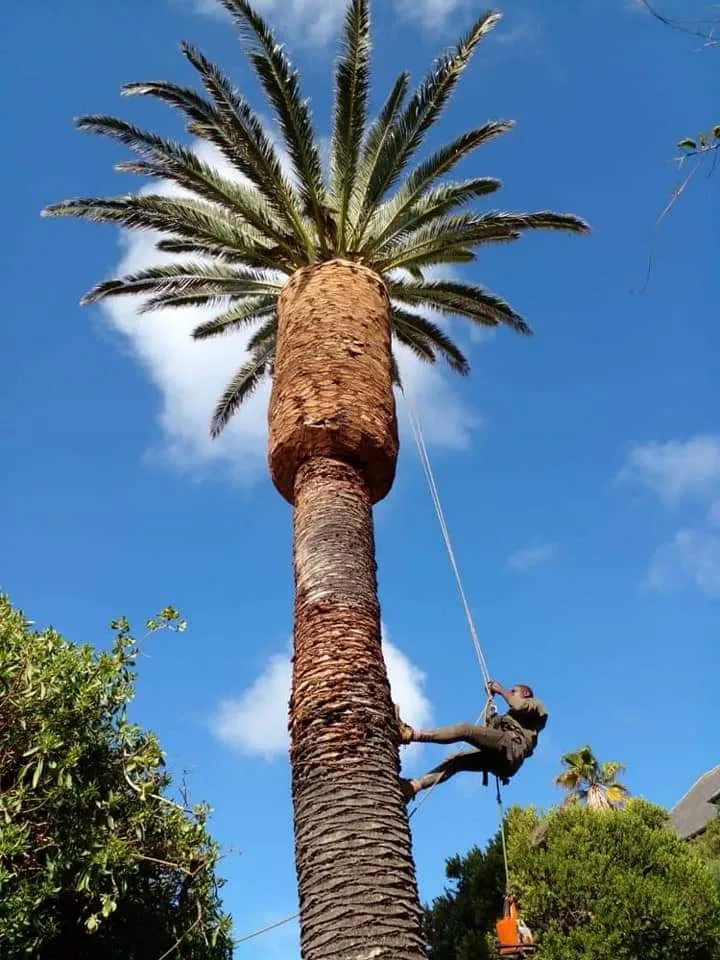
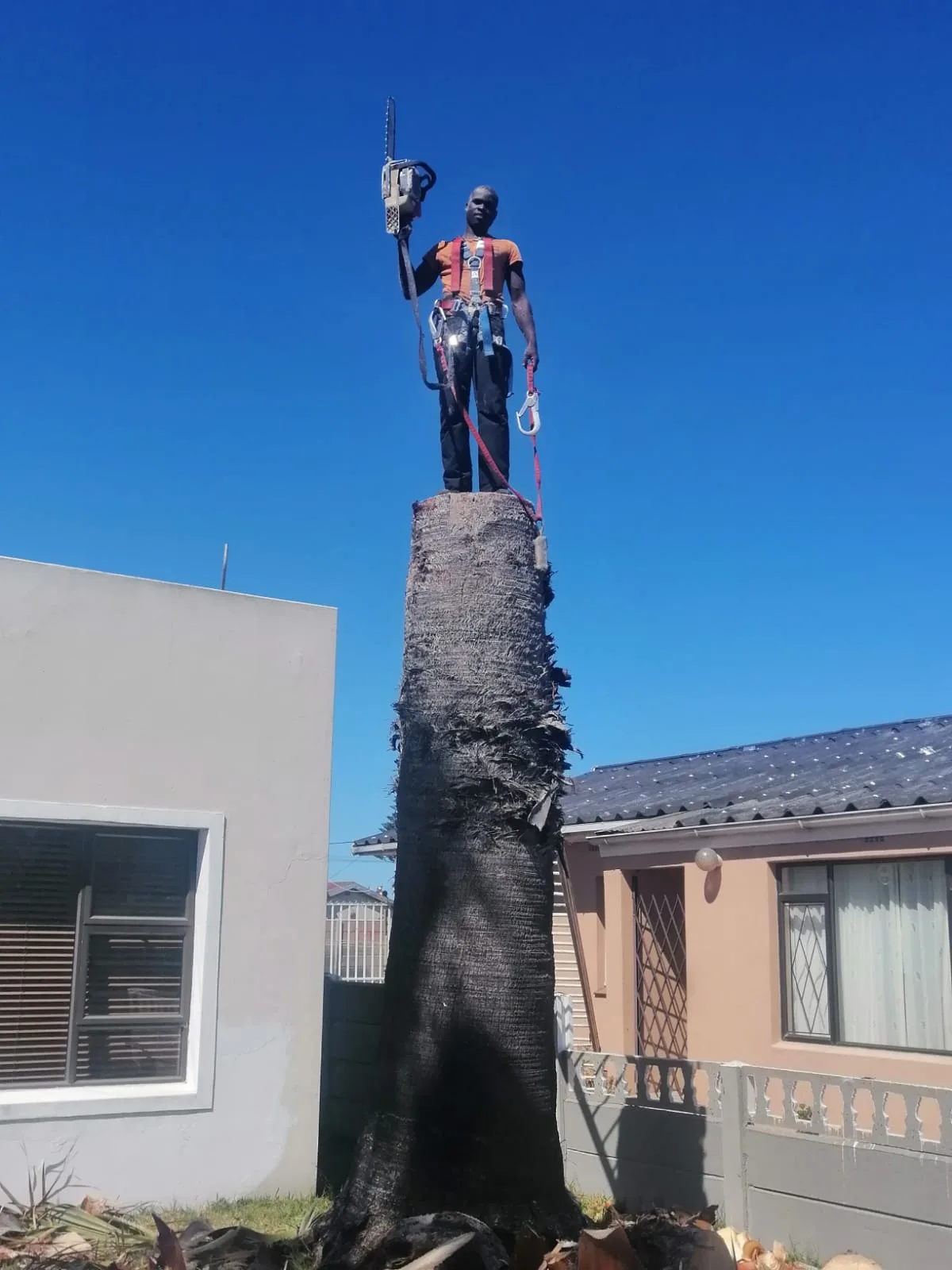
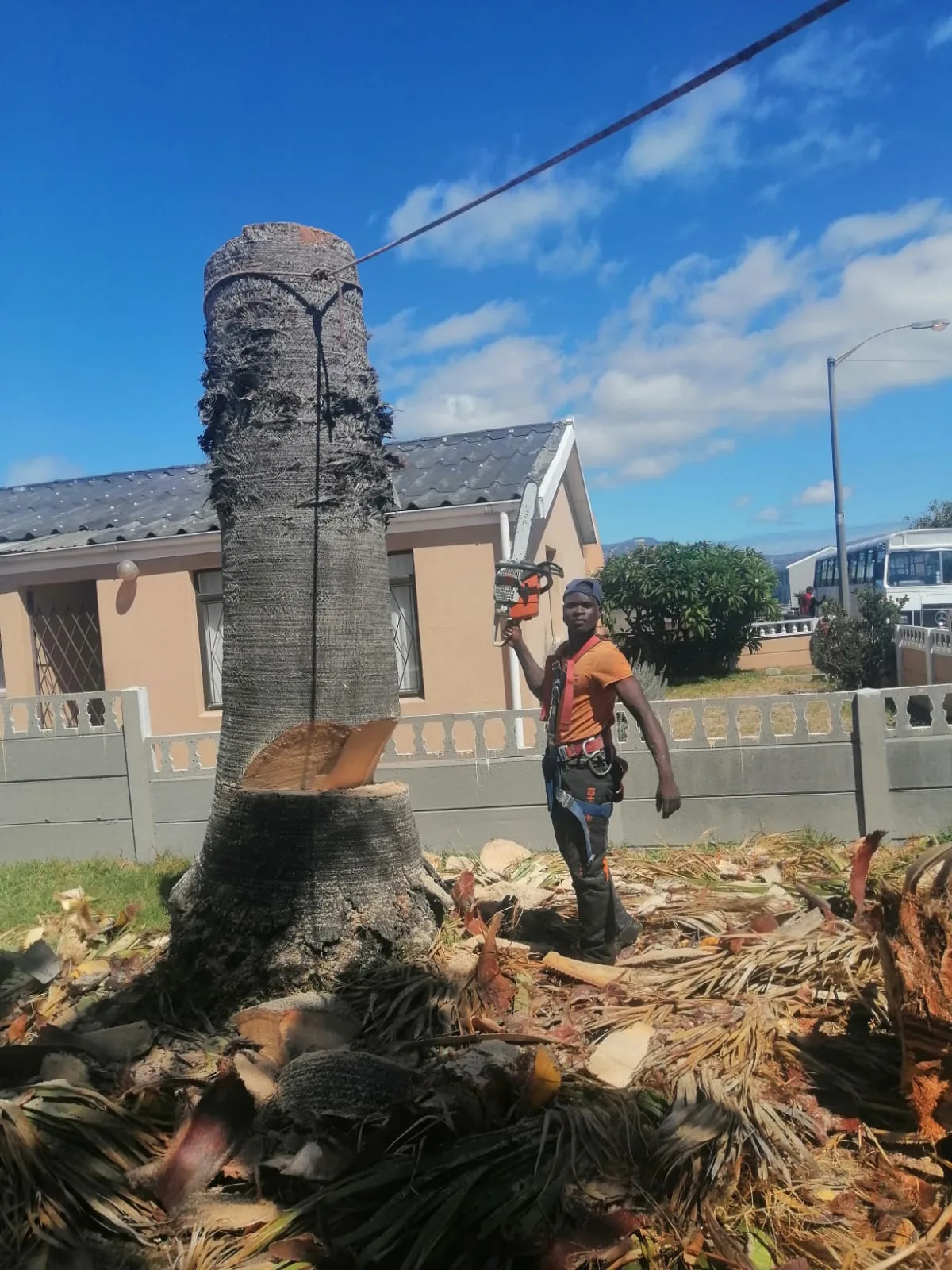
Palms behave differently to every other tree in a quote. The trunk is a uniform column, so there's no canopy to reduce piece by piece. The crew climbs it, strips the fronds, and then takes the trunk down in short sections from the top. The whole cost is driven by how far up someone has to go and how heavy each section is coming down. Palm timber is soaked with water and is far heavier than people expect.
| Palm height | Typical price | How it's done |
|---|---|---|
| Under 3 m | R1,500 – R2,500 | Mostly from the ground |
| 3 – 6 m | R2,500 – R4,500 | Climbed on spikes and harness |
| 6 – 12 m | R4,500 – R8,000 | Climbed, sectioned and lowered on ropes |
| Over 12 m | R8,000 – R15,000+ | May need a crane or cherry picker |
Those bands follow the height-based breakdown published by ServiceLink SA, which also notes crane hire adding R3,000 to R8,000 or more when a palm is too tall or too tight to climb safely. The Canary Island date palms scattered across the Southern Suburbs are the ones that hit the top band. They're enormous, the frond bases are spiked, and the trunk weight per metre is brutal. If yours is over 12 m, expect the quote to reflect that rather than the R2,500 figure someone half-remembers from a neighbour's small fan palm. It's worth reading up on how palm removal differs from ordinary felling before you compare prices.
Storm damage and after-hours call-outs
Cape Town's winter fronts bring down branches and whole trees every year, usually at night and usually across a driveway or a roof. Emergency work is genuinely more expensive, and it's fair that it is. A crew is being pulled off scheduled jobs, working in wind and rain, and cutting timber that's under tension in ways a standing tree never is. Across the South African market, the pattern is consistent:
Call-out fee
Roughly R450–R650 just to get a crew and vehicle to your address outside normal hours. Some firms credit it against the job if you go ahead.
After-hours labour
Typically 1.5–2× the normal hourly rate for evenings, weekends and public holidays.
Same-day premium
Expect 50–100% above the standard price. A job that would be R5,000 on a booked Tuesday can be R7,500–R10,000 as an emergency.
There's a useful distinction worth making at 6am with a tree on your car. Making a site safe and clearing a whole tree are two different jobs at two different prices. Cutting the limb off the driveway so you can get out, then coming back in daylight to do the removal properly, is nearly always cheaper than trying to complete everything in the dark. Ask for it to be split that way. Also photograph the damage before anything is cut, because your insurer will want it and that photo can be worth more than the call-out fee.
Access, not saw work, is usually what separates a fair quote from an expensive one.
The Cape Town access gradient
Cost-to-serve varies genuinely across this city, and any crew telling you otherwise hasn't tried to park a chipper in Clifton. Three broad zones:
Atlantic Seaboard
Camps Bay, Clifton, Bantry Bay, Fresnaye. Steep, narrow, one-way streets with almost no parking. Timber often gets carried up or down steps to reach the truck. Expect the upper half of every range.
Deep Peninsula & Helderberg
Noordhoek, Kommetjie, Simon's Town, Gordon's Bay. Access on site is usually fine. What you're paying for is travel time and a return trip to the dump site.
Southern & Northern Suburbs
Claremont through to Durbanville and Brackenfell. Wider streets, driveways a truck can reverse into, straightforward routes to a dump site. This is baseline pricing.
One suburb-specific thing to check before you budget anything: the tree between the pavement and the road usually isn't yours. Verge and street trees are Council assets under the City of Cape Town's Urban Forest Policy, so a verge tree is a call to the City rather than to a private crew. No quote applies.
What a fair quote includes, and what it usually doesn't
This is where two numbers that look R2,000 apart turn out to be identical, or where the cheaper one turns out to be R4,000 more. Before comparing anything, get both quotes onto the same basis.
Should be in the number
- Labour for the whole crew, not just the climber
- Ropes, rigging and the sectional take-down itself
- Cutting the tree down to manageable lengths
- Chipping the brush and raking the site
- Loading and hauling the material off your property
- Dump-site fees for the load
Commonly excluded — ask
- VAT, if the quote says "excl." in small print
- The stump, which is nearly always a separate line
- Hauling the trunk if it's been left as firewood
- Crane or cherry-picker hire on very large trees
- Permit applications for a protected tree
- Topsoil and levelling where the stump was
Why one quote has VAT on it and the next one doesn't
South African VAT sits at 15%, and on a R10,000 job that's R1,500 of difference between two otherwise identical prices. The reason one crew charges it and another doesn't is turnover. Registration only becomes compulsory once a business passes a set annual figure, and that figure moved sharply this year: SARS raised the compulsory VAT registration threshold from R1 million to R2.3 million from 1 April 2026. Plenty of legitimate small tree crews now sit under it and simply don't charge VAT.
That is not a red flag on its own. What matters is that you know which basis each quote is on before you compare them, and that the number you're shown is the number you'll be invoiced. If you're claiming the cost through a business or a body corporate, you'll want a VAT invoice, so ask up front. All our prices are quoted as the final figure you pay.
Why photo-only quotes come in wrong
A photo of a tree tells you roughly how big it is. It doesn't tell you any of the things that decide the price. It won't show the width of your side gate, the slope of the garden, the pool cover under the canopy, the Telkom line running through the branches, the neighbour's glass roof on the other side of the wall, or whether the truck can turn around in your road. It flattens depth, so a tree standing three metres from a wall looks identical to one growing against it.
This is why the "quick WhatsApp price" so often becomes an awkward conversation on the day. A crew that quoted from a photo arrives, finds a problem the photo hid, and either asks for more money with your tree half-cut, or rushes the job to stay within a number that never fitted. Neither is what you wanted. A ten-minute site visit costs nothing and removes the entire problem, which is why we'd rather come and look than guess. You can book a free on-site quote and get a fixed written figure with no obligation.
How to compare two quotes fairly
Once you've got two or three numbers in front of you, put them side by side on these six points. If both quotes answer all six the same way, then and only then is the cheaper one actually cheaper.
- Same scope? One tree or three. Full removal or a heavy reduction. Write down exactly what each price covers before you look at the rands.
- VAT in or out? A 15% gap explains most "unbeatable" quotes.
- Is the timber leaving? "We'll cut it up for you" and "we'll take it away" are separated by a full truck load and a dump fee.
- Stump included or extra? Get it priced now even if you decide against it, so you're not surprised later.
- Is it a fixed price or an estimate? An hourly estimate with no ceiling isn't a quote. Ask for a written number that won't move.
- Proof of cover. Ask any contractor you're considering for proof of public liability cover and what happens if something is damaged. Get the answer in writing before work starts, not after.
Underquote warning signs
- A price given over the phone in under a minute, sight unseen
- Far below every other quote with no explanation of why
- Nothing in writing, only a number in a WhatsApp message
- A large deposit demanded before anything is booked
- Vague on who removes the timber and where it goes
- No answer when you ask about cover for damage
Ways to bring the price down honestly
- Keep the logs. Ask for firewood lengths stacked instead of hauled, unless the tree has shot hole borer: that wood must be chipped on site
- Do several trees in one visit rather than one at a time
- Add the stump to the same booking, not a later call-out
- Clear cars, pot plants and furniture from the work area yourself
- Book off-peak. Winter storm season is the busiest and priciest
- Split with a neighbour if you both have work to do
Do permits add cost or delay?
For most Cape Town garden trees, no. An ordinary pine, cypress, gum or fruit tree on your own property needs no paperwork, and the felling can be booked as soon as you're happy with the price. Two situations change that.
The first is a protected indigenous species. Trees on the National Forests Act protected list can't be cut, damaged or removed without a licence from the national department, and cutting one without approval is an offence carrying serious penalties. The second is a heritage tree, or any tree on Council land including the verge, where the City has to approve removal. In both cases the licence itself is the delay rather than a big cost line, and it's measured in weeks rather than days. We can't put a firm turnaround on government processing, so the sensible order is to sort the permit first and book the crew once it's granted.
Invasive aliens go the other way. Rooikrans, Port Jackson, black wattle and bluegum are listed invaders that landowners are generally expected to remove, so there's no permit to wait for. What does affect the price is that they coppice hard from a cut stump. Fell one and walk away and you'll have a thicket by next summer, which is why the stump treatment or grinding really does belong in the same quote.
Frequently asked questions
How much does it cost to cut down a tree in Cape Town?
Most residential jobs fall between R1,200 and R15,000. A small garden tree with easy access sits near the bottom, a 15 m pine beside a house near the top. Trees over 20 m or needing a crane go higher again.
Why did I get quotes R6,000 apart for the same tree?
Usually scope, not greed. Check whether both include VAT, hauling the timber away and the stump. One crew may also be pricing a full sectional take-down where the other is assuming they can drop it whole.
Is it cheaper to fell a tree in winter?
Generally the opposite in Cape Town. Winter is storm season, crews are busiest, and emergency work crowds the diary. A booked job in late summer or autumn usually gets you a calmer schedule and a keener price.
Can I keep the wood to lower the price?
Yes, and it's one of the few reliable ways to trim a quote. Ask for the trunk cut to firewood lengths and stacked. You save the loading and the dump fee, though the brush still needs to go. The exception is a tree infested with shot hole borer: the City of Cape Town requires infested trees to be chipped on site, so that wood can't be kept as logs.
How much extra is stump grinding?
Around R800 for a small stump up to roughly R4,500 for a metre-plus one or a cluster. It's priced on the stump's diameter, and it's cheapest when done on the same visit as the felling.
Will my insurance cover a fallen tree?
Often for the damage the tree caused, less often for removing the tree itself. Policies differ. Photograph everything before anything is cut and phone your insurer before you authorise the work.
The short version
Budget R1,200 to R3,500 for a small tree, R3,000 to R8,000 for a mid-sized one, and R7,000 to R15,000 once you're dealing with something tall and close to a building. Add R800 to R4,500 for the stump depending on its width. Expect the top of each range on the Atlantic Seaboard and a premium again if it's an after-hours emergency. Then make sure every quote you're comparing includes VAT, the haulage and the stump on the same terms.
We're based in Muizenberg and quote across Cape Town. Tell us your suburb, send a photo or two so we know what we're coming to look at, and we'll come out, walk the site and give you one fixed written price. If it's more than you expected, we'll tell you exactly which part of the job is driving it.
Keep reading
Tree Roots Damaging Your House, Paving or Drains? What to Do
Lifted paving, a blocked drain or a crack in the boundary wall, and a big tree nearby. Here is what tree roots actually do to a property, what they almost never do, what the law says when the tree is your neighbour's or the City's, and how to decide between cutting a root, fixing a pipe and taking the tree out.
How to Cut Down a Tree Safely (And When to Stop)
Most people searching for how to cut down a tree are really asking a different question: can I do this one myself? Here is the sequence a trained feller works through, what the hinge actually does, and the situations where the honest answer is to put the saw down and phone someone.
Blue Gum Tree Removal in Cape Town
A mature blue gum in a Cape Town garden sits in an odd legal spot: the species is listed as an invasive, but a big urban trunk is often specifically exempt from the duty to remove it. Here is which gums are actually listed, the tape-measure test that decides it, why cutting one down never finishes the job, and what a safe take-down in a suburb actually involves.