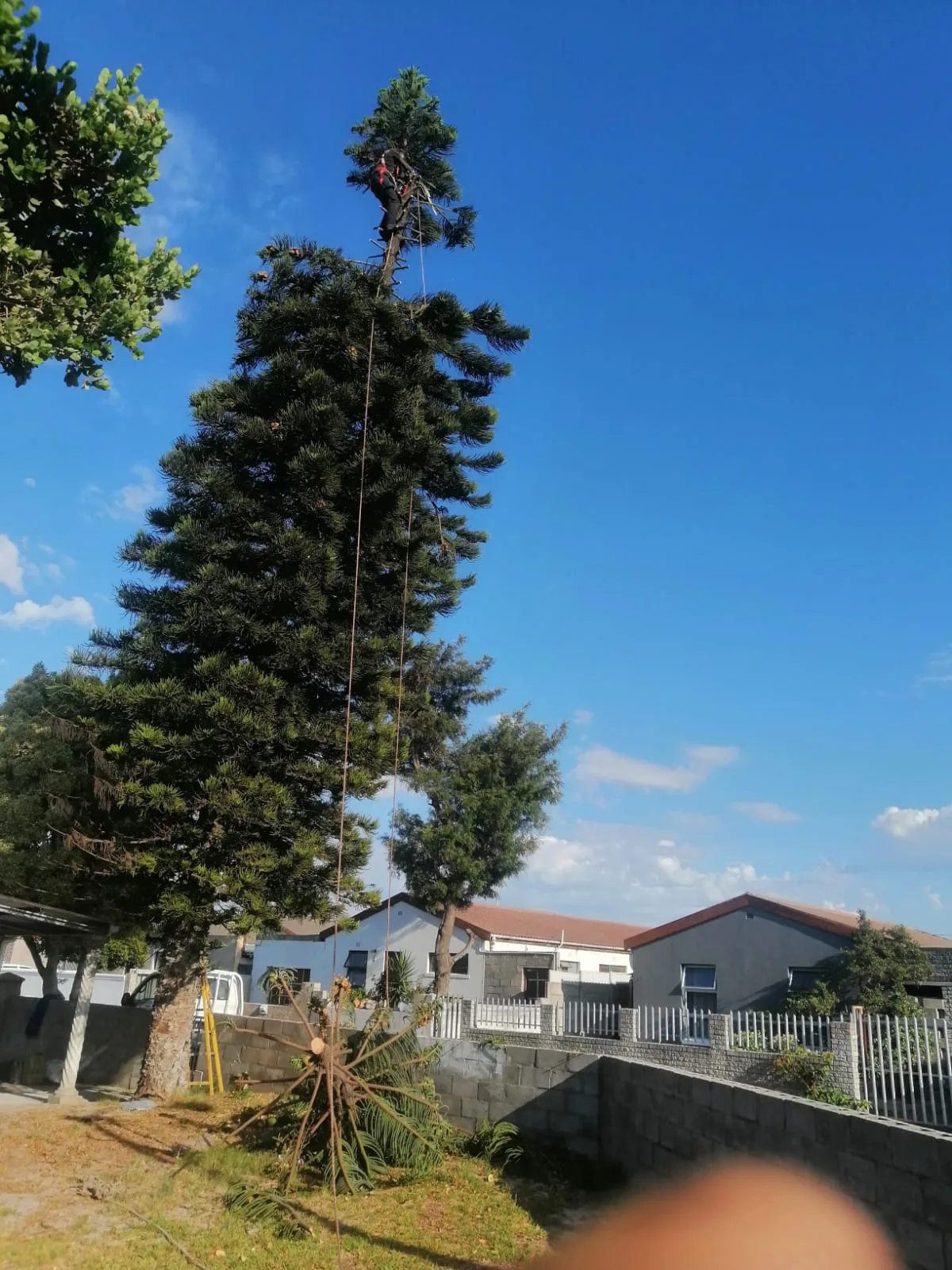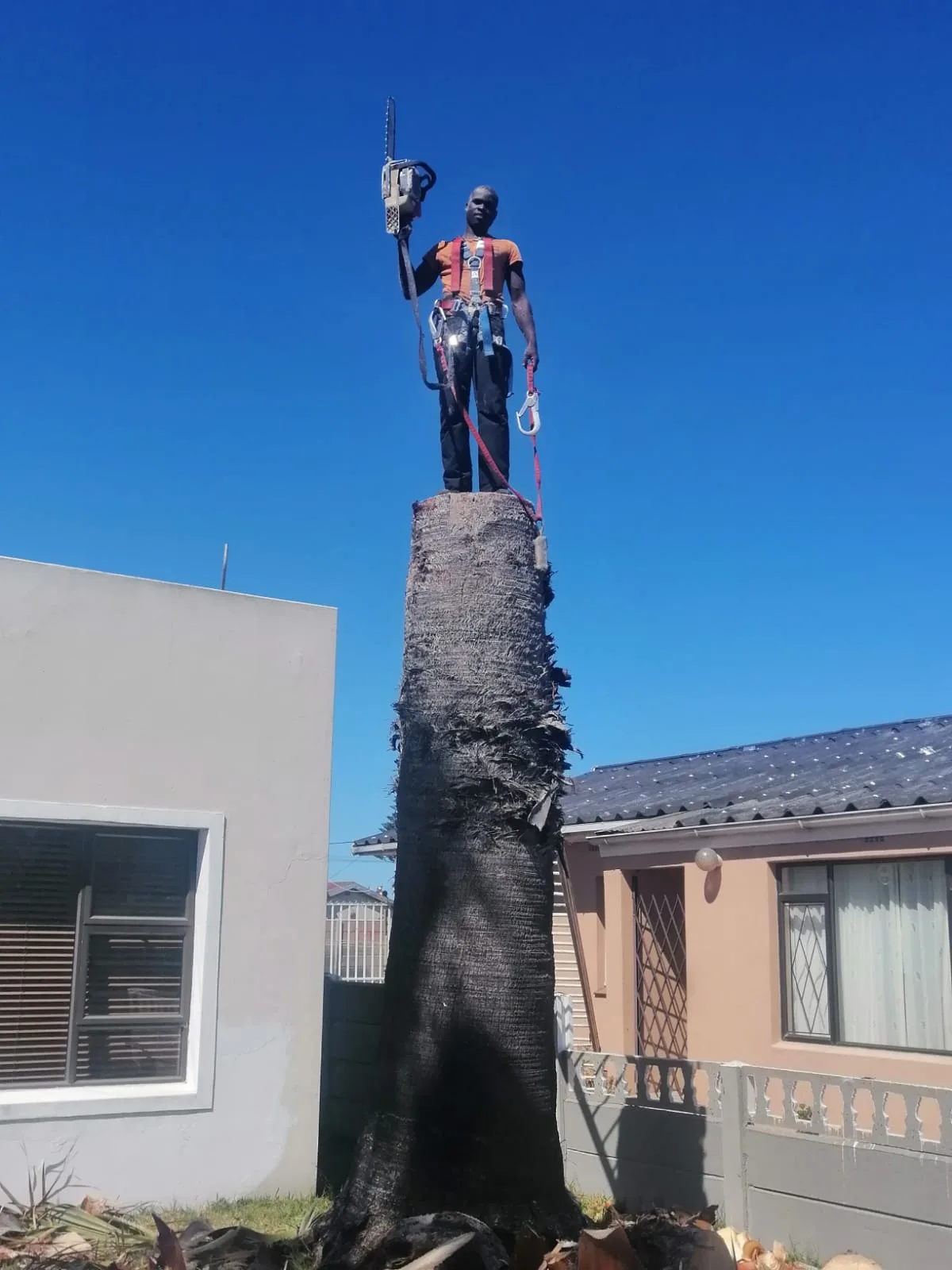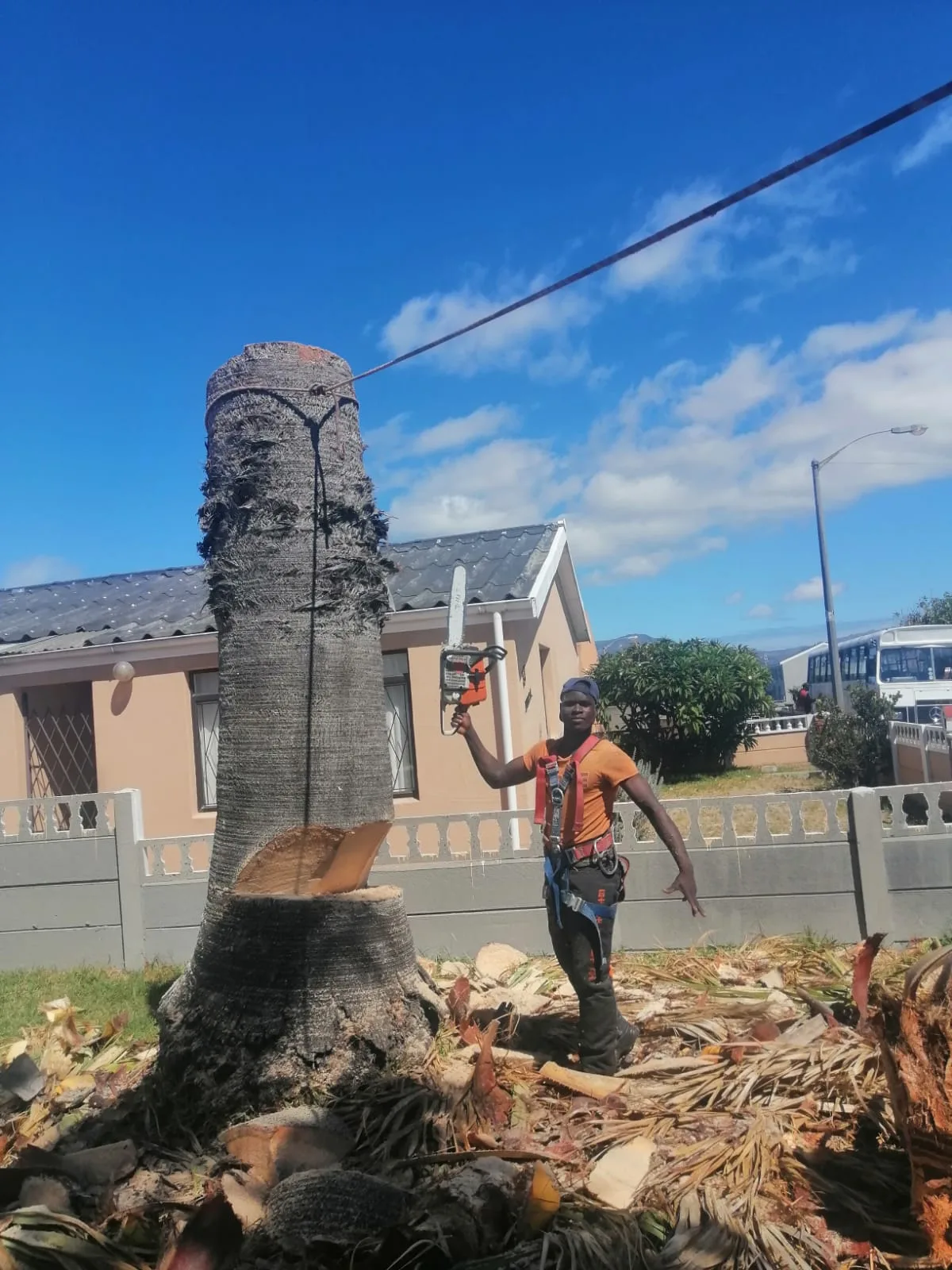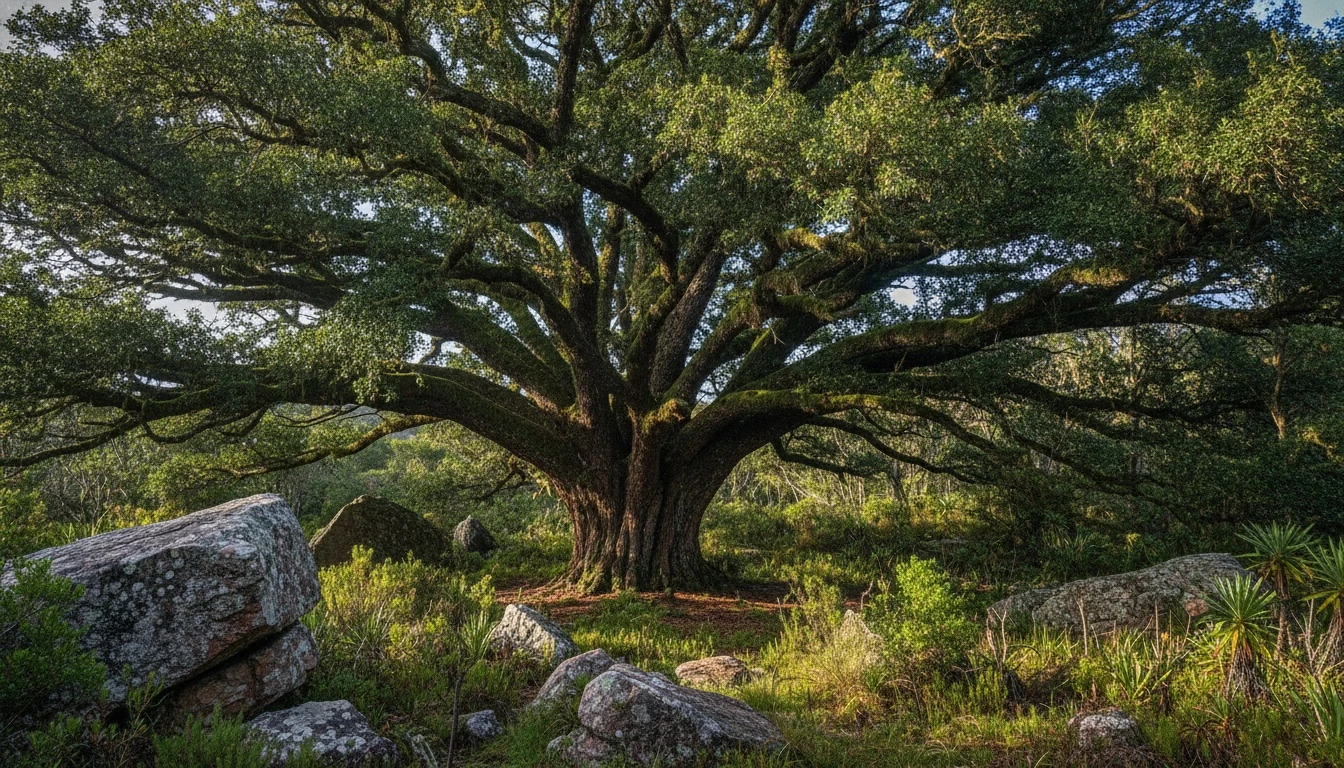
If you're looking for the list of protected trees in South Africa, here it is in full: all 51 species the government has declared protected under the National Forests Act, searchable below. But the list on its own only answers half the question. What most Cape Town homeowners really want to know is simpler: can I legally cut down the tree in my garden, or am I about to break the law? This guide gives you the full list, explains what "protected" actually means, sets out the real penalty for getting it wrong, and walks you through how to apply for a licence if your tree is on it.
Key takeaways
- 51 tree species are protected nationally under Section 12 of the National Forests Act, 1998, and the list is republished every year by the Minister.
- You may not cut, damage or even remove wood from a protected tree without a licence, on private property too, not just public land.
- Cutting one down without a licence is a first-category offence: a fine and/or up to three years' imprisonment. The "R5 million fine" you'll see online is not from this law.
- Several are Cape Town locals: the silver tree, real and Breede River yellowwoods, white milkwood, stinkwood and Clanwilliam cedar.
- Protected is the opposite of invasive: Port Jackson, rooikrans, pine and bluegum are aliens you're legally obliged to remove, not protect.
What "protected" actually means
A protected tree isn't just a tree someone thinks is special. It's a species the Minister of Forestry, Fisheries and the Environment has formally declared protected under Section 12 of the National Forests Act, 1998 (Act No. 84 of 1998). The list is published in the Government Gazette every year. The current version is Government Notice 4496 of 13 March 2024, and it's unchanged in substance from the year before.
Once a species is on that list, the protection follows the tree wherever it grows: your garden, a building site, a farm or a road reserve. The Act spells out exactly what you may not do:
National Forests Act, Section 15(1) — the prohibition
No person may, except under a licence granted by the Minister:
- cut, disturb, damage or destroy any protected tree; or
- possess, collect, remove, transport, export, purchase, sell, donate or in any other way acquire or dispose of any protected tree — or any product made from one.
Source: Department of Forestry, Fisheries & the Environment, GG 50291 (2024).
Good to know: the list is reissued every year. The current version is Government Notice 4496 (Gazette 50291), published on 13 March 2024 — the species rarely change, but it's always worth checking you're looking at the latest.
Read that second point again, because it catches people out. Even taking firewood from a protected tree that's already fallen, or selling a slab of its timber, needs a licence. The only way to legally fell or work on a protected tree is to apply to the Department of Forestry, Fisheries and the Environment (DFFE) first.
What happens if you cut one down without a licence
Let's clear up the biggest myth first. Search around and you'll find claims that felling a protected tree carries a "R5 million fine" or "three times the commercial value of the tree." Those figures are real in South African environmental law, but they come from other statutes (the biodiversity and environmental-management laws), not from the National Forests Act that governs protected trees. Repeating them just scares people with the wrong number.
Here's what the law that actually applies says. Cutting, damaging or removing a protected tree without a licence breaches Section 15(1), which is a first-category offence under the Act. On conviction, that carries a fine, or imprisonment for up to three years, or both.
The myth
"You'll be fined R5 million or three times the tree's value." Widely repeated online, usually with no source — those penalties belong to different environmental laws, not the protected-tree provisions.
The reality
Under the National Forests Act it's a first-category offence: a fine, or up to three years' imprisonment, or both, plus the practical headache of a stop order and a refused licence on a tree you've already damaged.
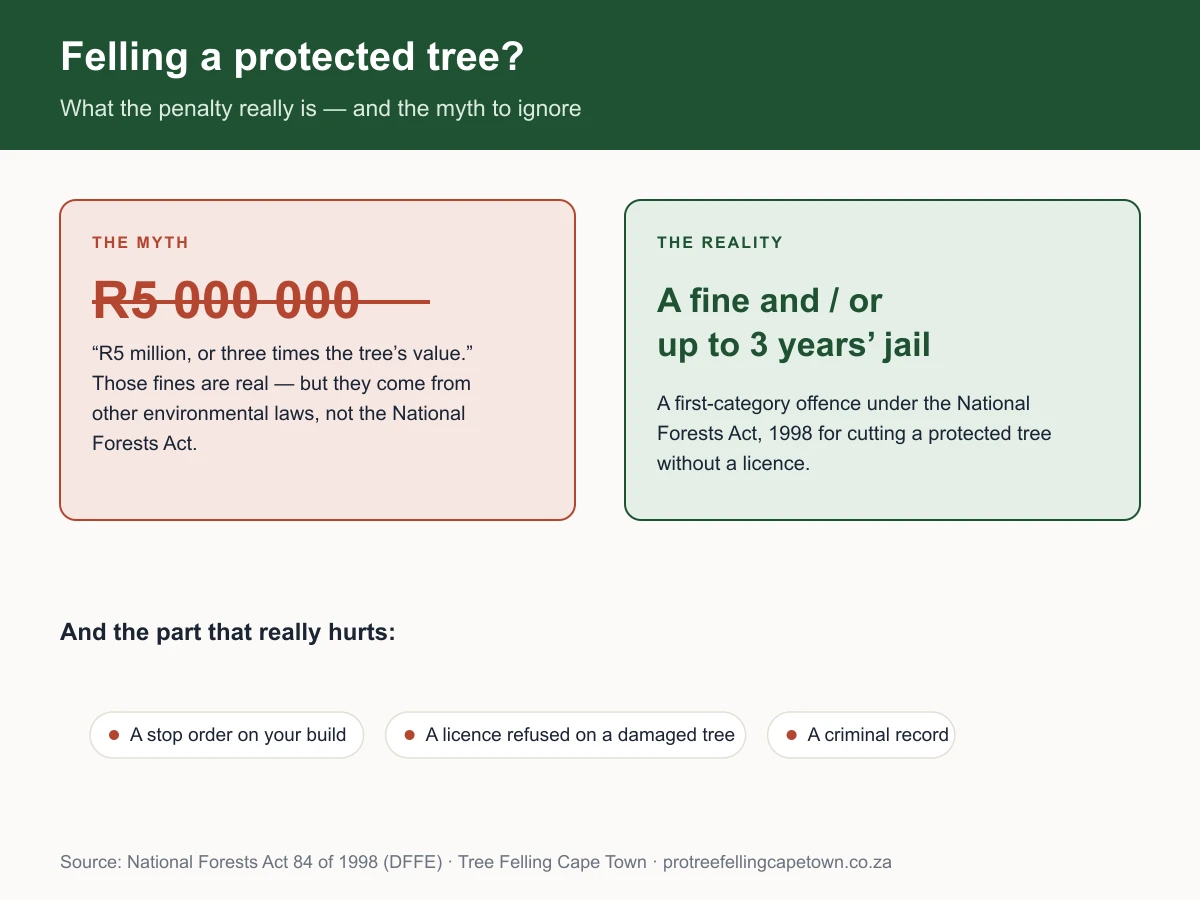
The honest takeaway: the fine alone may be less frightening than the internet suggests, but a criminal record, a halted building project and an unsellable property dispute are all very real. It's never worth the risk when a licence is straightforward to apply for.
The full list of protected trees in South Africa
Below is the complete, current list of all 51 nationally protected tree species. Search by name (botanical, English, or Afrikaans and other official-language names all work), or filter to the Cape Town species or just the threatened ones. Each entry shows a photo, where it grows, its conservation status, what it's used for, and the official national tree number.
Showing 51 of 51 protected species.
Baobab
Adansonia digitata
Kremetart (A), Seboi (P), Mowana (T), Ximuwu (XT)
Pod mahogany
Afzelia quanzensis
Peulmahonie (A), Mutokota (V), Inkehli (Z)
Torchwood
Balanites maughamii
Groendoring (A), Ugobandlovu (Z)
Powder-puff tree
Barringtonia racemosa
Poeierkwasboom (A), Iboqo (Z)
Red ivory / Pink ivory
Berchemia zeyheri
Rooi-ivoor / Rooihout (A), umNeyi, umNini (Z, X), Munia-niane (V)
Shepherd's tree
Boscia albitrunca
Witgat (A), Mohlôpi (NS), Motlhôpi (T), Muvhombwe (V), Umgqomogqomo (X), Umvithi (Z)
Msasa
Brachystegia spiciformis
Msasa (A)
Matumi
Breonadia salicina
Mingerhout (A), Mohlomê (NS), Mutu-lume (V), Umfomfo (Z)
Black mangrove
Bruguiera gymnorrhiza
Swartwortelboom (A), isiKhangati (X), IsiHlobane (Z)
Swazi onionwood
Cassipourea swaziensis
Swazi-uiehout (A)
Bushman's tea
Catha edulis
Boesmanstee (A), Igqwaka (X), Umhlwazi (Z)
Indian mangrove
Ceriops tagal
Indiese wortelboom (A), isinkaha (Z)
False tamboti
Cleistanthus schlechteri
Bastertambotie (A), Umzithi (Z)
Pondo weeping thorn
Colubrina nicholsonii
Pondo-treurdoring (A)
Leadwood
Combretum imberbe
Hardekool (A), Mohwelere-tšhipi (NS), Motswiri (T), Impondondlovu (Z)
Assegai
Curtisia dentata
Assegaai (A), Umgxina (X), Umagunda (Z)
Jackal-berry
Diospyros mespiliformis
Jakkalsbessie (A), Musuma (V), Muntoma, Mgula (TS)
Bushveld saffron
Elaeodendron transvaalensis
Bosveld-saffraan (A), Monomane (T), Ingwavuma (Z)
Bushveld red balloon
Erythrophysa transvaalensis
Bosveld-rooiklapperbos (A), Mofalatsane (T)
Ebony guarri
Euclea pseudebenus
Ebbeboom-ghwarrie (A)
Swamp fig
Ficus trichopoda
Moerasvy (A), Umvubu (Z)
Silver tree
Leucadendron argenteum
Silwerboom (A)
Tonga mangrove
Lumnitzera racemosa
Tonga-wortelboom (A), isiKhaha-esibomvu (Z)
Pondo bushman's tea
Lydenburgia abbottii
Pondo-boesmanstee (A)
Sekhukhuni bushman's tea
Lydenburgia cassinoides
Sekhukhuni-boesmanstee (A)
Coastal red milkwood
Mimusops caffra
Kusrooimelkhout (A), Umthunzi (X), Umkhakhayi (Z)
Lebombo wattle
Newtonia hildebrandtii
Lebombo-wattel (A), Umfomothi (Z)
Stinkwood
Ocotea bullata
Stinkhout (A), Umhlungulu (X), Umnukane (Z)
Gariep resin tree
Ozoroa namaquensis
Gariep-harpuisboom (A)
Apple-leaf
Philenoptera violacea
Appelblaar (A), Mphata (NS), Mohata (T), isiHomohomo (Z)
Cheesewood
Pittosporum viridiflorum
Kasuur (A), Kgalagangwe (NS), Umkhwenkwe (X), Umfusamvu (Z)
Breede River yellowwood
Podocarpus elongatus
Breëriviergeelhout (A)
Outeniqua yellowwood
Podocarpus falcatus (Afrocarpus falcatus)
Outeniekwageelhout (A), Mogôbagôba (NS), Umkhoba (X), Umsonti (Z)
Henkel's yellowwood
Podocarpus henkelii
Henkel se geelhout (A), Umsonti (X, Z)
Real yellowwood
Podocarpus latifolius
Regte-geelhout (A), Mogôbagôba (NS), Umcheya (X), Umkhoba (Z)
Saddleback sugarbush
Protea comptonii
Barberton-suikerbos (A)
Serpentine sugarbush
Protea curvata
Serpentynsuikerbos (A)
Red stinkwood
Prunus africana
Rooistinkhout (A), Umkhakhase (X), Umdumezulu (Z)
Wild teak (Kiaat)
Pterocarpus angolensis
Kiaat (A), Morôtô (NS), Mokwa (T), Mutondo (V), Umvangazi (Z)
Red mangrove
Rhizophora mucronata
Rooiwortelboom (A), isiKhangathi (X), Umhlume (Z)
Manketti
Schinziophyton rautanenii
Mankettiboom (A), Monghônghô (T), Mokongwa (T), Mongongo (E)
Marula
Sclerocarya birrea (subsp. caffra)
Maroela (A), Morula (NS), Umganu (Z), Nkanyi (XT)
Violet tree
Securidaca longepedunculata
Krinkhout (A), Mmaba (T)
White milkwood
Sideroxylon inerme
Witmelkhout (A), Ximafana (X), Umakhwelafingqane (Z)
Pondo poison pea
Tephrosia pondoensis
Pondo-gifertjie (A)
Umtiza
Umtiza listeriana
Umtiza (X), Omtisa (A)
Camel thorn
Vachellia erioloba
Kameeldoring (A), Mogohlo (NS), Mogôtlhô (T)
Grey camel thorn
Vachellia haematoxylon
Vaalkameeldoring (A), Mokholo (T)
Pepper-bark tree
Warburgia salutaris
Peperbasboom (A), Molaka (NS), Mulanga (V), isiBaha (Z)
Clanwilliam cedar
Widdringtonia cedarbergensis
Clanwilliamseder (A)
Willowmore cedar
Widdringtonia schwarzii
Baviaanskloofseder (A)
A = Afrikaans · E = English · NS = Sepedi · S = Sesotho · SW = siSwati · T = Setswana · TS = Xitsonga · V = Tshivenda · X = isiXhosa · Z = isiZulu
Photo credits & data sources
Species photos via Wikimedia Commons & iNaturalist, used under their stated licences. Conservation status from the SANBI Red List of South African Plants; the species list from the National Forests Act annual list (DFFE).
- Adansonia digitata — Ferdinand Reus from Arnhem, Holland (CC BY-SA 2.0)
- Afzelia quanzensis — SAplants (CC BY-SA 4.0)
- Balanites maughamii — Bev Oscroft (CC BY-SA 3.0)
- Barringtonia racemosa — Tom Hulse (CC BY 3.0)
- Berchemia zeyheri — JMK (CC BY-SA 3.0)
- Boscia albitrunca — JMK (CC BY-SA 3.0)
- Brachystegia spiciformis — A. Engler (Public domain)
- Breonadia salicina — Bernard DUPONT from FRANCE (CC BY-SA 2.0)
- Bruguiera gymnorrhiza — Ulf Mehlig (CC BY-SA 2.5)
- Cassipourea swaziensis — Smithsonian Institution, National Museum of Natural History (CC0)
- Catha edulis — User:Katpatuka (Public domain)
- Ceriops tagal — Ton Rulkens from Mozambique (CC BY-SA 2.0)
- Cleistanthus schlechteri — SAplants (CC BY-SA 4.0)
- Colubrina nicholsonii — Royal Botanic Gardens, Kew (CC BY 4.0)
- Combretum imberbe — JMK (CC BY-SA 3.0)
- Curtisia dentata — Abu Shawka (Public domain)
- Diospyros mespiliformis — LBM1948 (CC BY-SA 4.0)
- Elaeodendron transvaalensis — Robert Taylor (CC BY 4.0)
- Erythrophysa transvaalensis — JMK (CC BY-SA 3.0)
- Euclea pseudebenus — JonRichfield (CC BY-SA 3.0)
- Ficus trichopoda — Michael A. Alcorn (CC BY 4.0)
- Leucadendron argenteum — Abu Shawka (CC0)
- Lumnitzera racemosa — Sean.hoyland (Public domain)
- Lydenburgia abbottii — Graham Grieve (SANBI PlantZAfrica)
- Lydenburgia cassinoides — Mahomed Desai (CC BY 4.0)
- Mimusops caffra — Purves, M. (CC BY-SA 3.0)
- Newtonia hildebrandtii — Purves, M. (CC BY-SA 3.0)
- Ocotea bullata — Abu Shawka (Public domain)
- Ozoroa namaquensis — SAplants (CC BY-SA 4.0)
- Philenoptera violacea — Bernard DUPONT from FRANCE (CC BY-SA 2.0)
- Pittosporum viridiflorum — Forest & Kim Starr (CC BY 3.0)
- Podocarpus elongatus — JMK (CC BY-SA 4.0)
- Podocarpus falcatus (Afrocarpus falcatus) — Jimfbleak at English Wikipedia (CC BY-SA 3.0)
- Podocarpus henkelii — Stan Shebs (CC BY-SA 3.0)
- Podocarpus latifolius — Abu Shawka (Public domain)
- Protea comptonii — billandkent from Coventry, Connecticut, United States (CC BY 2.0)
- Protea curvata — billandkent from Coventry, Connecticut, United States (CC BY 2.0)
- Prunus africana — Marco Schmidt [1] (CC BY-SA 2.5)
- Pterocarpus angolensis — Susan Adams (CC BY-SA 2.0)
- Rhizophora mucronata — self (CC BY-SA 3.0)
- Schinziophyton rautanenii — NoodleToo (Public domain)
- Sclerocarya birrea (subsp. caffra) — Rotational (Public domain)
- Securidaca longepedunculata — Pieter Blignaut (CC BY-SA 4.0)
- Sideroxylon inerme — Abu Shawka (Public domain)
- Tephrosia pondoensis — SAplants (CC BY-SA 4.0)
- Umtiza listeriana — SAplants (CC BY-SA 4.0)
- Vachellia erioloba — I (user Neelix) am the originator of this photo, and hold the copyright. I release it to the public domain (Public domain)
- Vachellia haematoxylon — Manie Maree (CC BY-SA 4.0)
- Warburgia salutaris — JMK (CC BY-SA 3.0)
- Widdringtonia cedarbergensis — Linda Marie Botes (CC BY-SA 4.0)
- Widdringtonia schwarzii — Krzysztof Ziarnek, Kenraiz (CC BY-SA 4.0)
Want it to keep?
Download the full list as a one-page quick-reference PDF — handy to check before you book any tree work.
Protected trees you'll actually find around Cape Town
Most of the list is bushveld, mangrove and subtropical species you'll never see in a Cape garden. But a handful are very much locals — and they're the ones most likely to land a Cape Town homeowner in trouble, because they look like "just a tree" until someone checks. Here are the protected species you're genuinely likely to encounter in and around the city.
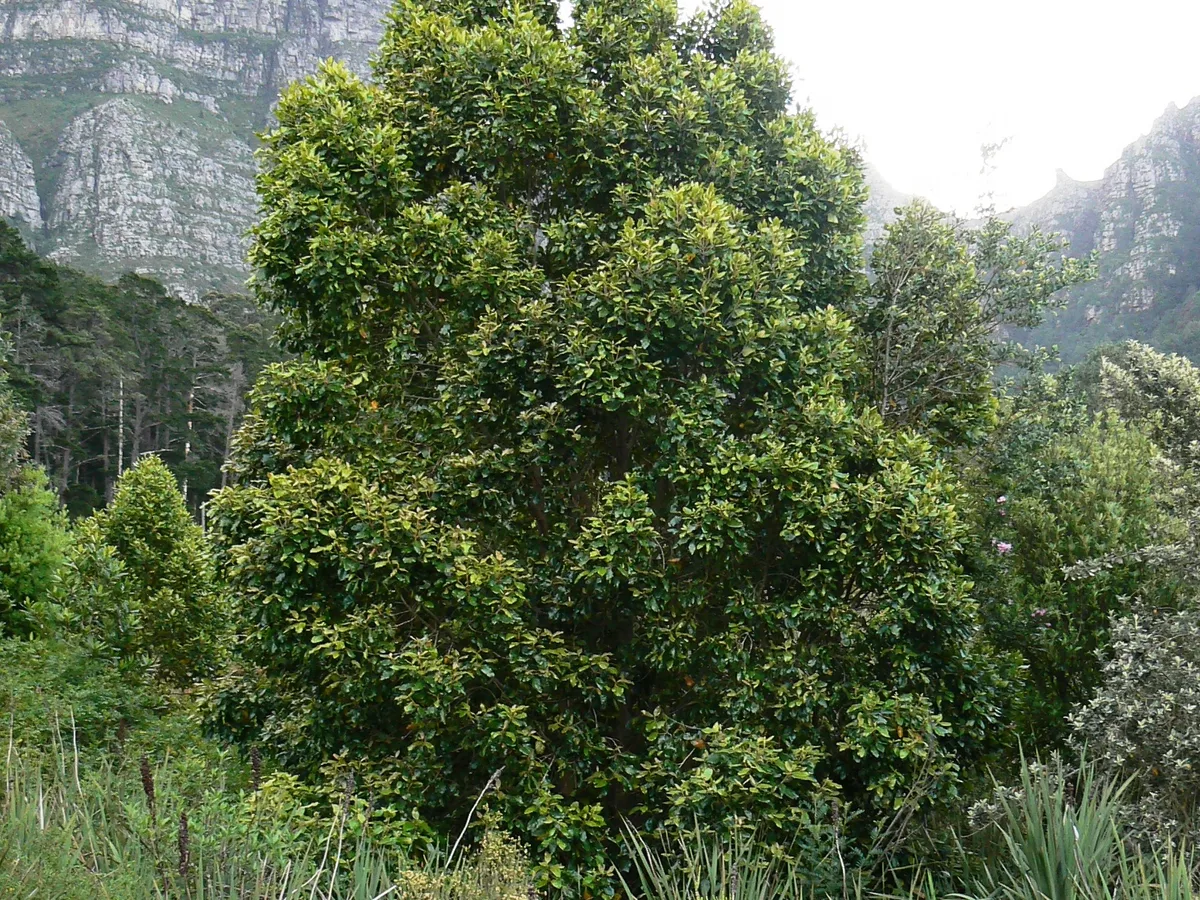
Assegai
Curtisia dentata
A Cape forest tree from the Peninsula through to Knysna. Its name comes from the assegai (spear) shafts once made from its hard wood; the bark is now too scarce for traditional medicine use.
Photo: Abu Shawka, public domain, via Wikimedia Commons
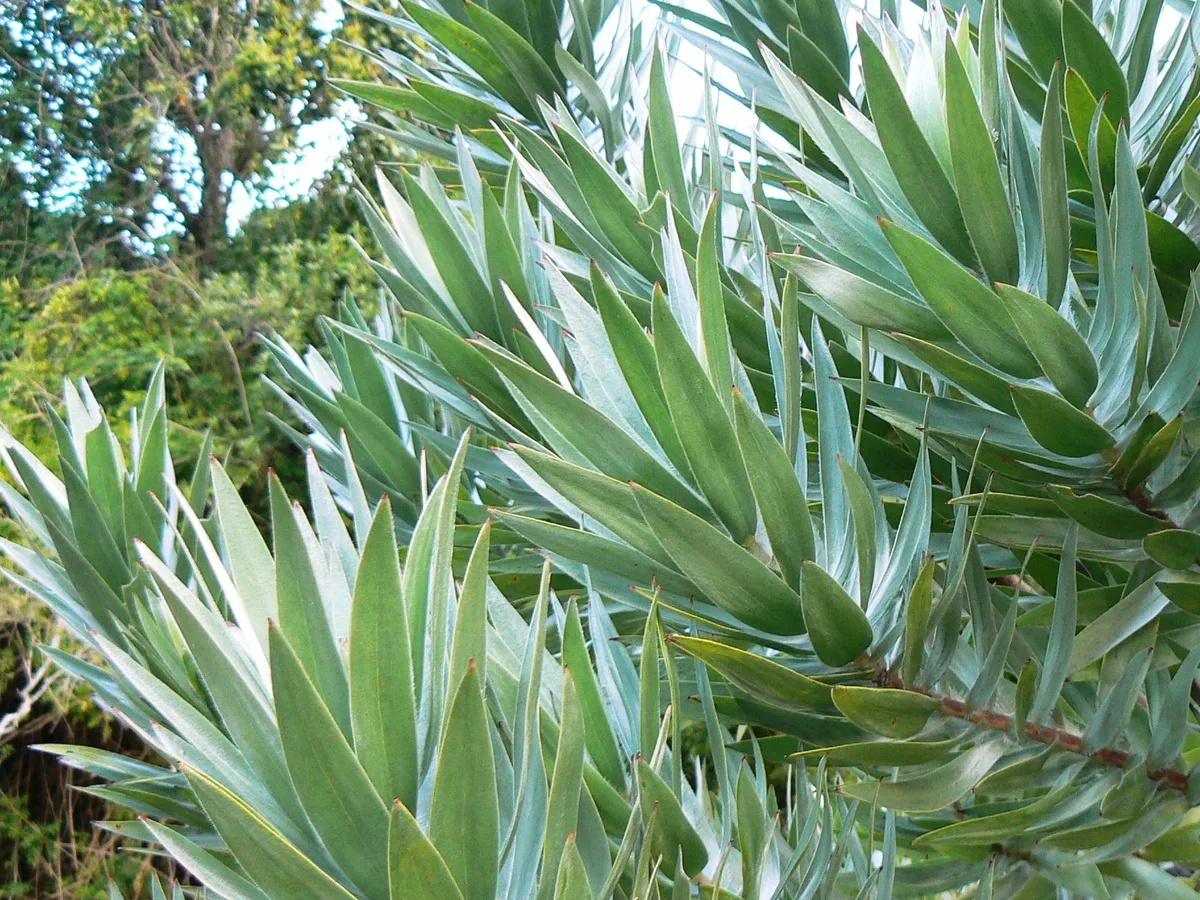
Silver tree
Leucadendron argenteum
Endemic to the Cape Peninsula — it grows wild almost nowhere else on Earth. The silvery sheen comes from fine hairs that lie flat in hot, dry weather to save water and lift when it's wet. Classed as Endangered.
Photo: Abu Shawka, public domain, via Wikimedia Commons
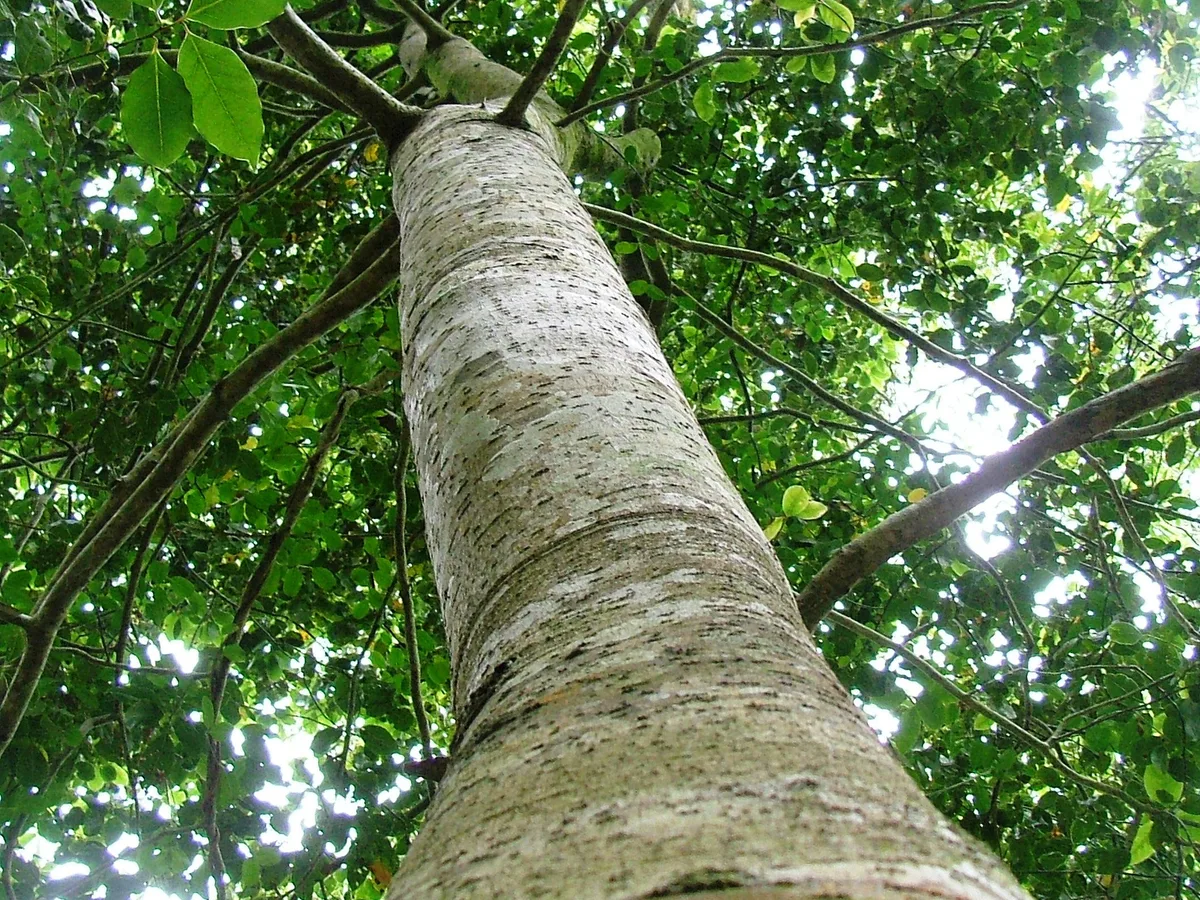
Stinkwood
Ocotea bullata
The prized Cape hardwood, found from the kloofs of Table Mountain to the Knysna forests. Centuries of felling for furniture timber and bark stripping for medicine left only stumps and saplings in places like Newlands forest — which is exactly why it's protected today.
Photo: Abu Shawka, public domain, via Wikimedia Commons
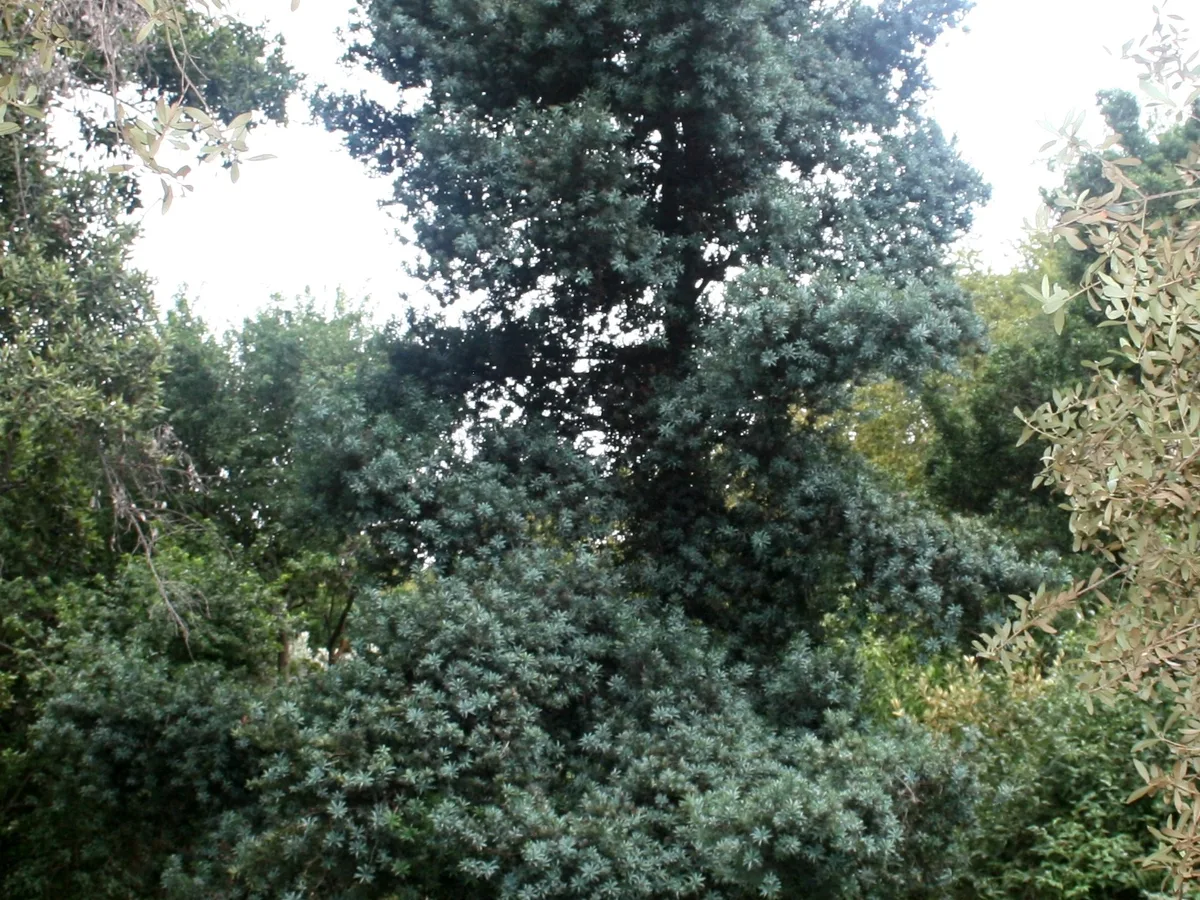
Breede River yellowwood
Podocarpus elongatus
Endemic to the Western Cape, often lining rivers from the Cederberg down to Swellendam. Unusually for a yellowwood it can resprout from its trunk — the 'Magic Tree' at Kirstenbosch regrew this way after a gale split it in 2005.
Photo: JMK, CC BY-SA 4.0, via Wikimedia Commons
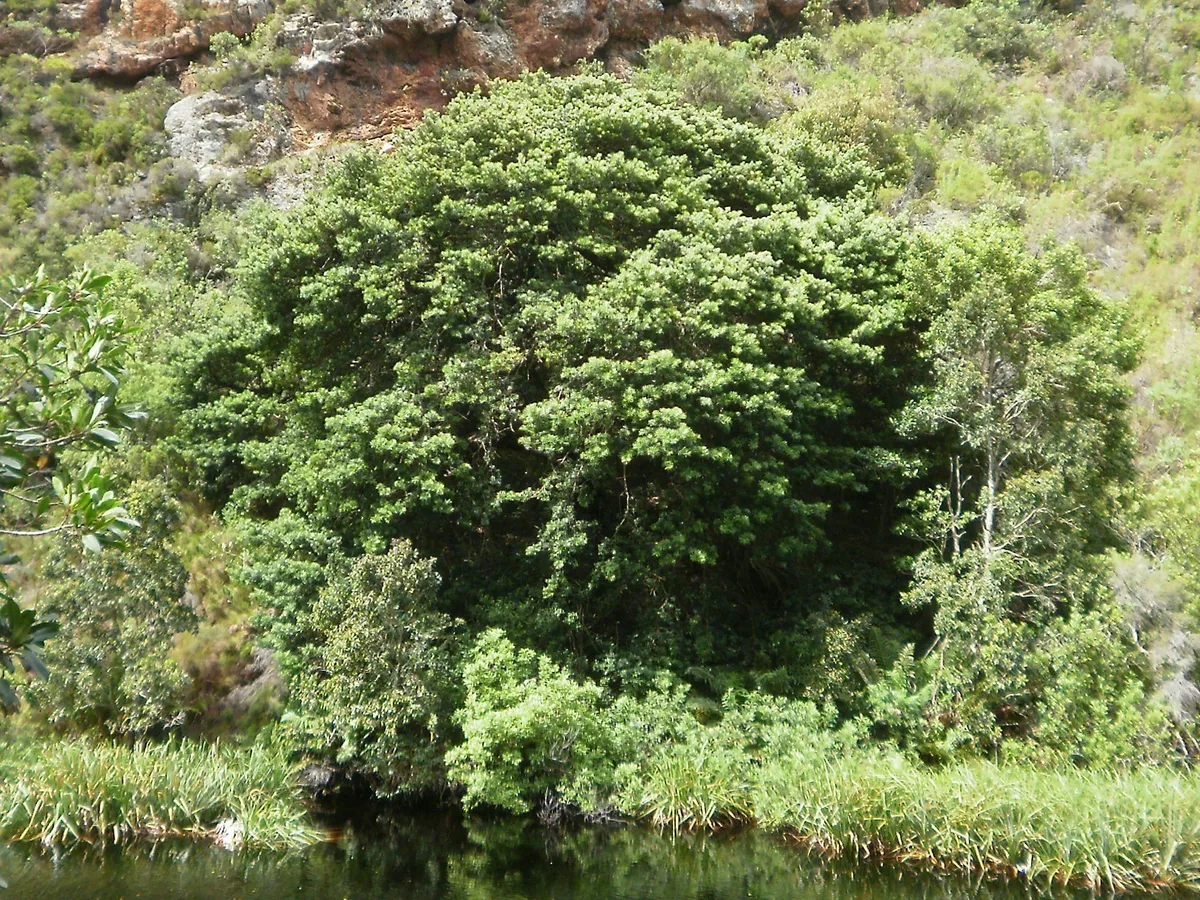
Real yellowwood
Podocarpus latifolius
South Africa's national tree, found in Western Cape mountain forests. Its even, scentless wood was once cut into butcher's blocks because it didn't chip or taint the meat.
Photo: Abu Shawka, public domain, via Wikimedia Commons
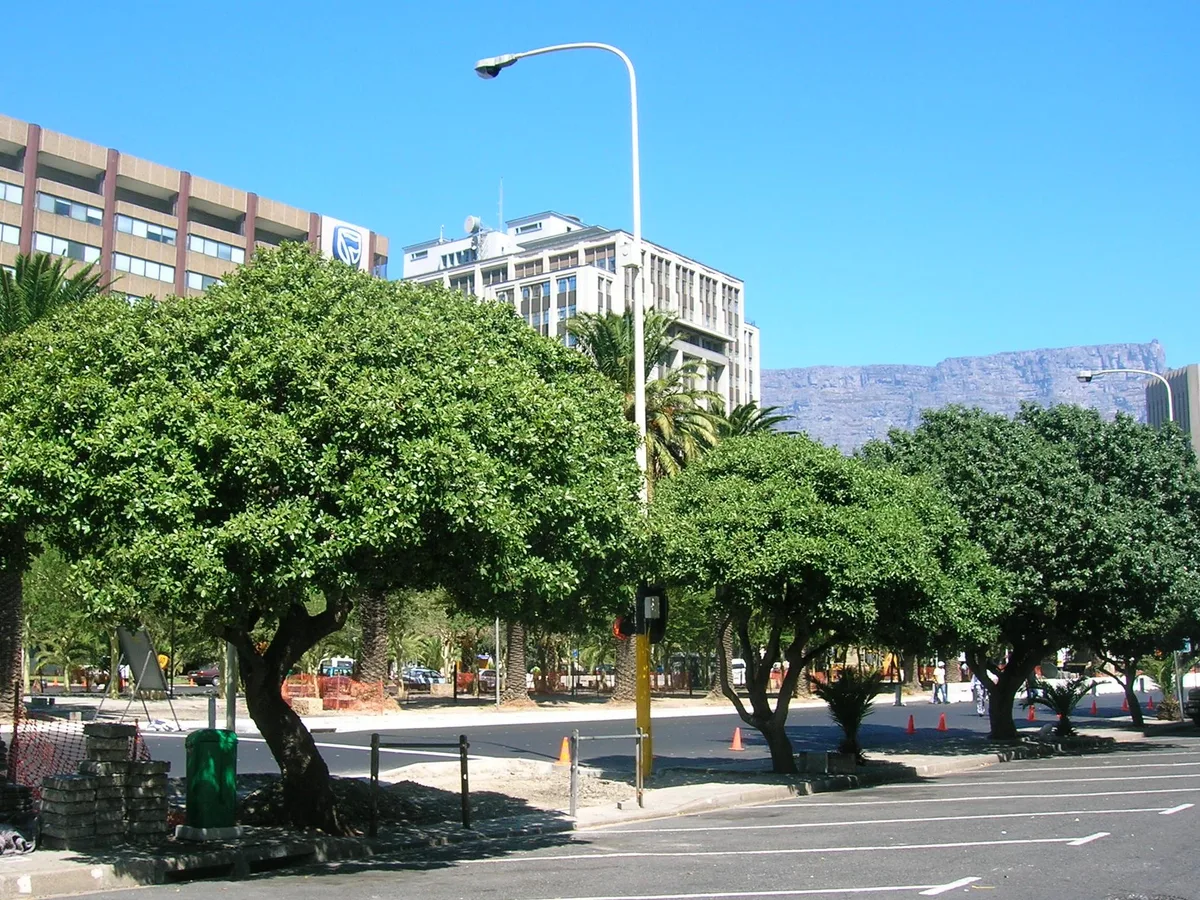
White milkwood
Sideroxylon inerme
A gnarled coastal tree of the Cape and southern shores. The 'Post Office Tree' at Mossel Bay — where a Portuguese sailor left a letter in a shoe in 1500 — is a white milkwood, and one of only three trees ever declared National Monuments.
Photo: Abu Shawka, CC0 1.0, via Wikimedia Commons
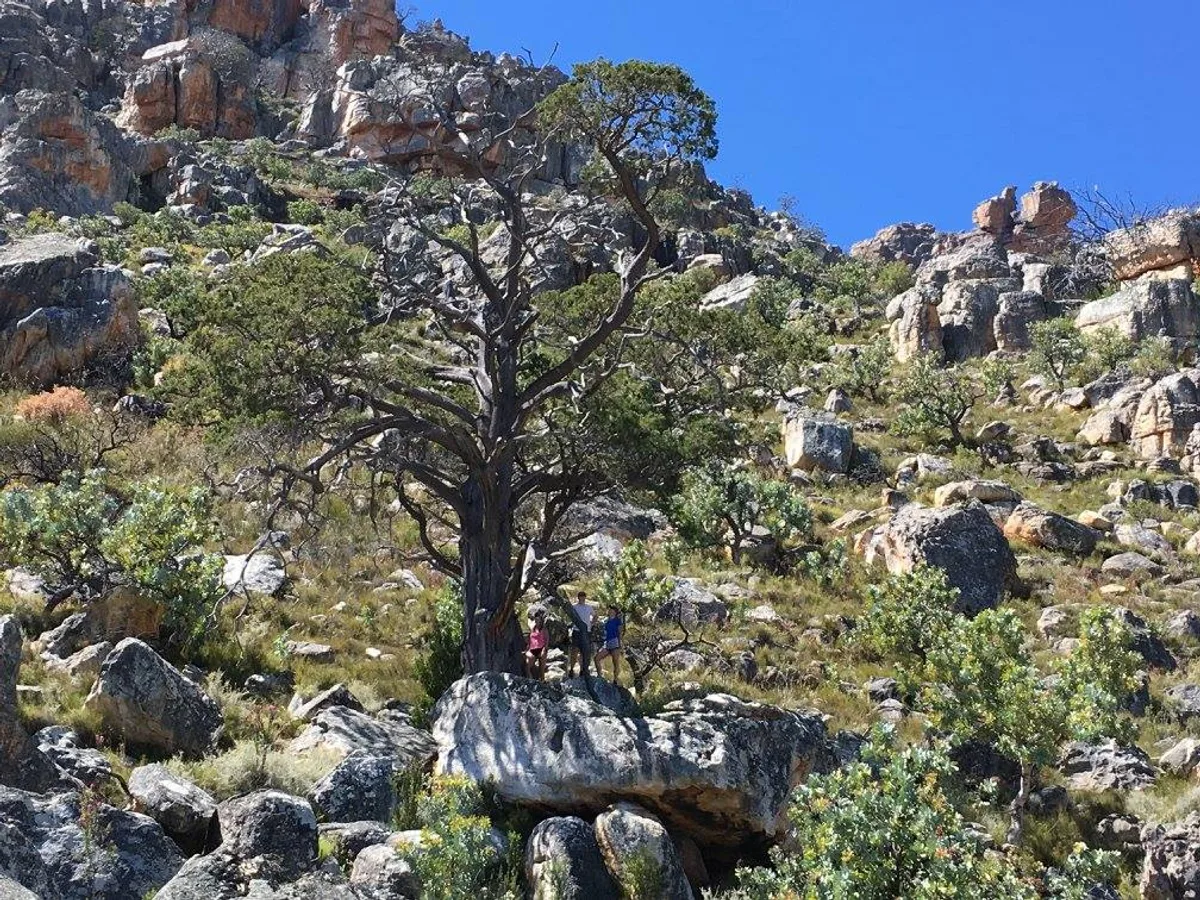
Clanwilliam cedar
Widdringtonia cedarbergensis
The tree that named the Cederberg, about 240 km north of Cape Town. Now Critically Endangered, the survivors cling to rocky, fire-sheltered ledges and can live for around 400 years.
Photo: Linda Marie Botes, CC BY-SA 4.0, via Wikimedia Commons
If you've got a gnarled old coastal tree, or anything you suspect might be a yellowwood or milkwood, get it identified before you plan any work. A quick look from an experienced arborist settles it — and if it is protected, we'll tell you straight and help with the licence.
Want to see why these trees matter? CapeNature has spent years trying to pull one of them back from the brink: the Critically Endangered Clanwilliam cedar, high in the Cederberg.
Protected vs invasive — don't confuse the two
This is the part that trips everyone up, because it's the exact opposite situation. Protected indigenous trees are ones you may not remove without permission. Invasive alien trees are ones you are legally obliged to control or remove — and many of Cape Town's most common "problem trees" fall in this second group. Mistaking one for the other is how people either illegally fell a milkwood, or illegally keep a stand of Port Jackson.
Protected (indigenous)
Yellowwood, white milkwood, stinkwood, silver tree, camel thorn. You need a DFFE licence to cut, prune heavily or remove them — even on your own land.
Invasive (alien)
Port Jackson, rooikrans, black wattle, bluegum, pine, lantana. Landowners are legally responsible for controlling these under the invasive-species regulations.
Cape Town's most common invasive trees are listed under the National Environmental Management: Biodiversity Act (NEMBA) and its Alien and Invasive Species Regulations, which place a legal duty on landowners to control them. Here's where the usual suspects sit:
| Invasive tree | NEMBA category | What it means |
|---|---|---|
| Port Jackson, rooikrans, lantana | Category 1b | Must be controlled or removed; may not be grown, sold or moved. |
| Black wattle | Category 2 | Allowed only under permit; becomes 1b within 32 m of a watercourse. |
| Bluegum, pine | Category 2 (often 1b) | Frequently 1b in Cape Town's fynbos and riparian areas, or where a fire risk. |
So if a tree on your property is an invasive alien, you don't need a protected-tree licence to remove it. Quite the reverse: clearing it is your legal responsibility. Our crews handle the common Cape invasives every week; see how that fits into our professional tree felling work if you've got a stand to clear.
How to get a licence to remove a protected tree
If the tree you want to remove is on the protected list, you can't simply book a felling — but the licence process is more paperwork than obstacle, especially when the tree is dead, dangerous or causing real damage. There are two separate authorities depending on the tree, and people often confuse them.
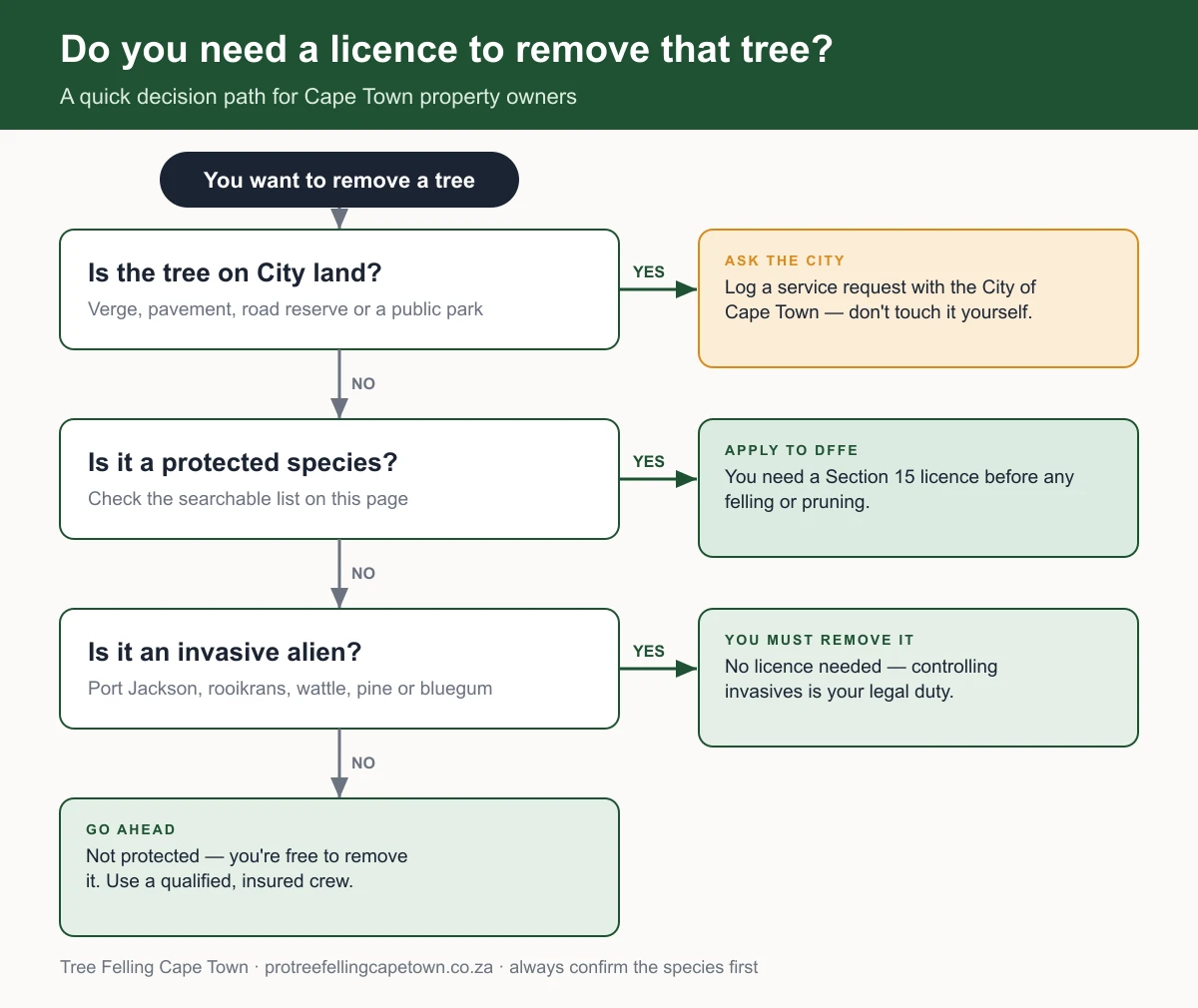
For a protected species (national)
Apply to DFFE under Section 15 using the official Application for a Licence regarding Protected Trees form. Complete it in full, attach the supporting documents, and submit it to your nearest DFFE forestry regional office.
For a City tree (municipal land)
Trees on verges, pavements and in parks belong to the City of Cape Town and may not be touched without its written permission, set out in the City's Urban Forest Policy. Log a service request rather than cutting it yourself.
A protected-tree licence doesn't override other laws: heritage overlays and environmental rules can still apply, so it's worth getting advice before you start. For the city-specific side of all this, our guide to the Cape Town tree-felling permit process breaks down who to contact and what to expect. And if you'd rather not tackle it alone, we can assess the tree, confirm whether it's protected, and handle the application as part of the job — book a free on-site assessment and we'll take it from there.
Frequently asked questions
Can I cut down a tree in my own garden in South Africa?
Usually yes, but only if it isn't a protected species. Most garden trees aren't, so you're free to fell or prune them. If it's on the national protected list, you need a DFFE licence first, even on your own property.
How do I know if my tree is protected?
Identify the species, then check it against the list above. If you're not certain what the tree is, an arborist can identify it on sight. Guessing is risky when the penalty is a criminal offence.
What is the fine for cutting down a protected tree?
It's a first-category offence under the National Forests Act: a fine, or imprisonment for up to three years, or both. The "R5 million" figure often quoted online comes from other environmental laws, not this one.
Is the milkwood a protected tree?
Yes. Both the white milkwood and the coastal red milkwood are on the national protected list, so you need a licence to cut, prune heavily or remove one — a common surprise for Cape coastal homeowners.
Who owns the tree on the pavement outside my house?
The City of Cape Town does. Street, verge and park trees may not be pruned or removed without the City's permission — report a problem tree via a service request and the City will assess it.
Am I required to remove invasive trees like Port Jackson or pine?
Often, yes. As a landowner you carry a legal duty to control listed invasive aliens such as Port Jackson, rooikrans, wattle and many pines and gums. That's the opposite of a protected tree — here clearing it is the law.
Protected trees are protected for good reason: many on this list took centuries to grow and survive in just a few places left in the country. If you've got one, the right move isn't to quietly remove it; it's to get it identified, apply for the licence if removal is genuinely needed, and have it done properly. Worth knowing the flip side too: some species carry the opposite obligation, and invasive aliens like Port Jackson and rooikrans must legally be controlled rather than protected. No guesswork, no scare stories — just check which list your tree is on before anyone starts cutting.
Keep reading
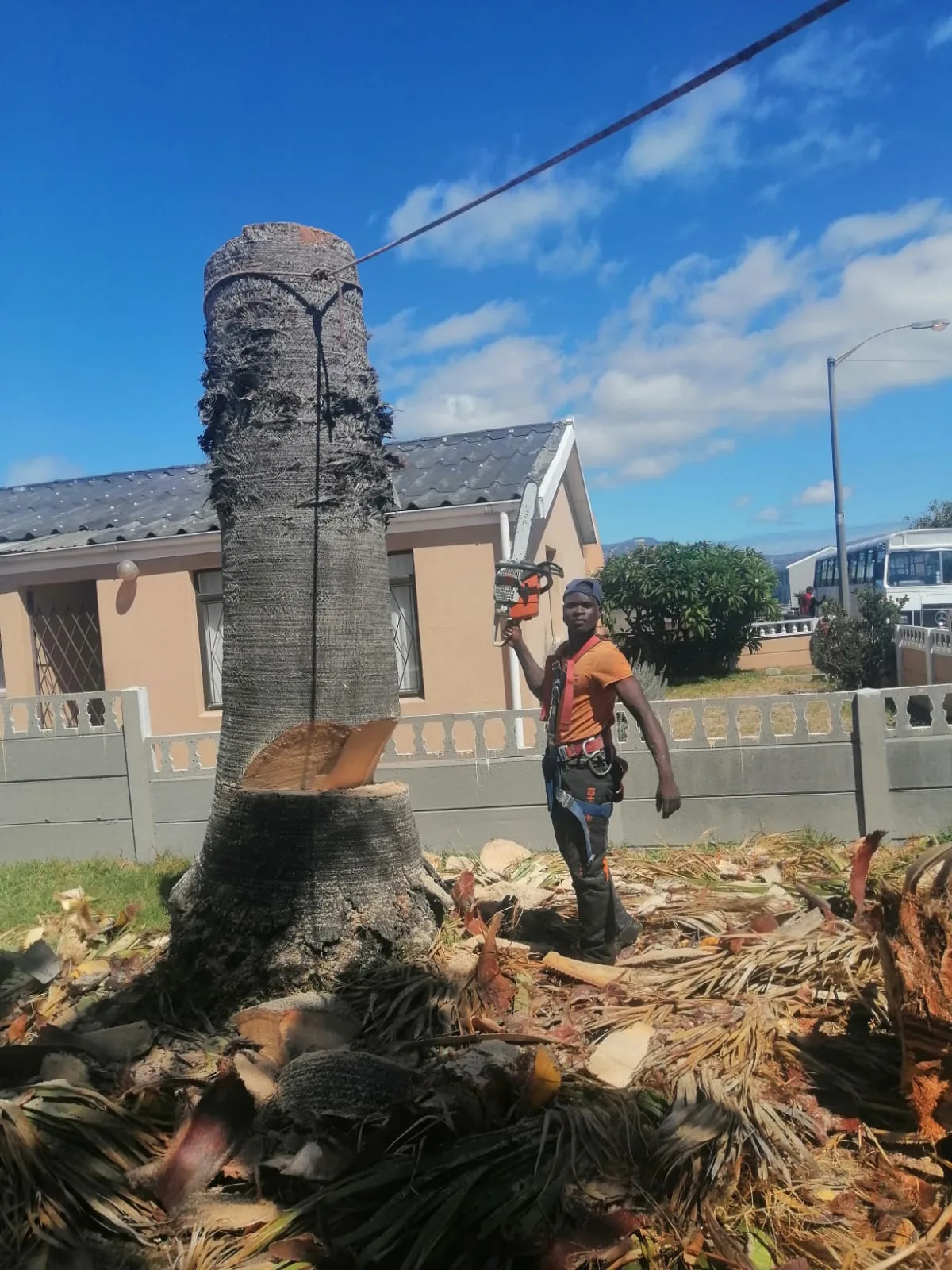
How to Cut Down a Tree Safely (And When to Stop)
Most people searching for how to cut down a tree are really asking a different question: can I do this one myself? Here is the sequence a trained feller works through, what the hinge actually does, and the situations where the honest answer is to put the saw down and phone someone.
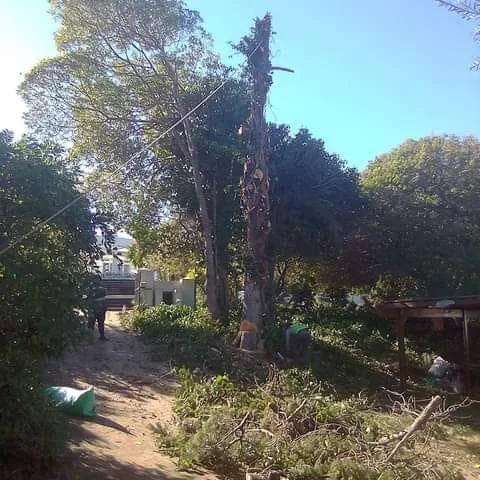
Blue Gum Tree Removal in Cape Town
A mature blue gum in a Cape Town garden sits in an odd legal spot: the species is listed as an invasive, but a big urban trunk is often specifically exempt from the duty to remove it. Here is which gums are actually listed, the tape-measure test that decides it, why cutting one down never finishes the job, and what a safe take-down in a suburb actually involves.
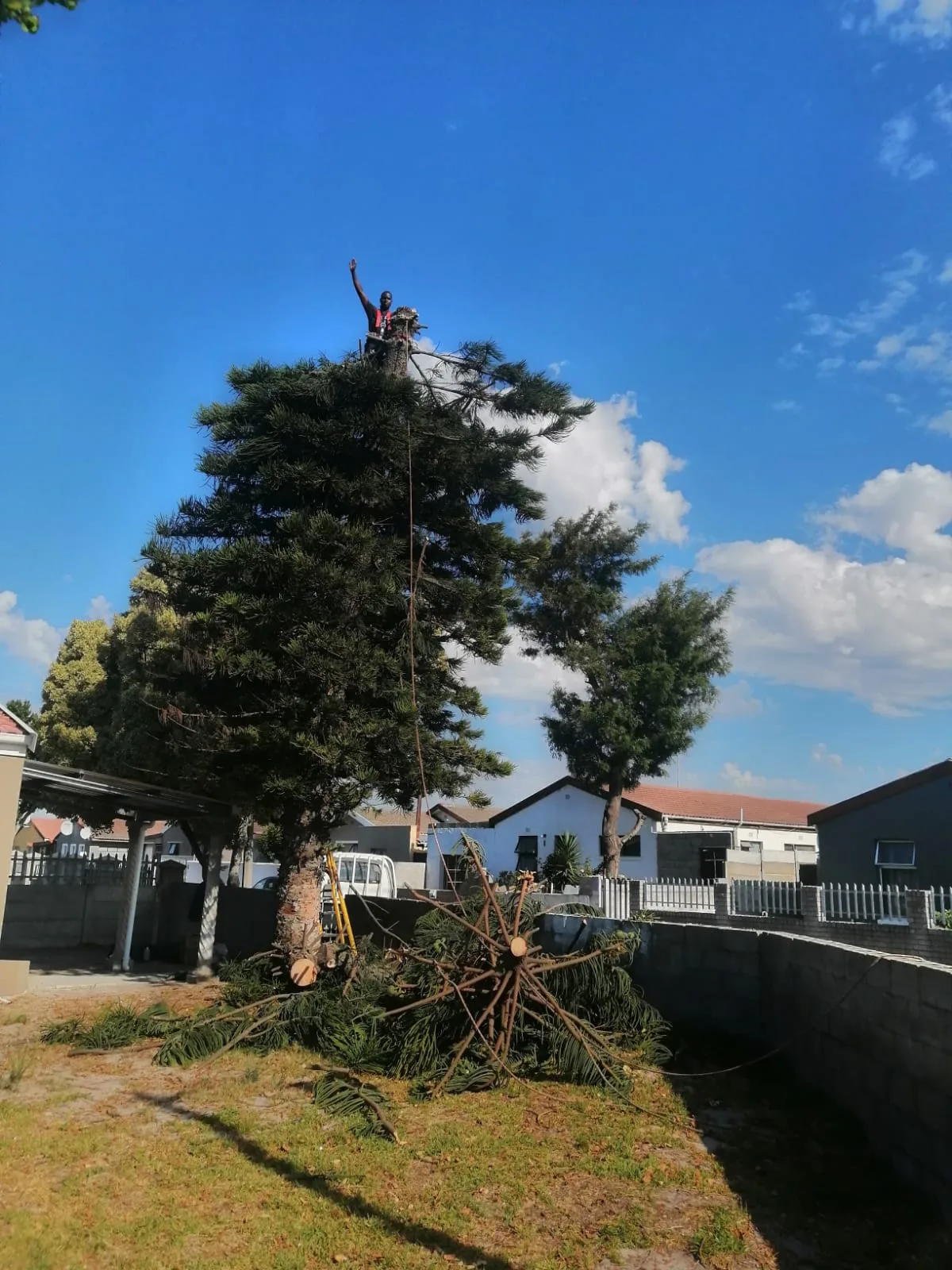
10 Signs a Tree Needs to Be Removed (And When It Doesn't)
Most of the trees people ask us to remove don't need removing. This is the honest diagnostic list — what a lean, a bracket fungus, a hollow trunk, a crack or a cut root really tells you, which signs mean act today, and which ones a prune will settle.