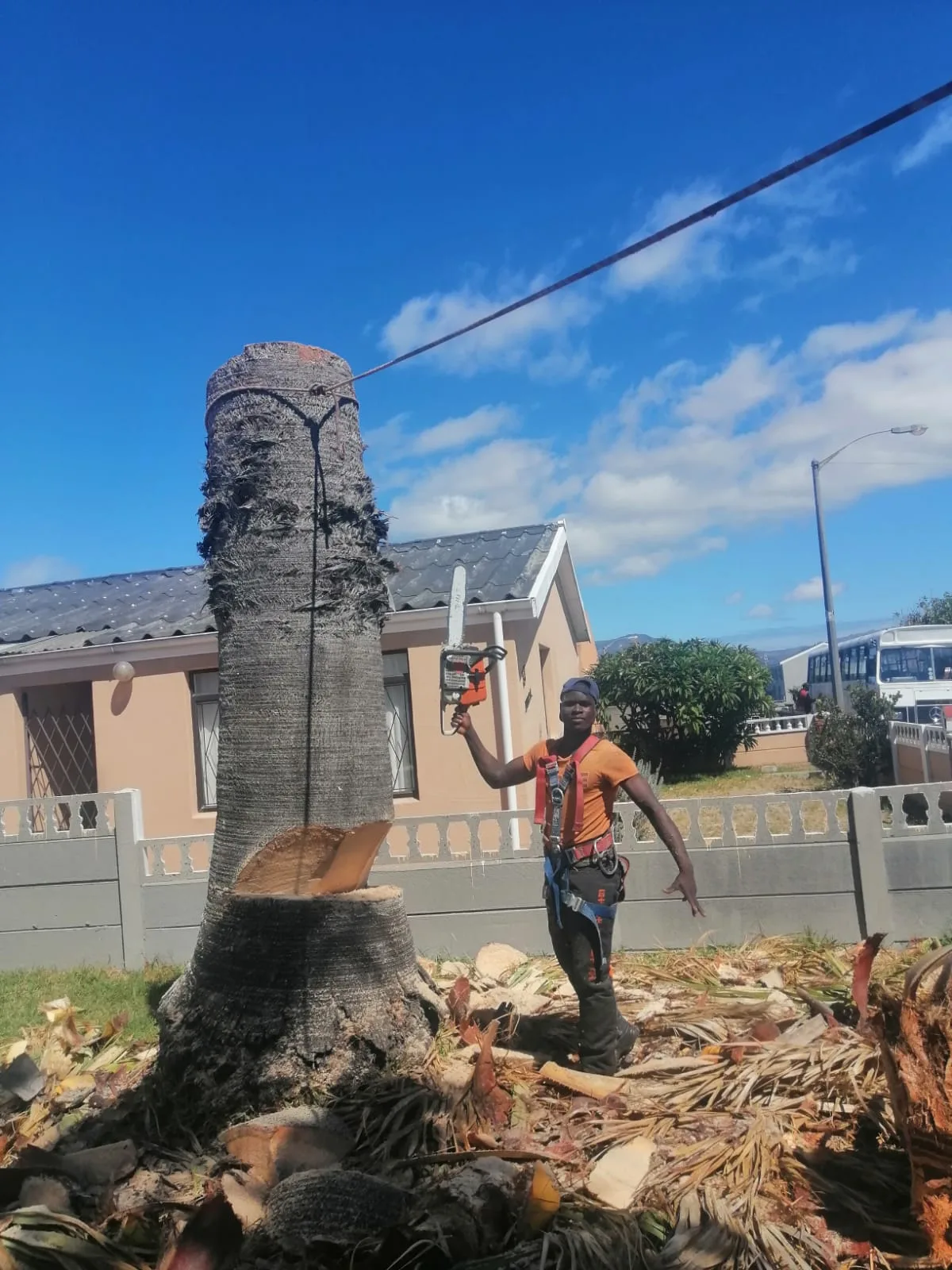
Tree Pruning & Trimming in Cape Town
Good pruning keeps a tree healthy, lets light back into the garden, clears branches off your roof and gutters, and keeps it from becoming a storm risk. We prune to proper standards — not a hack job. Free quotes, across Cape Town.
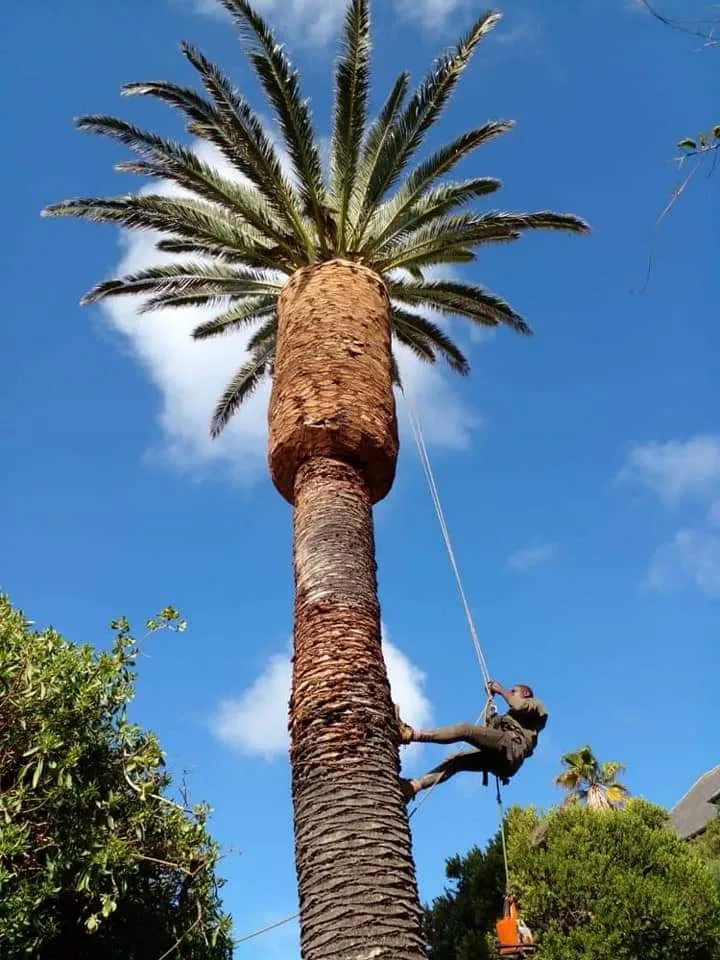
Good pruning is subtraction with a reason
Every cut is a wound the tree has to spend energy sealing, which is the whole argument for pruning properly: a branch comes off because the tree, or the house next to it, is genuinely better off without it. This limb is dead, this one is rubbing its neighbour, this one is lying on the roof, this side of the canopy catches too much wind. "Just take a bit off the top" has no reason behind it at all.
That one has a name, and it's what we get asked to repair more often than anything else. Topping is cutting the main stems back to stubs at whatever height suits the person holding the saw. The first problem is decay: a tree seals a cut best where it can still grow from — the branch collar, or a side branch big enough to take over as the new leader. A stub mid-stem has no growth point to draw on, so it dies back, and the exposed wood lets decay work down into the trunk.
The second problem is the regrowth. A topped tree throws out a dense cluster of fast, upright shoots below the cuts — epicormic growth. Within a few seasons it's taller and bushier than before, but those shoots are anchored in the outer layer of a decaying stub rather than in sound wood. That's a bigger storm risk than the branch you paid to remove, on a tree that now has rot in it.
The pruning jobs Cape Town gardens actually need
Nearly everything people call trimming is one of four jobs. Knowing which one you want is the difference between a quote you can compare and one you can't.
Crown thinning — letting the wind through
Taking out a measured share of the smaller branches, spread evenly through the canopy, so the south-easter blows through the tree instead of shoving the whole thing. On a big dense evergreen in an open garden this is usually the job. Evenly is the important part — stripping the inner growth and leaving tufts on the ends of bare limbs (lion-tailing) moves the weight outward and makes failure more likely, not less.
Crown reduction — bringing a too-big tree back
Reducing the height and spread of a tree that has outgrown where it stands — over a roof, into the neighbour's airspace, taking the whole afternoon's light. Done properly it isn't cutting the top off: each stem is shortened back to a side branch big enough to take over as the new leader, so there's a live growth point at every cut. That's why the tree still looks like a tree afterwards.
Crown lifting — clearance underneath
Removing the lowest limbs to buy height underneath: so the bakkie stops scraping up the driveway, so branches come off the gutters and the wall, or just to open up the light beneath the tree. It's the least invasive of the four and often all a garden needs. Lift a tree every year, though, and you end up with a bare pole carrying its weight up top — so we take the clearance you need and stop.
Deadwooding — the safety job
Taking out the dead, broken and hanging limbs and leaving the living canopy alone. Dead wood is what comes down in the first serious blow of the season, and a hanger left up there after a storm falls whenever it feels like it. Nothing living is removed, so it costs the tree nothing — it can be done on a tree too old or too stressed for anything heavier.
If what you're looking at is a boundary hedge rather than a tree, that's a different job with different gear — see hedge trimming and shaping. And if you're weighing pruning against taking the tree out altogether, that call is set out in felling versus pruning.
When to prune trees in Cape Town
There's no single date on the calendar — but there are general practices that hold up well in this climate.
- Deciduous trees are easiest in winter. Oaks, planes, liquidambars and most fruit trees are dormant and bare, so the structure is visible, the tree isn't spending energy on growth, and it pushes cleanly in spring. Most of our heavier structural work happens in the winter months for that reason.
- Heavy cuts in the peak of summer are the ones to avoid. A tree in a hot, dry Cape summer is already managing water stress, and bark on limbs that spent years shaded by the canopy above can scorch once it's suddenly in full sun.
- Dangerous wood is the exception to all of it. Dead, broken or hanging limbs, and anything resting on a roof or over a driveway, come off now — the season makes no difference.
- Thin wind-exposed trees before the season, not after it. The calls we get once the south-easter is running hard are usually from someone whose tree has already lost a limb; the same tree thinned in the quiet months generally keeps it.
Indigenous evergreens and most ornamental garden trees are more forgiving and take light work through much of the year, and fruit trees follow their own calendar by species. Tell us what you've got and we'll say honestly whether it's a job for now or a job for June.
How much can come off in one go
The most common request we get on a quote is some version of "can you take it right down". The honest answer is that a healthy mature tree shouldn't lose a large share of its living canopy in one visit. Leaves are how a tree feeds itself — strip too many at once and it answers with a flush of weak, fast growth, which is exactly what you were trying to avoid.
General arboricultural practice puts the ceiling for a healthy mature tree somewhere around a quarter to a third of the live crown in a season, and less on an old, stressed or already thin one. That's a working guideline rather than a rule anyone can quote at you, but it's the right ballpark to hold a contractor to.
Two things follow. Every reduction cut goes back to a growth point that can take over, never to a stub. And when a tree is a long way too big for its spot, the right fix is usually two lighter visits a season or two apart rather than one drastic one — we'll say so at the quote even though it means less work today. The structural side of that thinking, including shaping a young tree for the next thirty years, is in our guide to structural pruning for Cape Town homeowners.
Dead wood doesn't count against any of this. Every dead branch can come off without touching the tree's ability to feed itself, which is why deadwooding is so often the right first job on a tree nobody has looked at in years.
What tree pruning costs in Cape Town
We publish prices wherever we honestly can — a small garden tree felled runs about R1,200 to R2,500, and most residential tree work lands between R1,200 and R15,000. Pruning is one of the services we won't put a figure on before seeing it, and that isn't evasion: two eight-metre trees on the same street can be an hour's work or a full day depending on what's underneath and whether a chipper can get near.
So instead of a made-up number, here's what we're pricing when we walk your garden. When one quote comes in much higher than another, it's nearly always one of these five lines that explains it.
| What we look at | Why it moves the price |
|---|---|
| Height and how we reach the crown | Ground and pole-saw work is quick. Once a climber is up on rope and harness with someone working below, you're paying for two people and the skill. |
| Canopy size and how much comes out | A crown lift is a handful of limbs; a thin and reduce on a mature canopy fills a truck. Volume drives cutting time and disposal. |
| Chipper and vehicle access | Feeding a chipper at the gate is the fast version. Carrying the same volume through a house or up garden steps is hand work, and costs more. |
| What's under and beside the tree | An open lawn is cheap. A tiled roof, a pool, a boundary wall or a power line means every piece is roped and lowered rather than dropped. |
| Where the cuttings end up | Chipped and hauled away, spread on your beds as mulch, or logs stacked for firewood — tell us which and we price it that way. |
You get one fixed written price before anyone starts, covering the pruning and the clean-up together — no hourly rate that grows, no separate bill for the mess. For a rough idea before booking a site visit, send photos with the whole tree in frame and something for scale, and say what you want gone.
Free on-site look, one fixed written price, garden left clean. Call 084 966 4252 or send the form.
Get my pruning quotePruning that still needs permission
Most pruning on a private garden tree needs no paperwork at all. Three situations are the exception, and people assume permits are a felling problem — they aren't.
Nationally protected species. The National Forests Act 84 of 1998 protects a listed set of trees — declared under section 12 — and section 15(1) covers cutting, damaging and disturbing, not only felling. Heavy pruning of a protected tree needs a licence in the same way removal does. The current list is Government Notice 4496 in Government Gazette 50291 of 13 March 2024, and the species a Cape Town garden realistically holds are white milkwood, real and Outeniqua yellowwood, stinkwood, assegai and the Peninsula's own silver tree. If you think you have one, say so — we won't put a saw into a protected tree on a maybe.
Street and verge trees. A tree on the pavement outside your wall is generally the City's, not yours, even though you're the one sweeping up after it. Pruning it is a matter for the City, including the branches leaning over your side — the City's Urban Forest Policy is explicit that a tree planted in a public road becomes the property of the City.
Heritage overlays and estate rules. Older heritage protection areas, some estates and plenty of body corporates layer their own approval on top. We check which of these apply at the quote stage and tell you straight, even when the answer is that we can't start this week. The full picture is in our guide to tree felling permits in Cape Town.
How we actually work in a garden
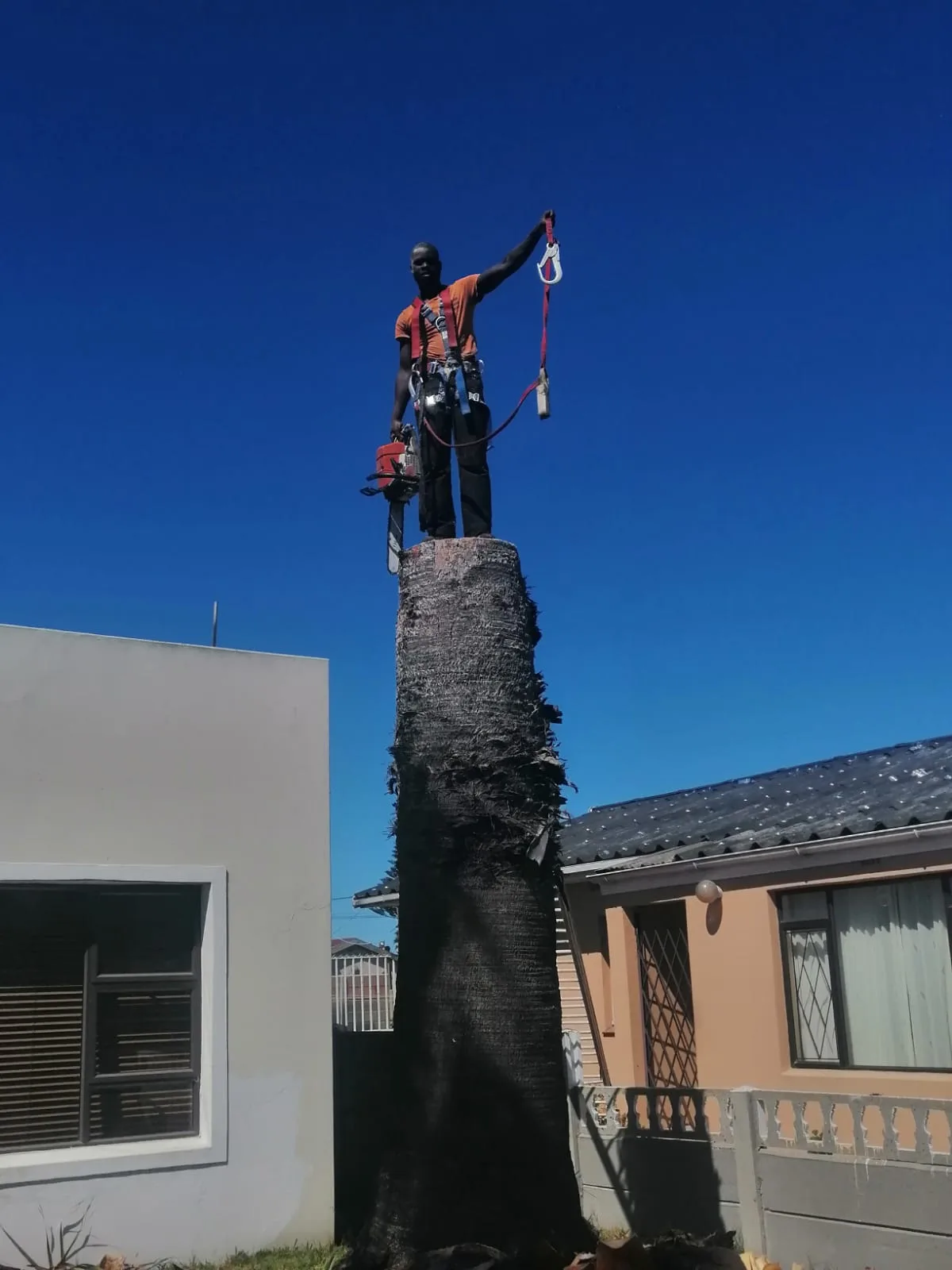
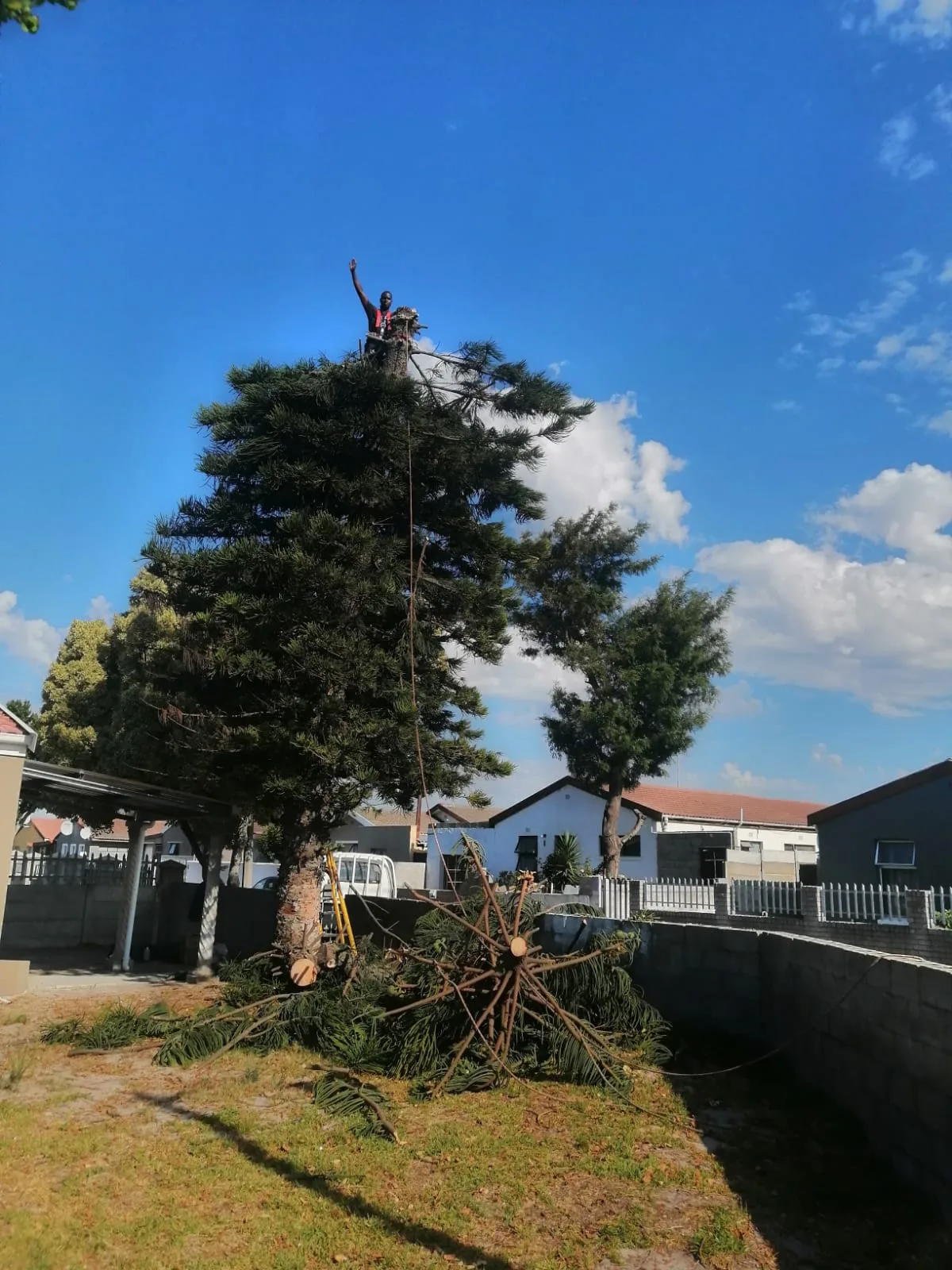
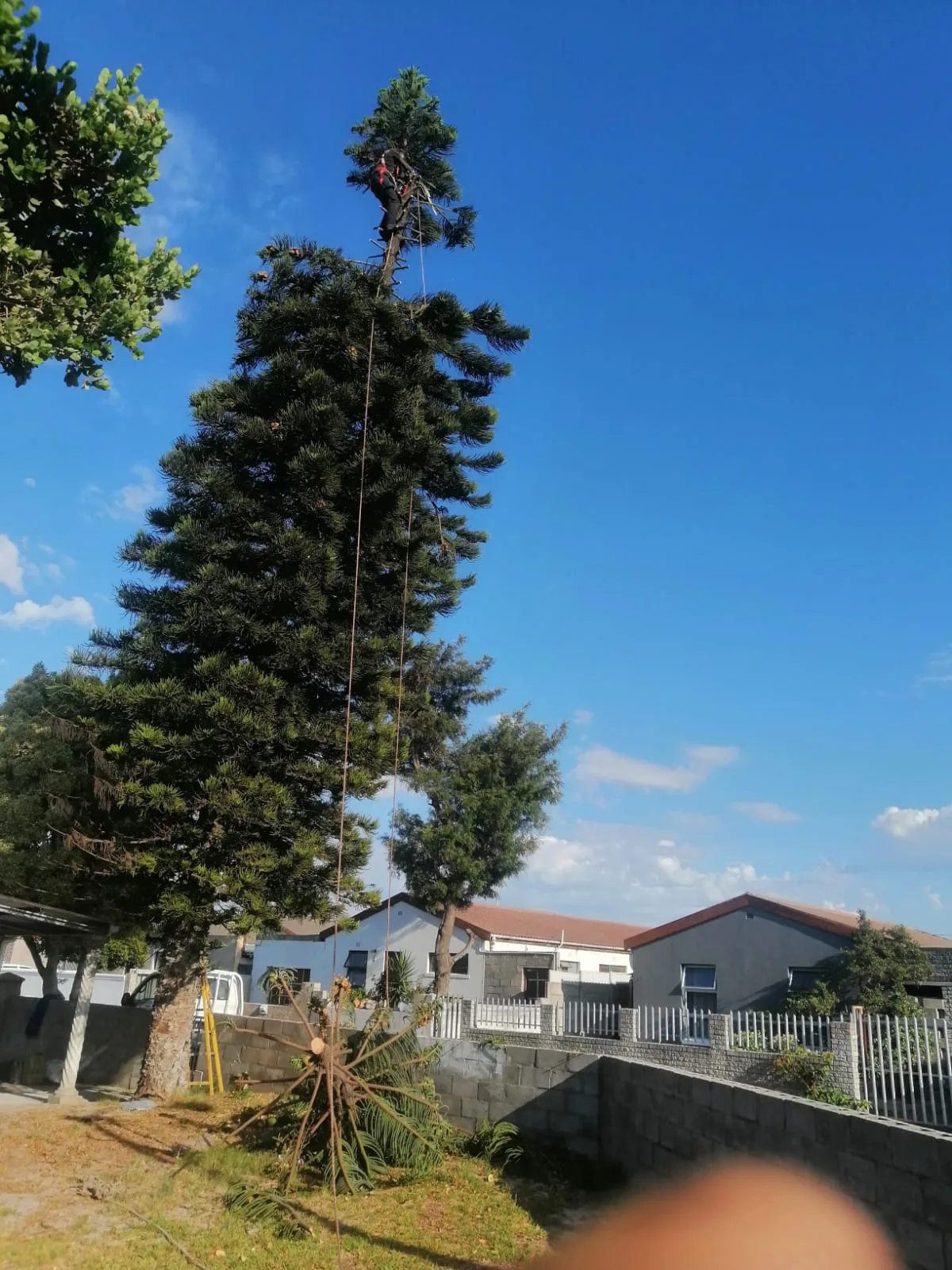
No spikes on a tree that's staying. Climbing irons belong on a tree that's coming down. Every spike is a puncture through the bark into the living tissue underneath, and on a tree you plan to keep for another thirty years that's a spiral of wounds for no reason. Our climber works on rope and harness.
Nothing gets dropped that can be lowered. On most Cape Town plots there's a bed, a pool, a car or a glass roof under the tree. Limbs over anything that matters are roped and lowered rather than cut free, and we move furniture and board over what we can't move before we start.
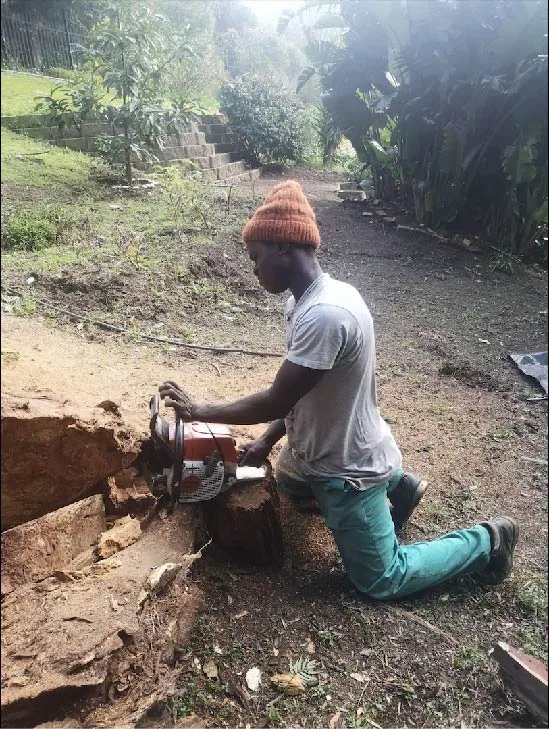
Clean cuts, in the right place. Back to the branch collar so the tree can seal over it, back to a viable side branch on a reduction, and no flush cuts into the trunk. Saws stay sharp and clean — and where shot hole borer is a concern we sterilise tools between trees and chip the material on site rather than carting it off to spread the problem into someone else's garden.
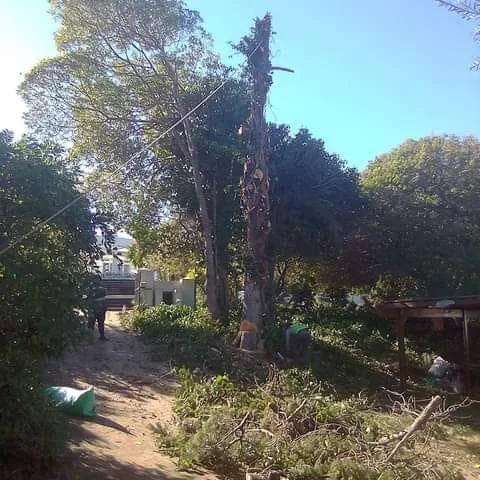
We leave it looking like a tree. The test is whether a neighbour walking past can tell it was pruned last week: balanced canopy, natural outline, no stubs, no flat top. Then the beds get raked, the gutters cleared, and the chips hauled away or spread wherever you want them. It's the same crew everywhere, so have a look at what else we do with trees around Cape Town if there's more than pruning on your list, or call 084 966 4252 and describe the tree.
Our pruning & trimming process
Walk the garden with you
We look at each tree, talk through what you want — more light, clearance off the house, a healthier shape — and quote it.
Climb and prune to standard
Our climber removes deadwood, crossing limbs and overgrowth, and lifts or thins the crown using proper cuts that the tree heals over cleanly.
Shape and balance
We step back and balance the canopy so it looks natural and well-kept, not butchered — and stays structurally sound.
Clear the cuttings
All the trimmings are gathered, chipped or bagged, and hauled away, leaving the garden neat.
Every pruning & trimming job is quoted up front in writing, and cleaned up afterwards.
Get my free quoteGet a free pruning & trimming quote
Fill this in and we'll come and look, then give you one fixed written price. No call-out fee.
Tree Pruning & Trimming FAQs
Common questions about this service in Cape Town.
Pruning & Trimming across Cape Town
We provide tree pruning & trimming right across the city — including Camps Bay, Sea Point, Constantia, Newlands, Durbanville and Table View. Not on the list? We cover the whole of greater Cape Town.
Other tree services we offer
All across greater Cape Town.
Tree Felling
Safe, controlled felling of large and awkward trees anywhere in Cape Town.
Learn more
Tree Removal
Complete tree removal — felled, cleared, hauled away and the site left tidy.
Learn more
Stump Removal & Grinding
Grind out unsightly stumps below ground level so you can pave, build or replant.
Learn more
Palm Tree Removal & Cleaning
Remove, trim or clean tall palms — our specialty across the Cape.
Learn more