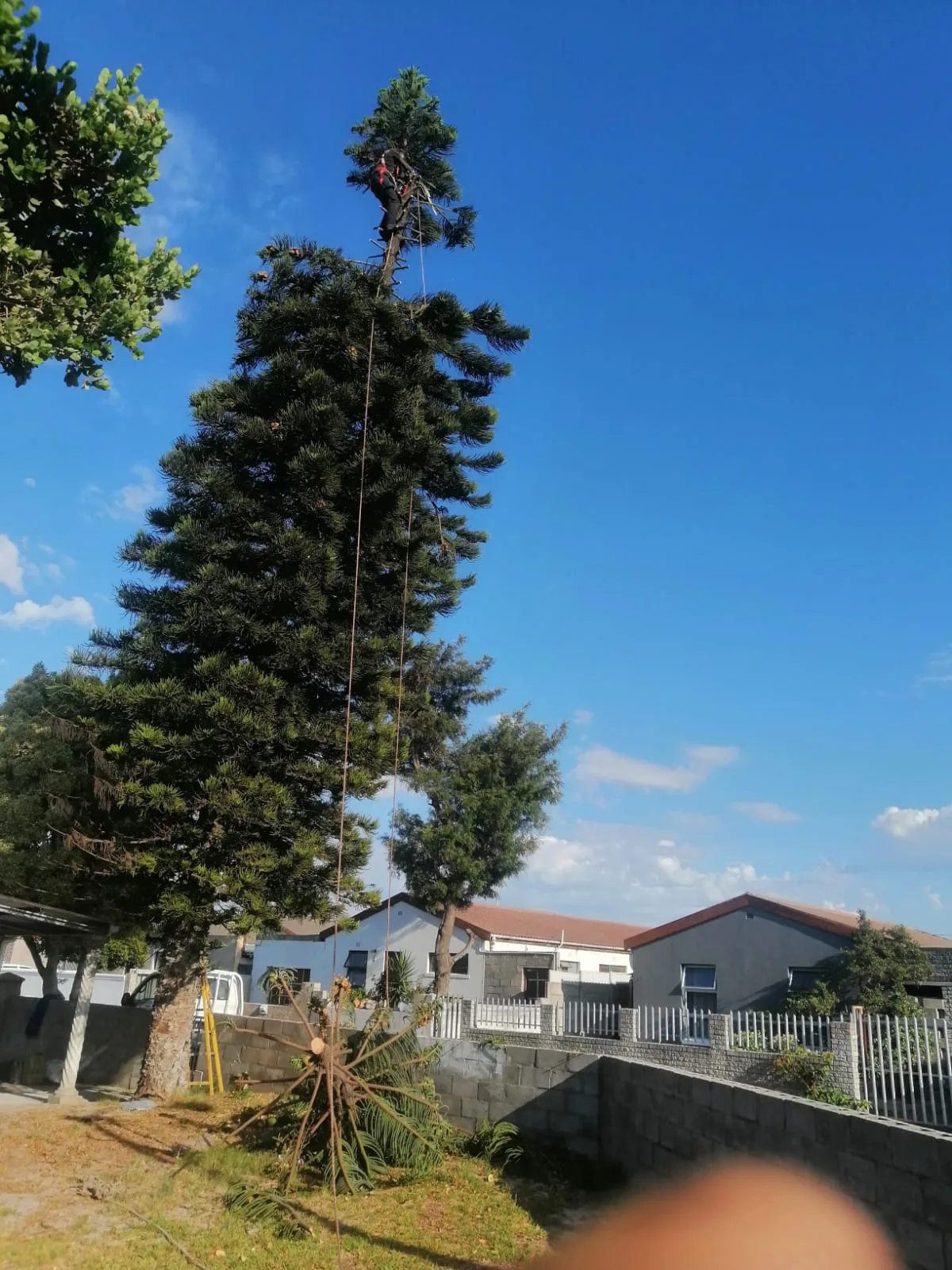
Palm Tree Removal & Cleaning in Cape Town
Palms are a Cape Town signature, but a neglected one drops heavy fronds, harbours rats, and gets dangerous when it's tall. We climb and remove palms entirely, or clean them up — dead fronds, seed stalks and skirt. Prices published below by height, fixed in writing before we start.
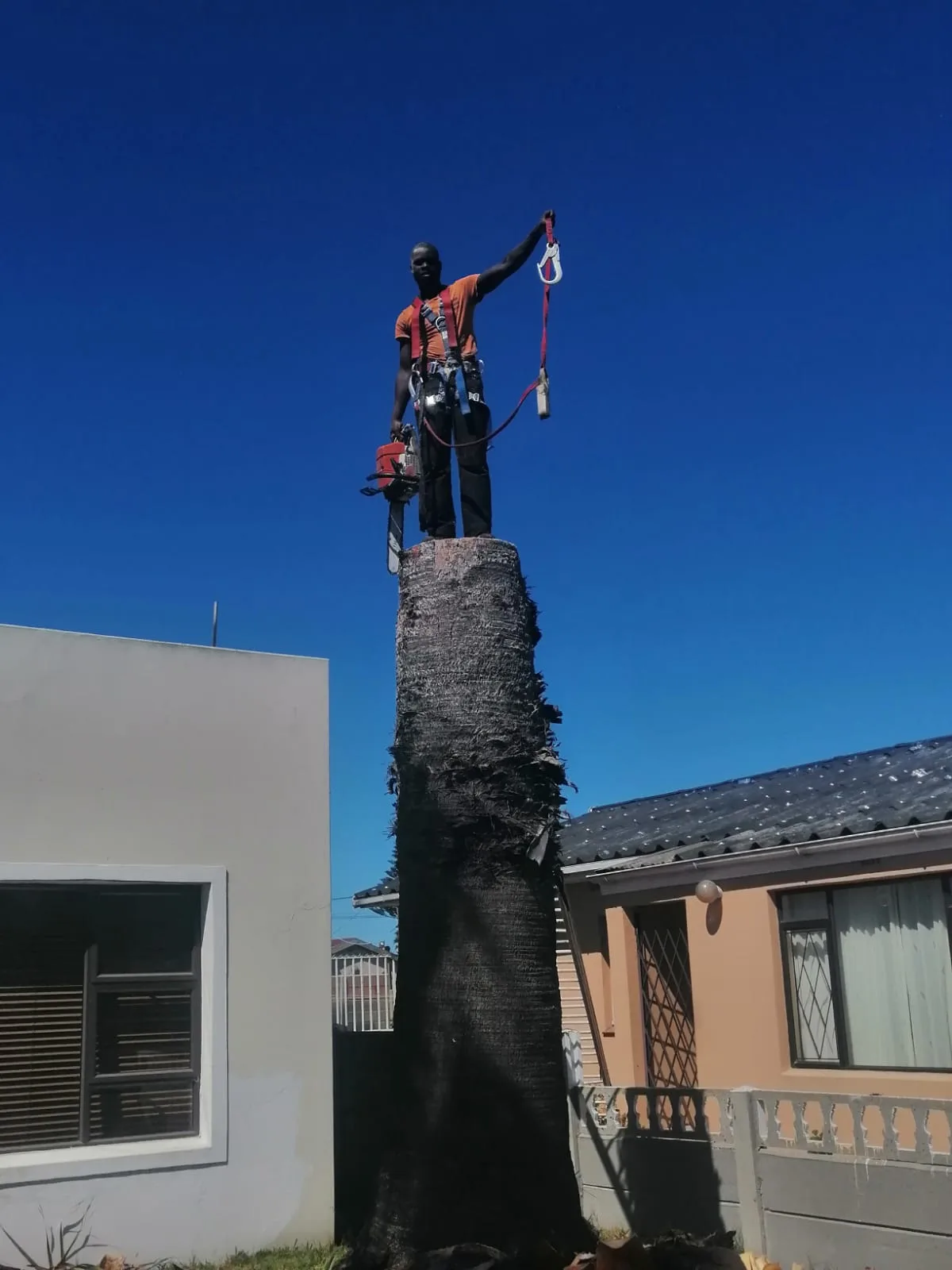
When a Cape Town palm stops being worth keeping
Most of the big palms in Cape Town were planted as small garden features thirty or forty years ago — along the Atlantic Seaboard, through the Southern Suburbs, in the older Northern Suburbs streets. Nobody planning a front garden in 1985 pictured a fifteen-metre trunk leaning over the driveway. That's the tree we get called to now.
Palm tree removal in Cape Town is nearly always about size rather than sickness — the tree is usually still perfectly healthy when it comes out, it has just outgrown the property around it. Below is what actually prompts the call, in the order we hear it.
Falling fronds and fruit stalks
A dead Canary date palm frond is a two- to three-metre, spine-armed length of hard timber, and a mature palm drops it from ten metres up. Date palms add heavy hanging fruit bunches that rain sticky fruit for weeks, then let go of the whole stalk. Below that is usually a car, a pavement or a pool cover.
What's living in the crown
An uncleaned crown and the dead-frond skirt on a fan palm is a known nesting spot for rats, bees and pigeons. For plenty of owners that — not the look of the tree — is what finally makes the decision.
Wind
The summer south-easter strips loose fronds off a neglected palm in a single afternoon. The winter north-wester is the one that takes a whole crown out of a palm that's already sick at the top.
Space, light and the pool
Straight answer on roots: a palm's root system is fibrous and shallow, and it very rarely lifts paving the way an oak or a fig does. What people actually want gone is the shade, the constant frond and fruit litter in the pool, and a trunk that has outgrown a two-metre strip beside the house.
If the crown is browning rather than dropping, it may not need to come out at all — the causes and what they mean are set out in our guide to brown palm fronds in Cape Town. Removal is the right call when the palm has outgrown the spot, not just when it looks untidy.
Which palm it is changes the job — and the price
"Palm removal" covers two very different jobs in Cape Town. Getting a quote that makes sense starts with identifying the tree, so here's how to tell them apart from the ground.
Canary Island date palm (Phoenix canariensis)
Thick, heavily textured trunk and a huge dense crown of arching fronds. This is the heavyweight — the one scattered through Constantia, Newlands and the older Southern Suburbs gardens. The frond bases carry hard spines, the crown is enormous, and the trunk weight per metre is brutal. A tall one is the single most expensive palm to remove in the city and the most likely to justify a crane. It's also the species hit by Fusarium wilt, which was confirmed in Cape Town.
Mexican fan palm (Washingtonia robusta)
The tall, skinny one with fan-shaped fronds that you see lining streets and towering over single-storey houses. Slim trunk, so the sections are manageable — but the height is the problem, and the dead fronds fold down into the classic brown skirt that houses the rats. Straightforward to climb, awkward to work over a road.
Smaller garden and cluster palms
Queen palms, multi-stemmed clumps and the shorter ornamental palms in courtyards and complexes. Under about three metres these are mostly ground work with a saw and a bakkie, and they're priced accordingly — not the same job as a fifteen-metre date palm, and you shouldn't be quoted as if they are.
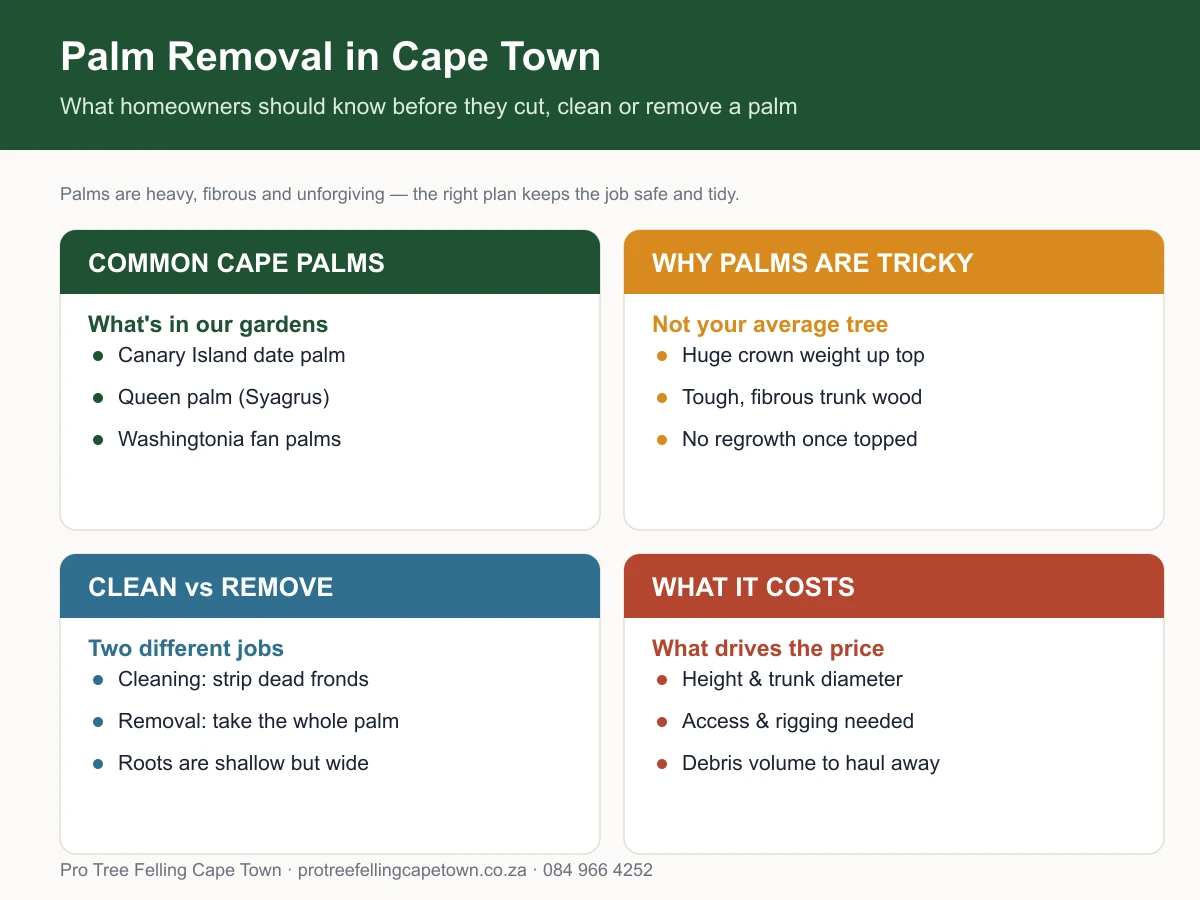
Not sure which one is in your garden? Send us a photo from the pavement with the whole tree in frame and we'll tell you what species it is and roughly which price band it falls into. The firm number still comes after we've seen the access and what's underneath, but the photo saves you a wasted appointment.
What palm tree removal costs in Cape Town
Almost nobody in this trade publishes prices. We do, because the alternative is you phoning five companies to find out. Palms are priced on height, not trunk width — the trunk is a uniform column with no canopy to reduce piece by piece, so the cost is driven by how far up someone has to climb and how heavy each section is coming down. Palm timber is soaked with water and far heavier than people expect.
| Palm height | Typical price | How it's done |
|---|---|---|
| Under 3 m | R1,500 – R2,500 | Mostly from the ground |
| 3 – 6 m | R2,500 – R4,500 | Climbed on spikes and harness |
| 6 – 12 m | R4,500 – R8,000 | Climbed, sectioned and lowered on ropes |
| Over 12 m | R8,000 – R15,000+ | May need a crane or cherry picker |
Where a palm genuinely can't be climbed safely — dead at the top, wedged over a roof, or simply too tall — crane hire adds roughly R3,000 to R8,000 on its own. That's the single biggest swing in any palm quote, which is why we always look before pricing rather than giving a number over the phone and revising it on the day.
Three things move a quote inside those bands: access (can the truck get to the base, or is everything carried through the house), what's underneath (an open lawn is cheap, a glass roof and a pool are not), and whether you want the stump and root ball out afterwards. The full breakdown across every tree type is in our 2026 Cape Town tree felling price guide.
Every palm is quoted at a fixed written price before we start. No day-rate, no "we'll see how it goes".
Get my palm quoteWhat customers say about the palm work
I had a great experience with Peter. They were very efficient, arrived on time, and trimmed my palm tree beautifully. They also cleaned up everything afterwards and removed all the rubble, leaving the area neat and tidy.
Very professional, safe, respectful, lovely guys. Second time using Peter's team. Very pleased with the result. These guys are going far. I recommend them.
Peter is such a friendly guy and his work really impressed me. Great work and great clean-up. Highly recommend.
Clean it, or take it out?
A fair number of the palms we're called to remove don't need removing. If the trunk is sound and the tree isn't in the wrong place, a clean — dead fronds, seed and fruit stalks and the skirt taken off by a climber — solves the falling-frond and the rat problem for a year or two at a fraction of the cost. We'll tell you when that's the better buy, even though it's the smaller job.
One warning, because it's the most common damage we see. The tight "hurricane cut" — everything stripped back to a narrow tuft of upright fronds — is sold as a tidy-up and is genuinely bad for the tree. Repeatedly over-pruned palms decline, and a palm that has been shaved every summer for five years is a weaker tree than one left alone. Green fronds feed the palm; only the dead and hanging ones should come off.
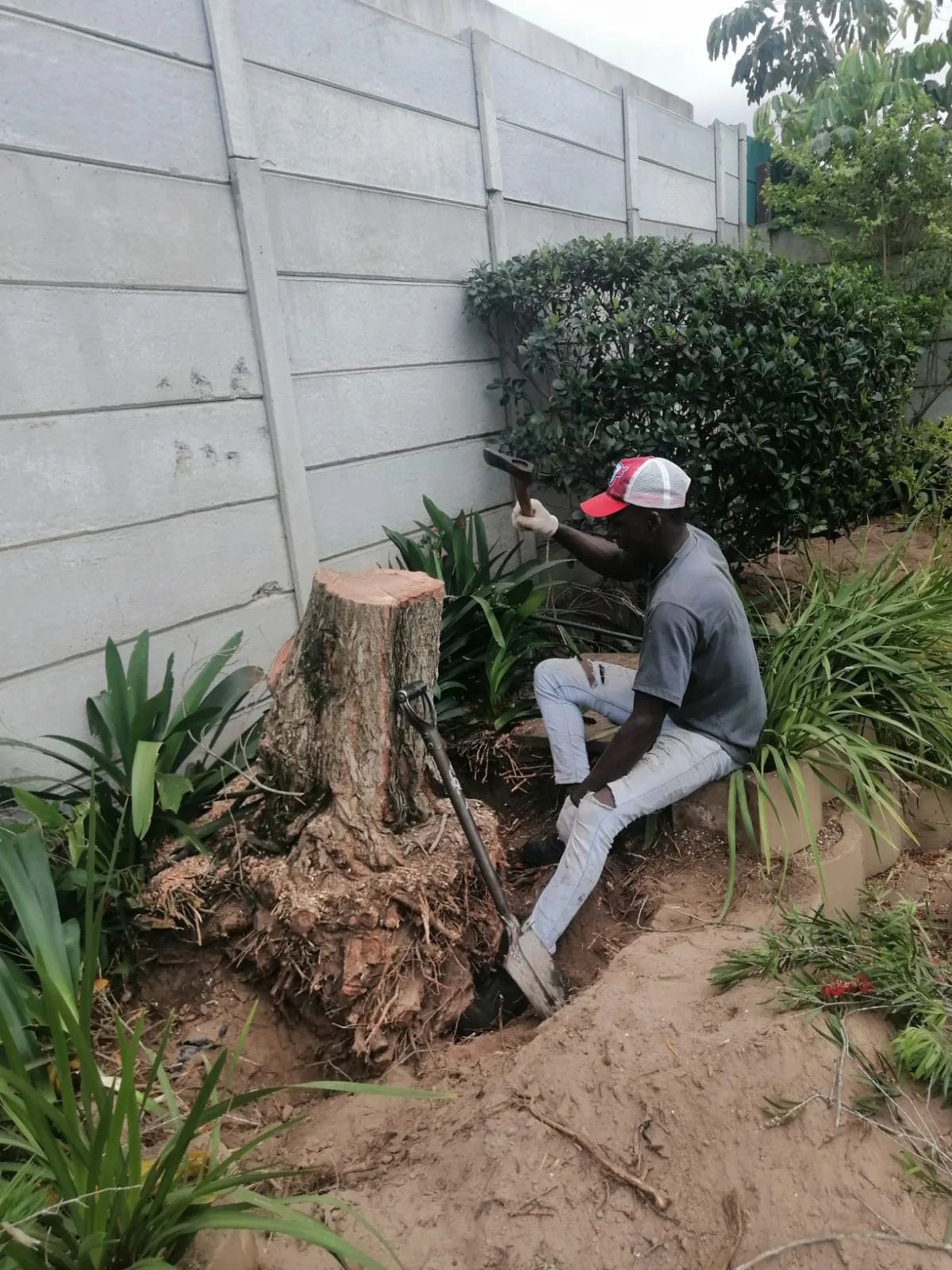
Removal is the right answer when the palm is too big for the position, is dying from the crown down, sits over a roof or a road, or you simply want the space and light back. If you want the base gone as well, we grind or dig out the stump in the same visit rather than sending a second crew a fortnight later.
Do you need a permit to remove a palm in Cape Town?
For a palm growing inside your boundary: almost always no. Palms are ornamental, non-indigenous garden trees, and ornamental trees on private property in Cape Town can be removed without a municipal permit. You don't need to apply for anything, and any contractor telling you otherwise is padding the job.
The exception is the one people get wrong. A palm on the road verge outside your wall is usually a City of Cape Town street tree, not yours — even though you're the one sweeping up its fronds. The City's Urban Forest Policy is explicit that a tree planted in a public road becomes the property of the City. Those need Council approval before anyone touches them, and taking one out without it is an offence. Same goes for a palm inside a heritage overlay area or on a listed property. We check which side of that line your tree falls on at the quote stage and tell you straight — we won't cut a Council tree on your say-so.
The full rules — protected species, heritage trees and how to apply if you do need approval — are in our guide to tree felling permits in Cape Town.
How we get a tall palm down between two houses
Cape Town plots are tight, and most palm tree removal here happens in a gap of three or four metres between a wall and a house, or on a verge with traffic going past. There's no room to drop anything, so nothing gets dropped.
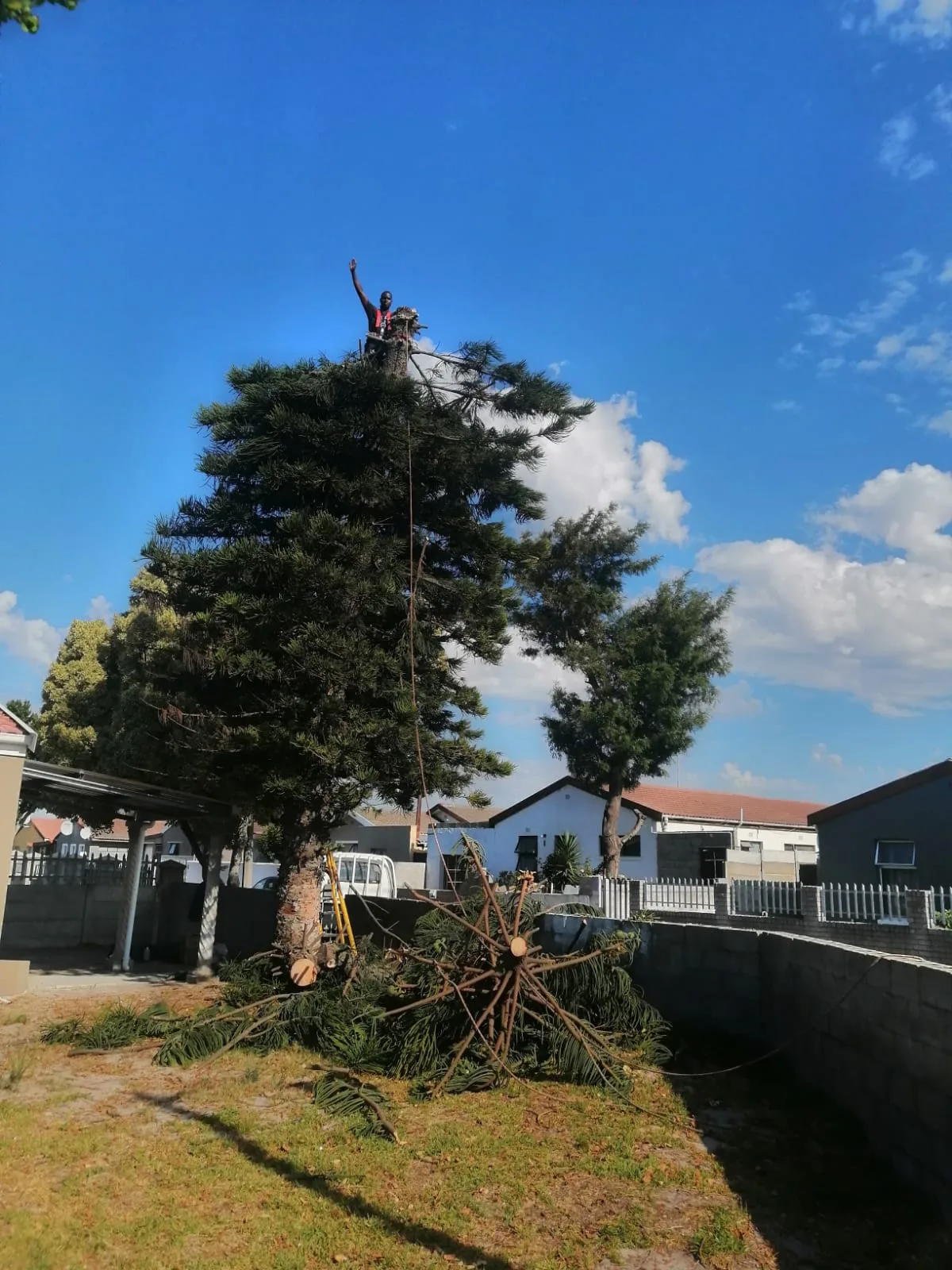
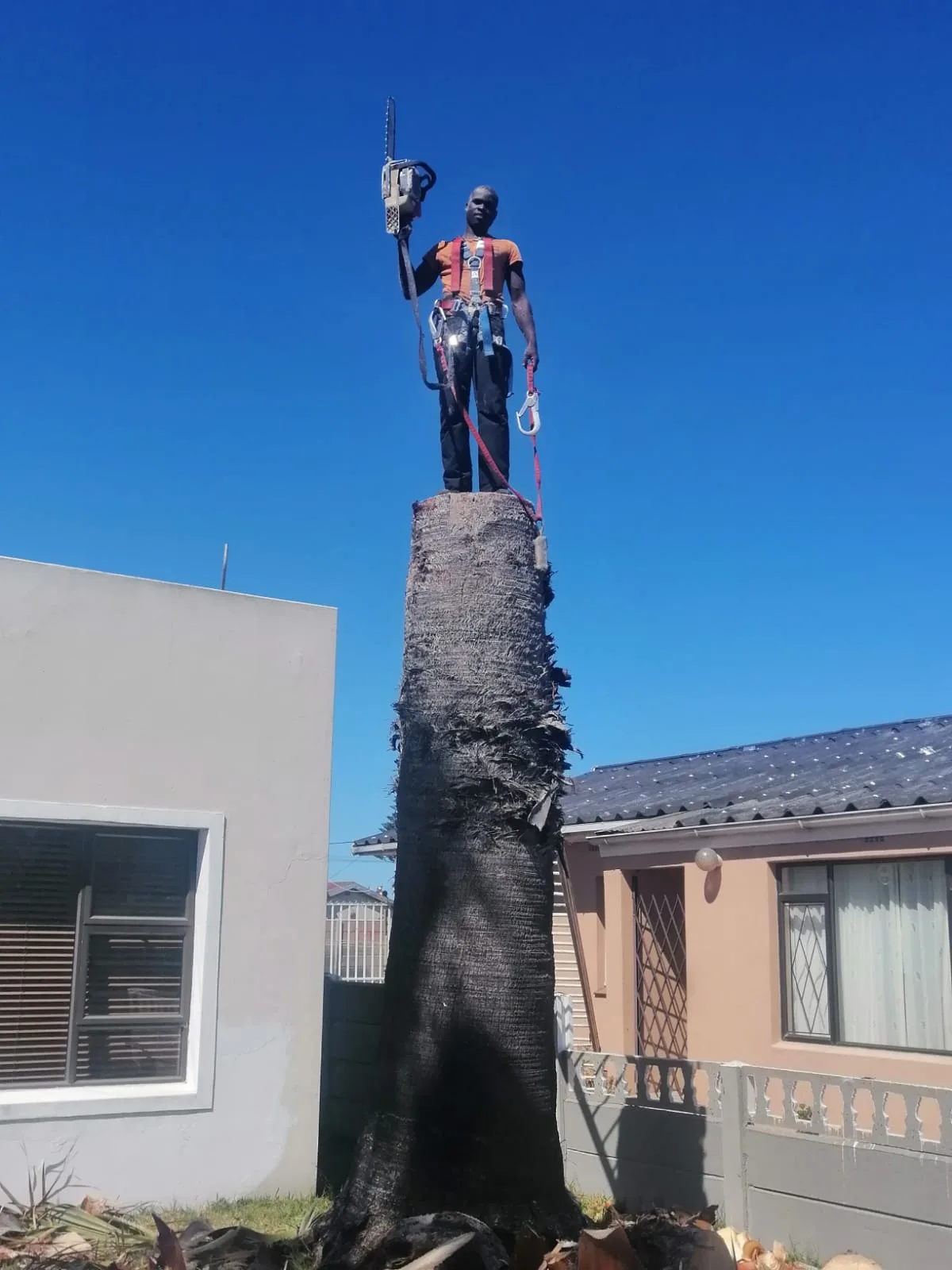
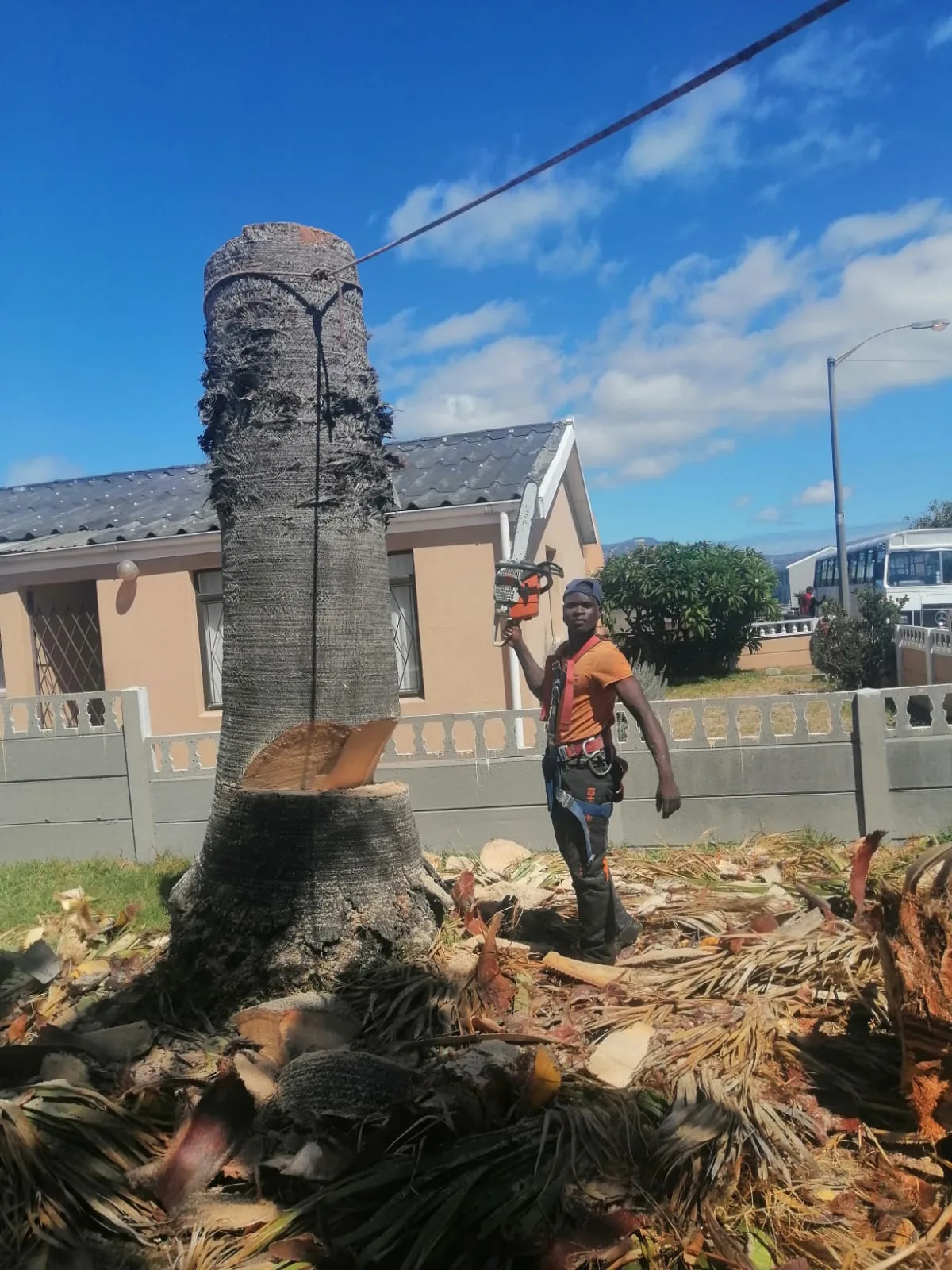
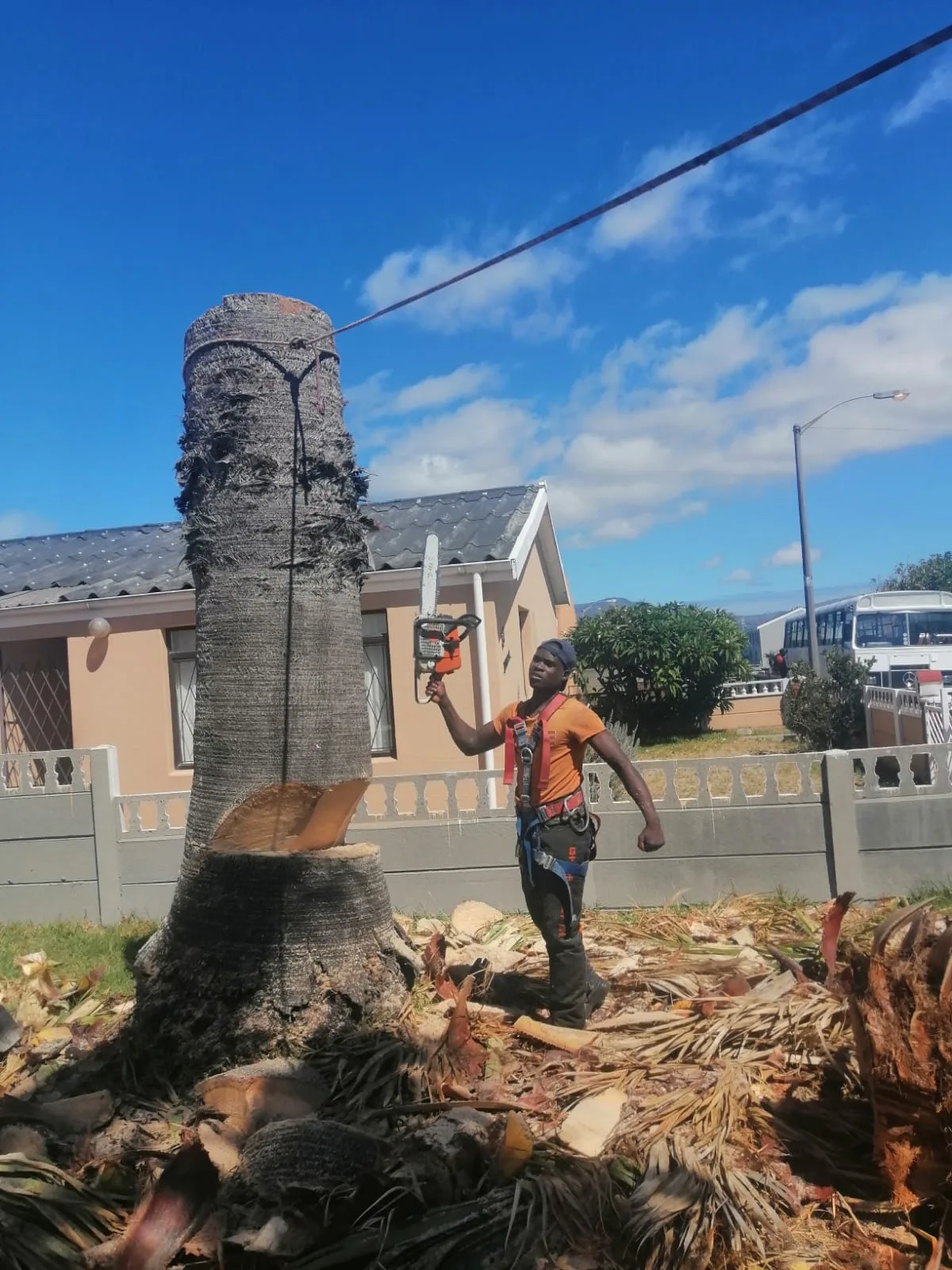
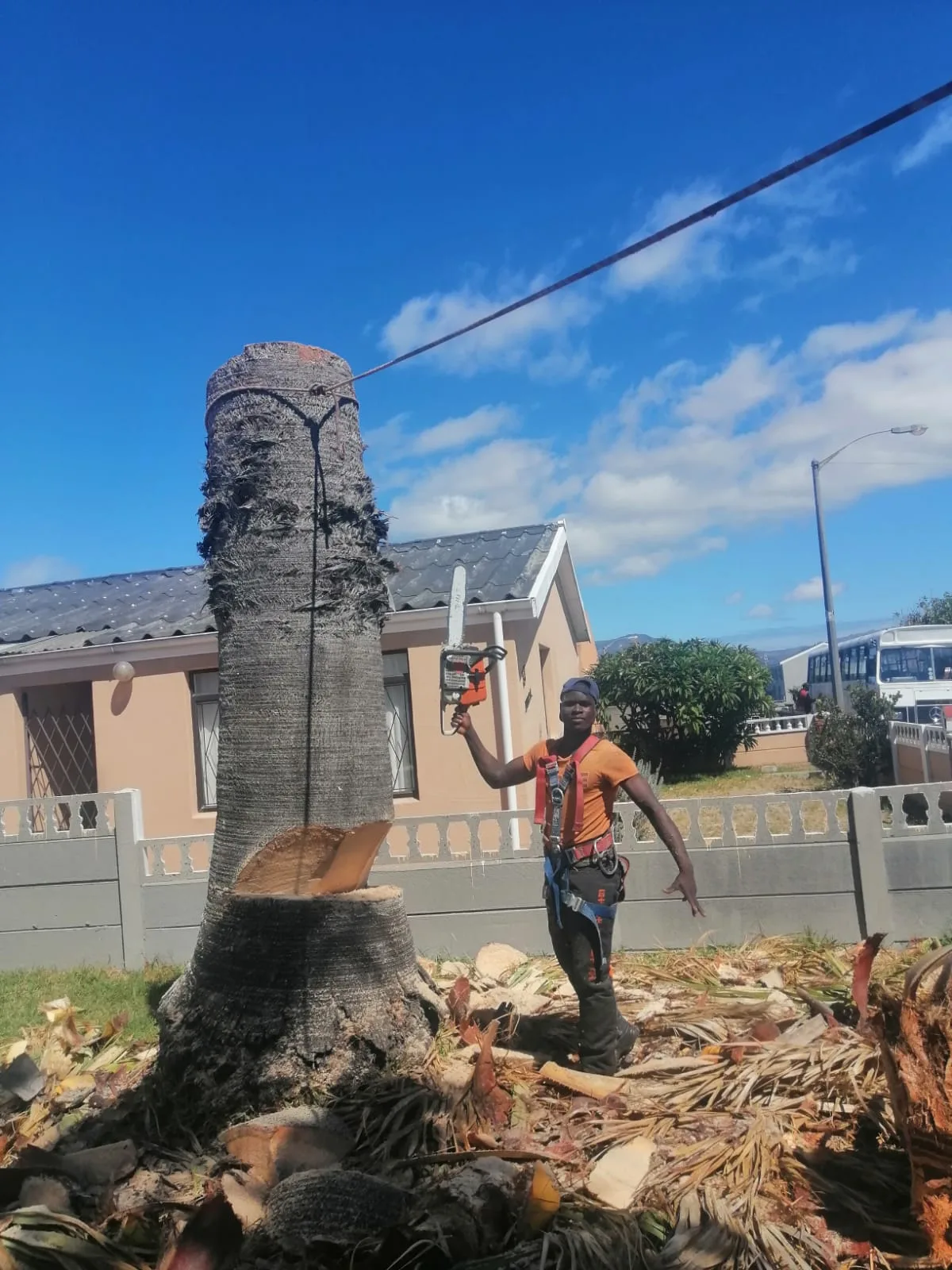
Our climber goes up the trunk on spikes and a harness — no cherry picker, no scaffolding, nothing driven across your lawn. The fronds come off first and are lowered or thrown into a cleared zone. With the trunk bare, it's cut from the top down in short sections, each one rigged and lowered on a rope rather than allowed to fall. On a date palm those sections are heavy enough that this is the whole safety case for the job. The trunk is the last thing standing, and by then it's a bare pole in a controlled space.
Then the part people underestimate: the clean-up. A mature palm produces a genuinely enormous volume of bulky, water-heavy material, and it all has to be carried out and loaded. Our price includes hauling the lot away and sweeping the driveway or pavement before we leave. You should not be paying twice for the mess.
We do this work right across the city, including a lot of it on the Atlantic Seaboard — see, for example, palm removal in Sea Point, where the palms are tall, old and almost always over a pavement.
Our palm removal process
Assess height and access
Tall palms wedged between houses or on the verge need careful planning — we check the rope routes and drop zones before we start.
Climb and strip the fronds
Our climber works up the trunk removing dead and live fronds, seed pods and skirt, either to clean the palm up or to prep it for removal.
Section down the trunk
For full removal we cut the bare trunk down in controlled sections, lowering each piece so nothing below is at risk.
Clear the heavy debris
Palm fronds and trunk sections are heavy and bulky — we load and haul the lot, and sweep the street or driveway clean.
Every palm removal job is quoted up front in writing, and cleaned up afterwards.
Get my free quotePalm Removal jobs in Cape Town
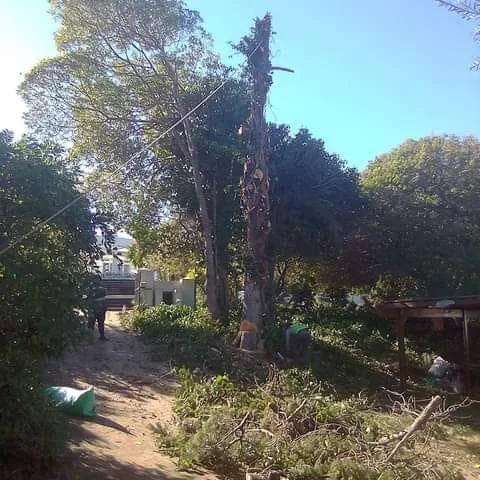
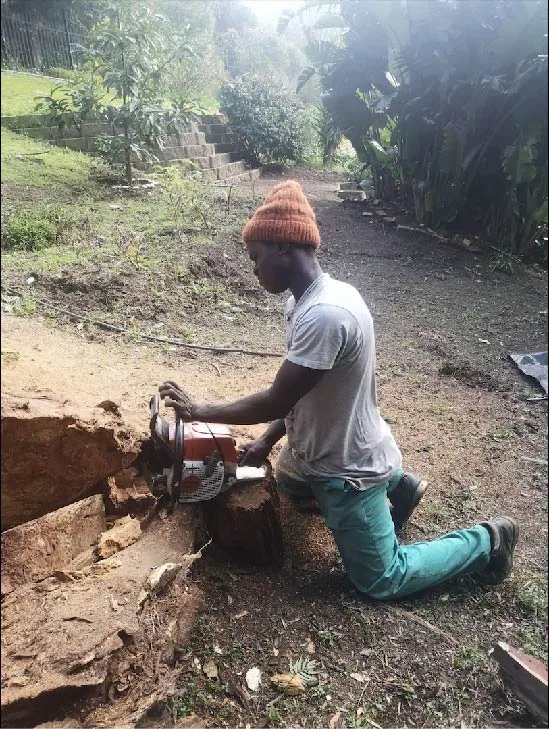
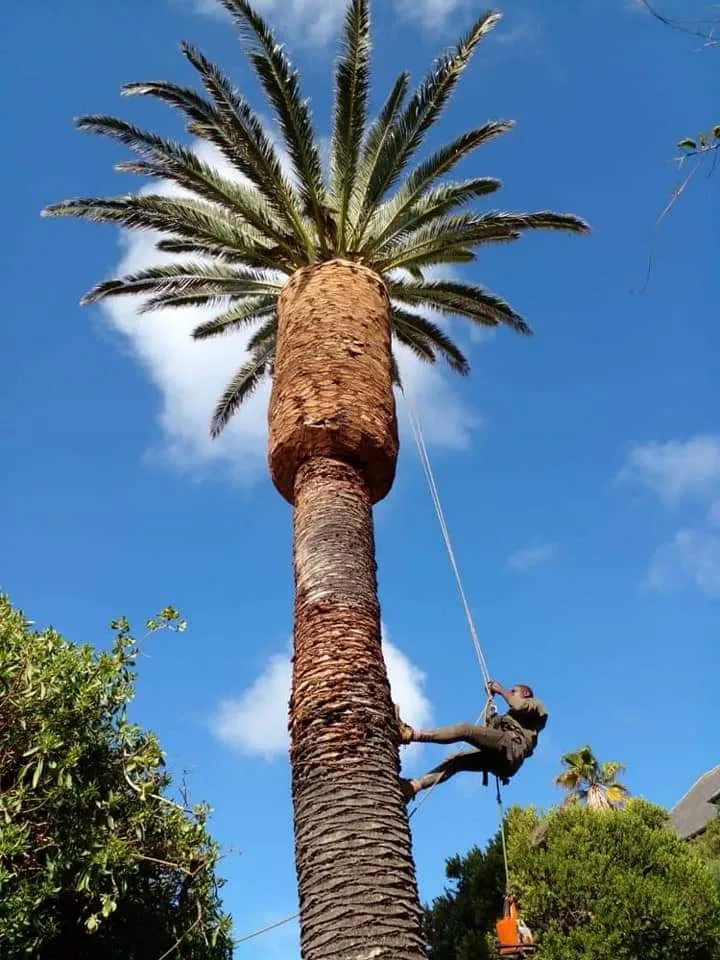
These are our crew on real jobs — no stock photography. More of them are in the job photo gallery.
Get a free palm removal quote
Fill this in and we'll come and look, then give you one fixed written price. No call-out fee.
Palm Tree Removal & Cleaning FAQs
Common questions about this service in Cape Town.
Palm Removal across Cape Town
We provide palm tree removal & cleaning right across the city — including Camps Bay, Sea Point, Constantia, Newlands, Durbanville and Table View. Not on the list? We cover the whole of greater Cape Town.
Other tree services we offer
All across greater Cape Town.
Tree Felling
Safe, controlled felling of large and awkward trees anywhere in Cape Town.
Learn more
Tree Removal
Complete tree removal — felled, cleared, hauled away and the site left tidy.
Learn more
Stump Removal & Grinding
Grind out unsightly stumps below ground level so you can pave, build or replant.
Learn more
Tree Pruning & Trimming
Shape, thin and lift your trees for health, light and a tidy garden.
Learn more