Why Are My Palm Fronds Brown and Drooping? (Cape Town Guide)
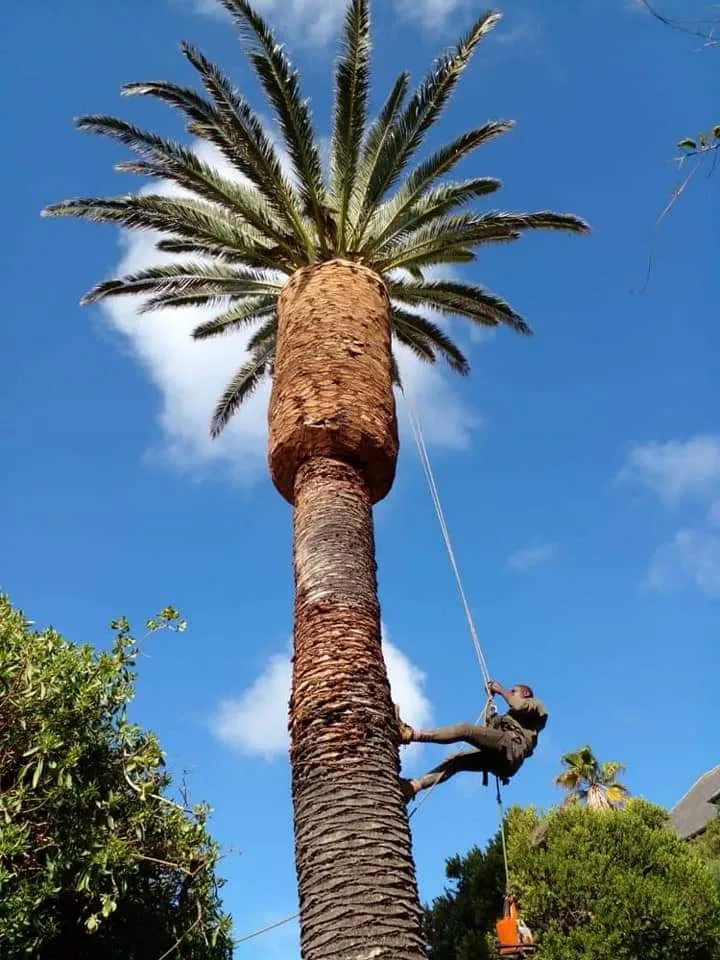
A palm with brown, hanging fronds is the single most common call we get about palms in Cape Town. Sometimes it's nothing at all. Sometimes it's a soil problem you can fix with fertiliser. Occasionally it's a disease that no amount of trimming will stop. And quite often the browning was made worse by the last person who "cleaned it up". This guide walks through what the browning actually means, how to read your own palm from the ground, and what the right response is in each case.
Key takeaways
- A healthy palm always has a few dead fronds at the bottom of the crown. Old fronds dying off from the underside is normal, not a warning sign.
- Where the browning starts tells you almost everything. Oldest fronds first usually means nutrition or age; newest fronds first is the serious one.
- Potassium deficiency is the most common palm nutrient problem, and cutting the discoloured fronds off makes it worse, not better.
- The tight "hurricane cut" — everything stripped back to a feather duster — makes palms less wind-resistant, not more.
- Fusarium wilt of Canary Island date palms was confirmed in Cape Town in November 2023. It kills one side of the crown at a time and spreads on unsterilised pruning tools.
- Falling fronds and seed pods are heavy. On a verge or over a driveway, that's the thing that usually forces the decision.
First: some brown is meant to be there
Palms don't shed branches the way an oak does. They grow new fronds from a single growing point at the top and let the oldest ones die off from the bottom of the crown. So on any mature palm you will see a ring of yellowing and then brown fronds under the green ones, hanging down against the trunk. That's the palm doing exactly what it should. On a Washingtonia those dead fronds build up into the classic brown "skirt", and left alone it can hang for years.
The question is never "are there brown fronds", it's "where on the crown are they and how fast are they appearing". Two or three brown fronds at the very bottom with a full green crown above is a palm in good health. A third of the crown browning in one season, or browning that starts at the top, is a different story.
| Where the browning starts | What it usually is | How worried to be |
|---|---|---|
| Bottom fronds only, slowly | Normal ageing of old fronds | Not at all |
| Frond tips, all over the crown | Salt wind or drought stress | Cosmetic, worth watching |
| Oldest fronds, orange-yellow speckling | Potassium deficiency | Treat the soil, don't cut |
| Oldest fronds, yellow edges with a green centre | Magnesium deficiency | Treat the soil, don't cut |
| One side of the crown, top to bottom | Possible Fusarium wilt | Get it looked at properly |
| Newest central fronds, frizzled | Manganese deficiency or bud damage | Serious — the growing point |
The five things browning Cape Town palms
1. Salt wind
Anyone with a palm on the Atlantic Seaboard, in Bloubergstrand or along the False Bay coast knows the look: fronds burnt brown on the seaward tips, the whole crown combed one direction by the south-easter. Salt spray desiccates the leaf tips and the wind shreds and abrades the leaflets. It is ugly and it is almost never fatal on its own. Palms are among the better trees for a coastal Cape garden precisely because they bend and take that punishment. Expect tip burn every summer, and expect the palm to push new fronds through it.
2. Drought and root stress
Our dry Cape summer, water restrictions and the sandy soils across the Flats and the Deep South all conspire against a palm that was planted into a hole and never watered again. Drought browning tends to be uniform tip burn across the crown with fronds folding inward and hanging limp rather than holding out flat. A palm growing in a lawn that gets irrigated will nearly always look better than the same species in a gravelled courtyard. Deep, infrequent watering through summer does far more for a struggling palm than any amount of trimming.
3. Potassium deficiency — the big one
This is the most common nutritional problem on landscape palms, and it is the one homeowners misread most often. It shows up first on the oldest fronds as translucent yellow-orange or necrotic spotting, then the leaflet tips die back and the whole frond looks scorched and frizzled while the top of the crown still looks fine. The palm is doing something clever and unhelpful at the same time: potassium is mobile inside the plant, so a hungry palm strips it out of its old fronds to feed the new ones.
Which is exactly why cutting those ugly fronds off backfires. University of Florida IFAS Extension puts it bluntly: removing discoloured older potassium-deficient leaves on a regular basis has been shown to accelerate the rate of decline and can result in the premature death of the palm. You take away the reserve the palm was living off. The fix is a slow-release palm fertiliser with a proper potassium and magnesium ratio, applied over a couple of seasons, and patience while the new fronds come through clean.
4. Magnesium deficiency
Magnesium looks similar but reads differently up close. On the oldest fronds you get a broad, bright lemon-yellow band along the outer margins of the leaflets while the centre of the frond stays green — a stripe down the middle rather than all-over scorch, as UF/IFAS describes it. It is not fatal and it is not contagious. Same treatment: feed the soil, leave the fronds on the palm.
5. Disease — and one that's now local
In November 2023, wilting ornamental palms at the V&A Waterfront were sampled and the cause identified as Fusarium oxysporum f.sp. canariensis along with the pink rot fungus Nalanthamala vermoesenii. As reported by researchers at the University of Pretoria's forestry pathology group, this was the first record of either pathogen in South Africa. Fusarium wilt of Canary Island date palms has a signature look: fronds die on one side of the crown first, often with one half of an individual frond dying while the other half stays green. There is no cure once a palm has it.
The part that matters for you is how it travels. Internationally it is understood to move mainly on pruning equipment carrying infected sawdust and sap from palm to palm. Ask whoever prunes your Canary palm what they do about tool hygiene between trees. It's a fair question and a good contractor won't mind it.
How to read your own palm from the ground
You can get most of the way with a pair of binoculars and five minutes. Look at the newest fronds in the centre of the crown, the spear leaf that hasn't opened yet, and the pattern of the damage rather than the amount of it.
Just needs a clean
New centre fronds green and full, spear leaf firm and upright, browning confined to the bottom ring and the tips. This palm is fine. Take off the fully dead fronds and the seed pods, and leave everything green where it is.
Feed it and wait
Oldest fronds speckled orange or edged yellow, newest fronds clean. That's a soil problem, not a dying palm. Slow-release palm fertiliser, deep watering, and resist the urge to cut the ugly ones off.
Get it looked at
Newest fronds coming through small, frizzled or brown; a spear leaf you can pull out by hand; one whole side of the crown dying; or a soft, foul-smelling top. Damage at the growing point is the one thing a palm cannot recover from.
The reason the centre matters so much is that a palm has one growing point. A tree that loses a limb grows another. A palm that loses its bud is finished, however green the rest of the crown still looks. So the newest growth is your health check, and the old brown fronds are mostly a cosmetic question.
The falling frond problem
Here's where brown fronds stop being a gardening question. A dead Canary date palm frond is a two- to three-metre spine-armed length of hard timber. A Washingtonia skirt holds dozens of them. They come off in the first proper south-easter, and they do not flutter down. Add the fruit stalks: a mature date palm carries heavy hanging bunches that drop a constant rain of sticky fruit, then the whole stalk lets go.
What lands
Dead fronds, seed and fruit stalks, and the loose fibrous matting off the trunk. Off a tall palm that's a fall of eight to fifteen metres onto whatever is underneath — a car bonnet, a pavement, a pool cover, a tin roof.
What else lives in there
An uncleaned crown and skirt is a well-known nesting spot for rats, bees and pigeons. For a lot of owners that, rather than the look of the thing, is what finally prompts the call.
If the palm overhangs a pavement, a shared driveway or the road, that changes the calculation from "when I get round to it" to something worth booking. Worth checking too whether the palm is actually yours: a palm growing on the road verge outside your wall is often a City tree rather than a private one, and that's a call to make before anyone starts cutting.
Why over-trimming kills palms
This is the part most people have never been told, and it's why so many Cape Town palms look worse a year after they were "tidied". The tight cut — everything taken back to a narrow tuft of upright fronds, sometimes called a hurricane cut — is sold as making the palm safer in wind and cheaper to maintain because it needs doing less often. Both claims are wrong.
Palms given the tight "hurricane cut" were more likely to have their crowns snapped off in a storm than palms left with full crowns. UF/IFAS, Pruning Palms
The fronds are what shelter the bud. Strip them and you expose the growing point to the full force of the wind. You also take away the palm's food factory and its nutrient reserve at the same time, which is why over-pruned palms so reliably develop the potassium-deficiency look described above. Do it repeatedly and the trunk itself narrows where the new growth is made — the "pencil-point" you see on badly maintained street palms, which is a genuine structural weak point.
Right
Take off fully dead fronds, the loose skirt, and the flower and fruit stalks. The industry standard is to leave anything whose tip sits above the horizontal — the 9 o'clock to 3 o'clock line across the crown. Removing fruit stalks actually helps: the palm puts that energy into new leaves instead.
Wrong
Cutting green or yellowing fronds to buy time before the next visit. Shaving the crown to a feather duster. Cutting into the trunk fibres to "neaten" the base of the fronds. Every one of those weakens the palm and none of them make it safer.
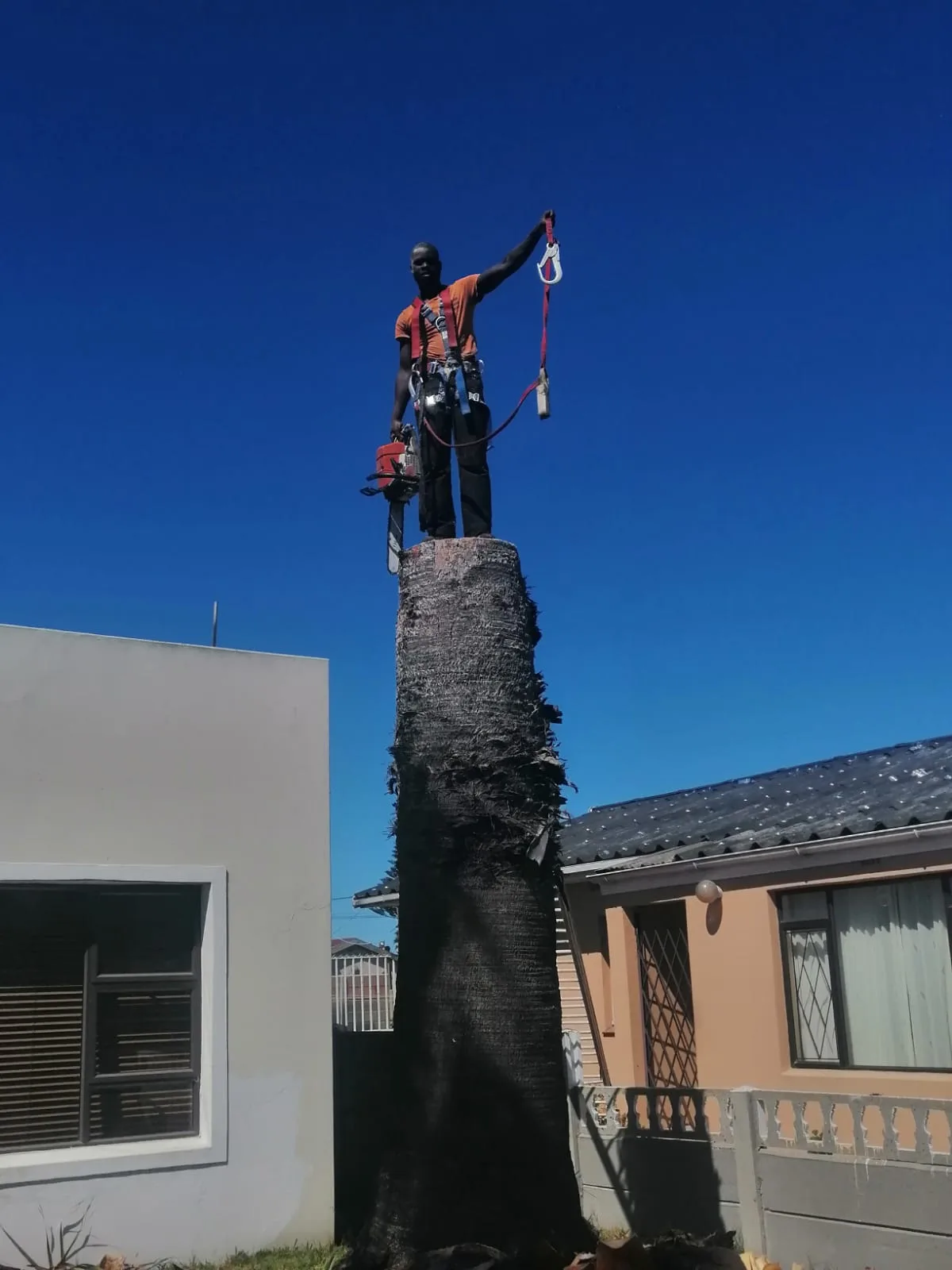
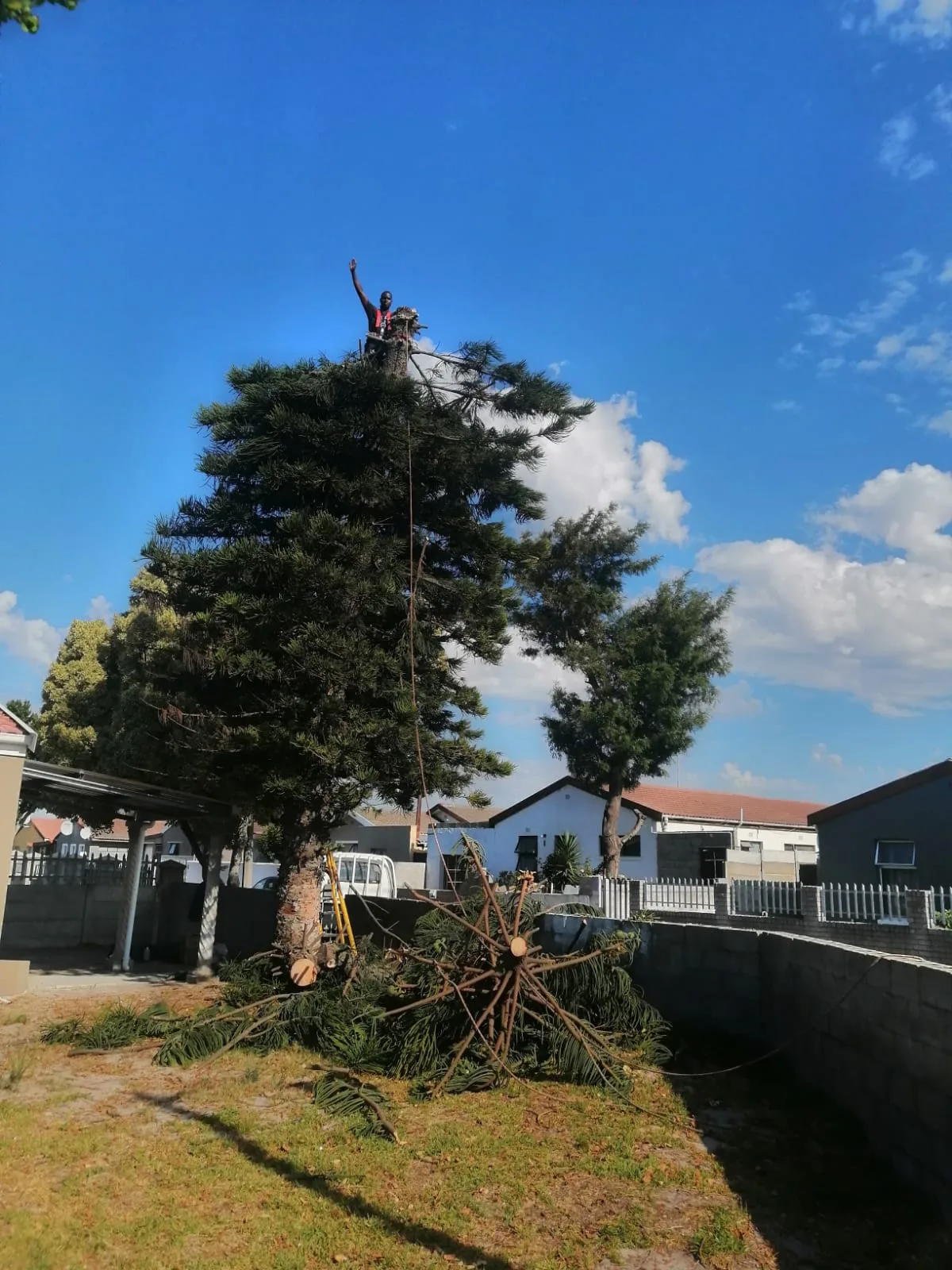
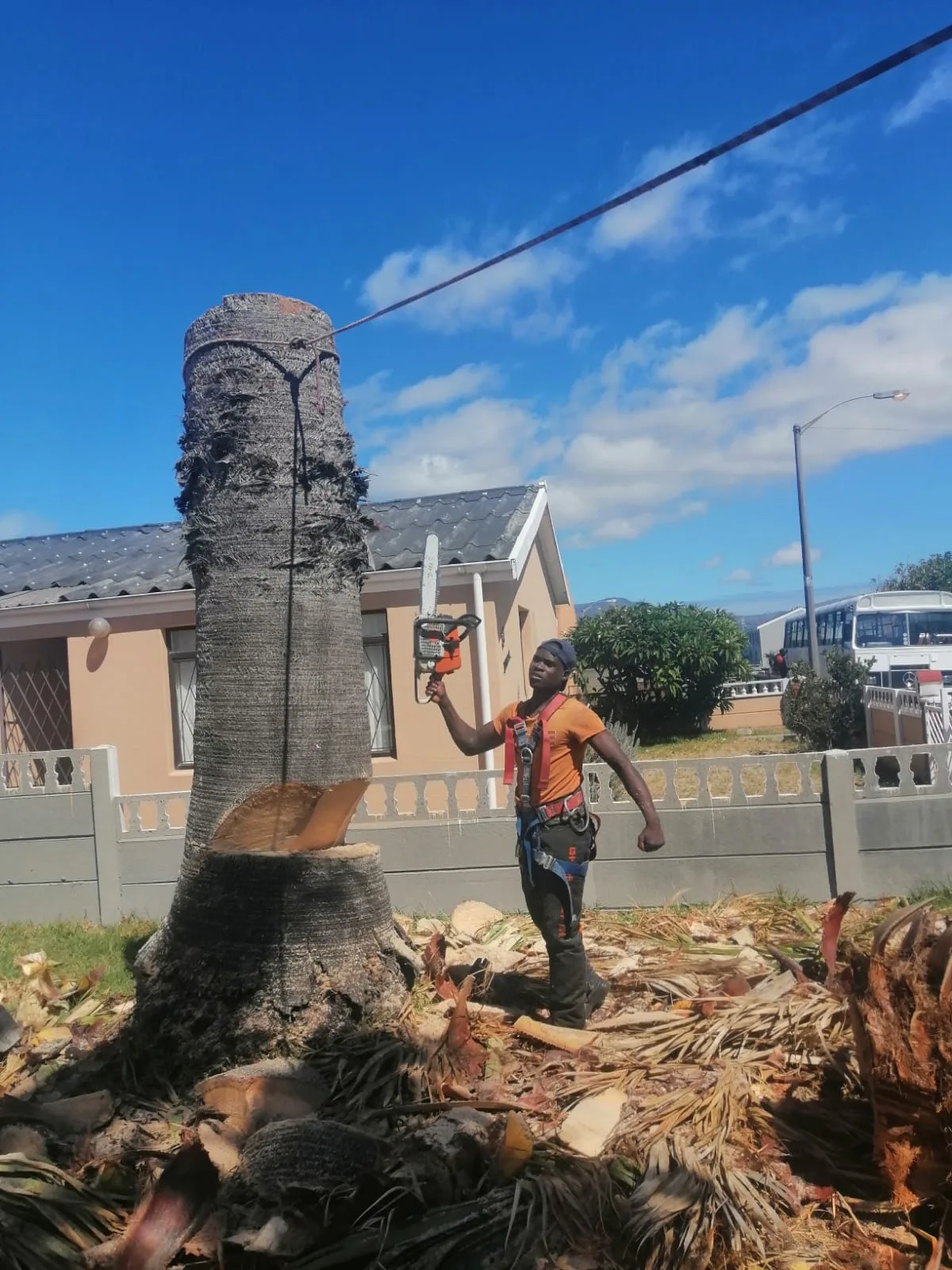
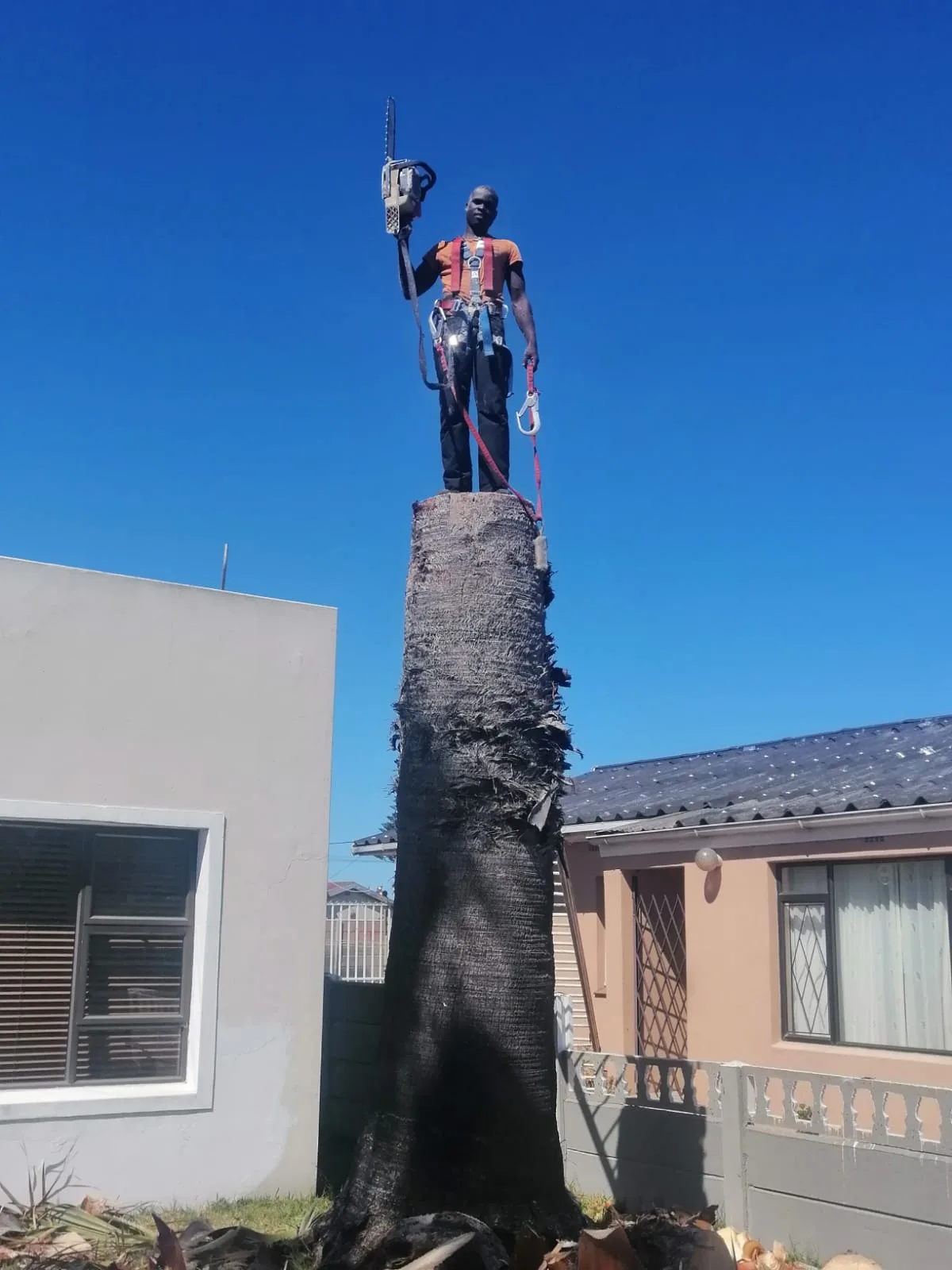
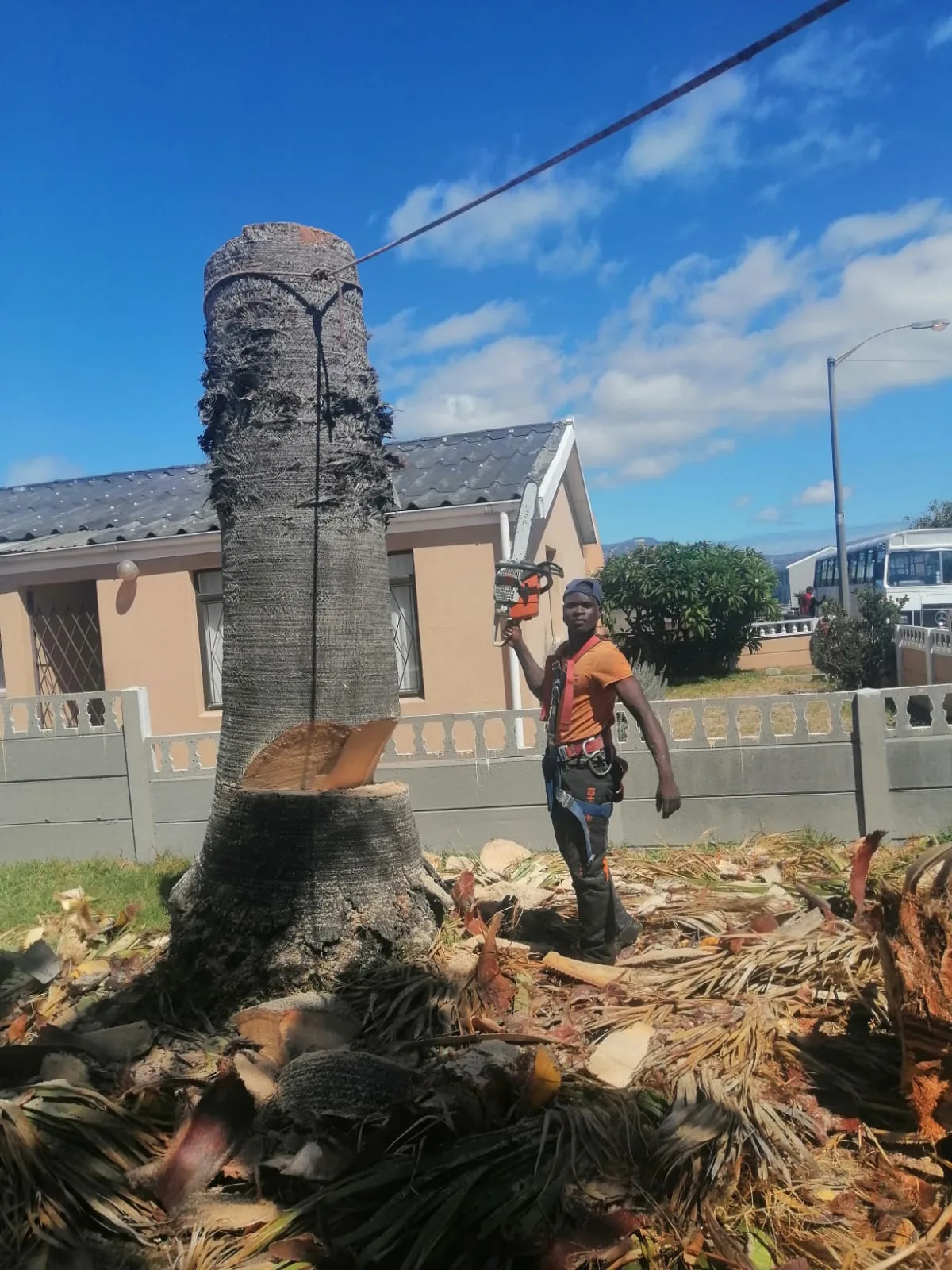
If a quote for a palm clean is unusually cheap and the crew is planning to be off site in twenty minutes, that's usually because they intend to take everything. A proper clean takes longer and leaves the palm looking fuller, not barer. Ask any contractor straight out how much green frond they plan to remove, and whether they work off ropes or off a ladder — the photos from our own palm jobs show what rope-and-harness work in a palm crown actually looks like.
Cleaning versus removal
Most brown-frond calls end in a clean, not a removal, and that's usually the right answer. A tall palm in good health with a messy crown gets climbed, de-fronded, de-podded and left to carry on. Done once a year on a date palm, or every second year on a Washingtonia, it keeps the mess off the driveway and the rats out of the head.
Removal earns its place in a smaller set of cases. A palm whose growing point has gone will never recover, so waiting only makes the job more dangerous as the trunk decays. A palm outgrowing its position, hard up against a roof or tangled toward the service lines, has nowhere to go — you can't reduce a palm's height the way you can a tree's. And a palm that has become a liability over a public pavement is a decision the calendar eventually makes for you. That's where palm removal and crown cleaning splits into two very different jobs at two very different prices.
| Situation | Usual answer | Why |
|---|---|---|
| Brown skirt, green crown | Clean | Healthy palm, cosmetic and safety issue only |
| Old fronds discoloured, new ones clean | Feed, then clean lightly | Nutrition, not decline — cutting makes it worse |
| Heavy fruit stalks over a driveway | Clean, annually | Removing stalks also boosts leaf production |
| One side of the crown dead | Assess, likely remove | Consistent with wilt disease, which has no cure |
| Spear leaf pulls out, soft top | Remove | Growing point is gone; the trunk will decay |
| Palm against the roof or wires | Remove | A palm's height can't be reduced by pruning |
Palms price differently to other trees, which surprises people. The trunk sections are much heavier than they look, the fronds are bulky to load out, and the access is often a two-metre gap between a wall and a house. That's the same set of factors that drives what tree work costs in Cape Town generally, weighted harder on palms.
Frequently asked questions
Should I cut off brown palm fronds?
Fully dead, fully brown fronds — yes, take them off. Fronds that are yellowing or partly green — leave them. Those are feeding the palm, and removing them speeds up decline rather than tidying the problem away.
Will my palm recover if the fronds are brown?
Usually, if the new fronds in the centre are coming through green and full. Browning that works from the outside in is age, wind or hunger. Browning that starts in the newest growth is the one that doesn't recover.
How often should a palm be cleaned?
Roughly once a year for a fruiting date palm over a driveway, and every second year for most others. If someone tells you a harder cut will stretch it to three years, that's the cut that damages the palm.
What fertiliser fixes yellowing palm fronds?
A slow-release palm-specific fertiliser carrying potassium and magnesium, applied over the root zone rather than at the trunk. Expect to see the improvement in the new fronds over a season or two, not in the old ones.
Can a palm be made shorter?
No. A palm grows from a single point at the top, so cutting the top off kills it. If a palm has outgrown its spot, the honest options are to live with it or to remove it.
Is a leaning palm dangerous?
Not always — many palms grow with a natural lean toward the light and stay sound for decades. What matters is whether the trunk is solid and whether the lean has changed recently. A soft or hollow-sounding trunk is the warning sign.
The short version: read the newest fronds, not the oldest ones. Feed the palm before you cut it. Take off what's dead and the seed pods, and leave the rest. And treat a very cheap, very fast palm "clean" with suspicion, because the cheapest way to make a palm look tidy for a year is also the surest way to weaken it. If you'd like someone to climb it and tell you honestly which of these you're dealing with, it takes two minutes to get a free on-site quote.
Keep reading
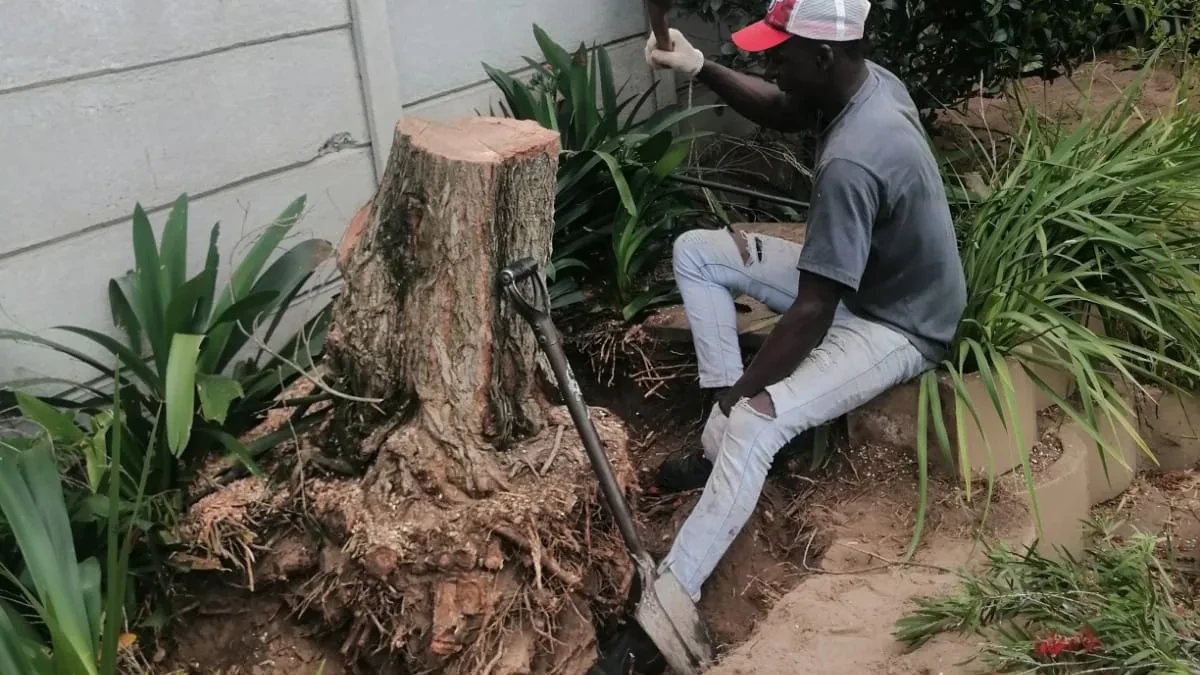
Tree Roots Damaging Your House, Paving or Drains? What to Do
Lifted paving, a blocked drain or a crack in the boundary wall, and a big tree nearby. Here is what tree roots actually do to a property, what they almost never do, what the law says when the tree is your neighbour's or the City's, and how to decide between cutting a root, fixing a pipe and taking the tree out.
How to Cut Down a Tree Safely (And When to Stop)
Most people searching for how to cut down a tree are really asking a different question: can I do this one myself? Here is the sequence a trained feller works through, what the hinge actually does, and the situations where the honest answer is to put the saw down and phone someone.
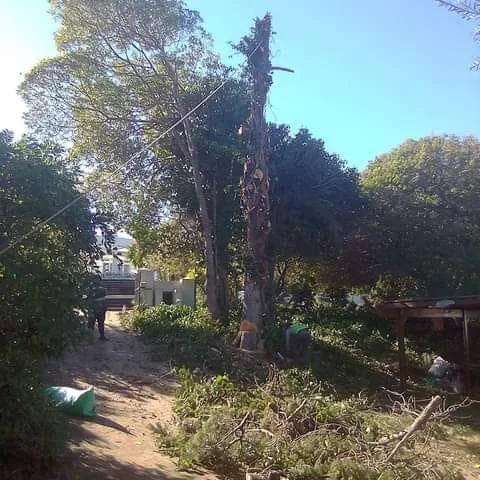
Blue Gum Tree Removal in Cape Town
A mature blue gum in a Cape Town garden sits in an odd legal spot: the species is listed as an invasive, but a big urban trunk is often specifically exempt from the duty to remove it. Here is which gums are actually listed, the tape-measure test that decides it, why cutting one down never finishes the job, and what a safe take-down in a suburb actually involves.