Once you've confirmed the polyphagous shot hole borer in a tree, the next question is expensive: can it be treated, or does it have to come down? There are people who will sell you an injection, and there are neighbours who'll tell you to fell it tomorrow. Both can be wrong. This guide sets out what the research and the official guidance actually say about every treatment on offer in South Africa, how to work out which side of the line your tree sits on, the three legal ways to destroy the wood afterwards, and roughly what the work costs around Cape Town.
Key takeaways
- No chemical product is registered in South Africa for use against PSHB. Anything sprayed or injected is off-label, and no one can legally promise you a cure.
- FABI's position is that injection may help a lightly infested tree, but that chemical control of a heavily infested tree "seems unattainable".
- Three questions decide it: is the species a reproductive host, is the main stem infested, and how far has the dieback gone.
- The wood is the real battleground. Chip it finer than 5 cm and compost it wet, solarise it under sealed clear plastic, or burn it on site where fire is allowed.
- PSHB and its fungus were made notifiable pests by two ministerial notices in 2020. Selling infested wood is prohibited, and infested wood must not be carted around.
- Trees on municipal verges and in parks are the City's to deal with, not yours. Trees on your property are yours.
Start here: three questions before you spend a cent
Almost every bad decision about a borer-infested tree comes from skipping straight to "what can I spray on it". The useful order is the other way round. Work out what you're dealing with first, because the answer changes whether treatment is even worth attempting.
1. Is it a reproductive host?
A tree the beetle breeds in is a factory pumping out new beetles. A tree it merely pokes at is mostly a cosmetic problem. This single fact changes everything.
2. Is the main stem infested?
If the holes are confined to a few branches, only those branches need to come off. If the trunk is peppered, you're past pruning.
3. How far gone is it?
A handful of holes and a full canopy is a different tree from one that's lost a third of its crown. Early is the only stage where treatment has any evidence behind it.
The official advice from the national invasive species programme is exactly this sequence: first determine whether the tree is a reproductive host and how severely it's infested, because that determines which action should be taken. If you're not certain what species you've got, start with which trees the beetle breeds in and work back from there.
What actually works: every treatment, honestly rated
Here's the uncomfortable summary. There is no cure. There are a few interventions with partial evidence behind them at the very early stage, several that have been tested and underperformed, and one thing that reliably reduces the beetle population, which is taking the breeding wood out of circulation.
| Approach | What the evidence shows | Where it might fit |
|---|---|---|
| Trunk injection (insecticide + fungicide) | Californian work found emamectin benzoate, bifenthrin and propiconazole can reduce infestation when applied early. Nothing is registered for PSHB in South Africa. | A lightly infested, high-value tree. Off-label, no guarantees. |
| Bark or foliar sprays | The beetle spends its life inside the wood. A surface spray struggles to reach it. | Not a standalone answer for an established infestation. |
| Biological (fungal biopesticides) | South African trials of Beauveria bassiana and Metarhizium anisopliae products looked promising in the lab but had little effect on beetle survival and reproduction in wood. | Not yet a field option. Research continues. |
| Pruning out infested branches | Genuinely useful when the trunk is clean, which is uncommon since PSHB usually goes for the stem first. | Early, branch-limited infestations on a healthy tree. |
| Removal and on-site destruction of the wood | The one intervention everyone agrees on. Removing breeding sites is what slows the spread down a street. | Heavily infested reproductive hosts. |
The registration problem nobody mentions in the sales pitch
This is the bit worth understanding before you pay anyone for a treatment. FABI at the University of Pretoria states plainly that no chemical product is registered (legal) to use on PSHB in South Africa. That doesn't mean injections are a scam. It means there is no product that has been assessed and approved for this pest in this country, so anyone applying one is working off-label and cannot honestly promise you an outcome.
FABI is equally clear about the ceiling on what chemicals can do. Control of light infestations may be achievable by direct injection of insecticides and fungicides, drawing on Californian research into emamectin benzoate, bifenthrin and propiconazole. But chemical control of PSHB in more heavily infested trees, in their words, "seems unattainable". South African trials have run too. A study published in the Journal of Plant Pathology in 2023 evaluated four chemical treatments on American sweetgum, and work on chemical control in a South African context is ongoing. The biological route has been tested here as well. Nel and colleagues, writing in Insects in 2023, found that two commercially available fungal biopesticides had little effect on beetle survival and reproduction in treated wood, despite looking useful in laboratory assays.
Questions to ask anyone selling you a PSHB treatment
- Which product, at what concentration, and is it registered for this pest?
- Have you confirmed the species is a reproductive host, and how?
- Is the main stem infested, or only branches?
- What happens if the tree keeps declining, and who carries that cost?
- How many repeat applications, over how long, at what total price?
Anyone who answers "guaranteed" to a PSHB question is telling you something about themselves, not about your tree.
When pruning is enough, and when it isn't
The line is drawn by where the holes are. National guidance is that if the main stem is not infested, only the infested branches need to come off, with the caveat that this is unlikely because PSHB usually attacks the stem first. So the honest version is: check the trunk properly before you convince yourself a tidy prune will fix it.
If the tree has only a few beetle holes and no sign of further activity after the first attack, it's most likely a non-reproductive host. Those are generally not expected to die, and the sensible response is to leave it alone and keep watching. A wild olive or a white stinkwood with a scatter of old holes is not an emergency.
Monitor and prune
Non-reproductive host, few holes, clean trunk, canopy still full. Take off affected limbs, destroy that wood properly, sterilise the saw between trees, and check it again each season.
Fell it
Reproductive host, holes through the main stem, visible dieback. FABI's position is that once a susceptible reproductive host is heavily infested it is generally not expected to survive. Every month it stands, it seeds the street.
The disposal rules: this is the part that matters most
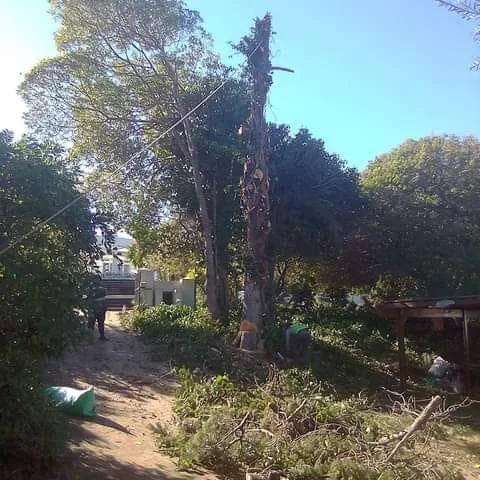
Felling the tree solves nothing on its own. What decides whether your infestation ends on your property or gets a lift to the next suburb is what happens to the timber in the hours after it hits the ground. The beetle and its fungus live inside the wood and carry on breeding there quite happily.
There are three accepted ways to destroy infested wood, and all three are meant to happen where the tree stood:
| Method | How to do it properly | How long |
|---|---|---|
| Chip and compost | Chip finer than 5 cm if the machine allows, then compost the chips in a heap kept wet | Ongoing, keep it damp |
| Solarise | Chopped wood in full sun under thoroughly sealed clear plastic sheeting or bags | At least six weeks in summer, up to six months in winter |
| Burn on site | Only where fire is permitted. Beetles fly out as the wood heats, so never burn in a clean area | Same day |
The City of Cape Town puts it in the plainest possible terms: infested trees must be chipped on site and may not be removed from the property, because moving the chipped wood spreads the pest to other areas. The City's own timings for solarisation are at least six weeks in summer and up to six months in winter. If wood genuinely has to leave a property, it goes to a dedicated disposal site, in a closed vehicle, and not into anybody's braai pile.
A practical Cape Town detail from the team at Arderne Gardens in Claremont: don't burn the arisings if you can chip them instead, because chipping kills most of the beetles, and covering the chip pile with black plastic solarises whatever survived.
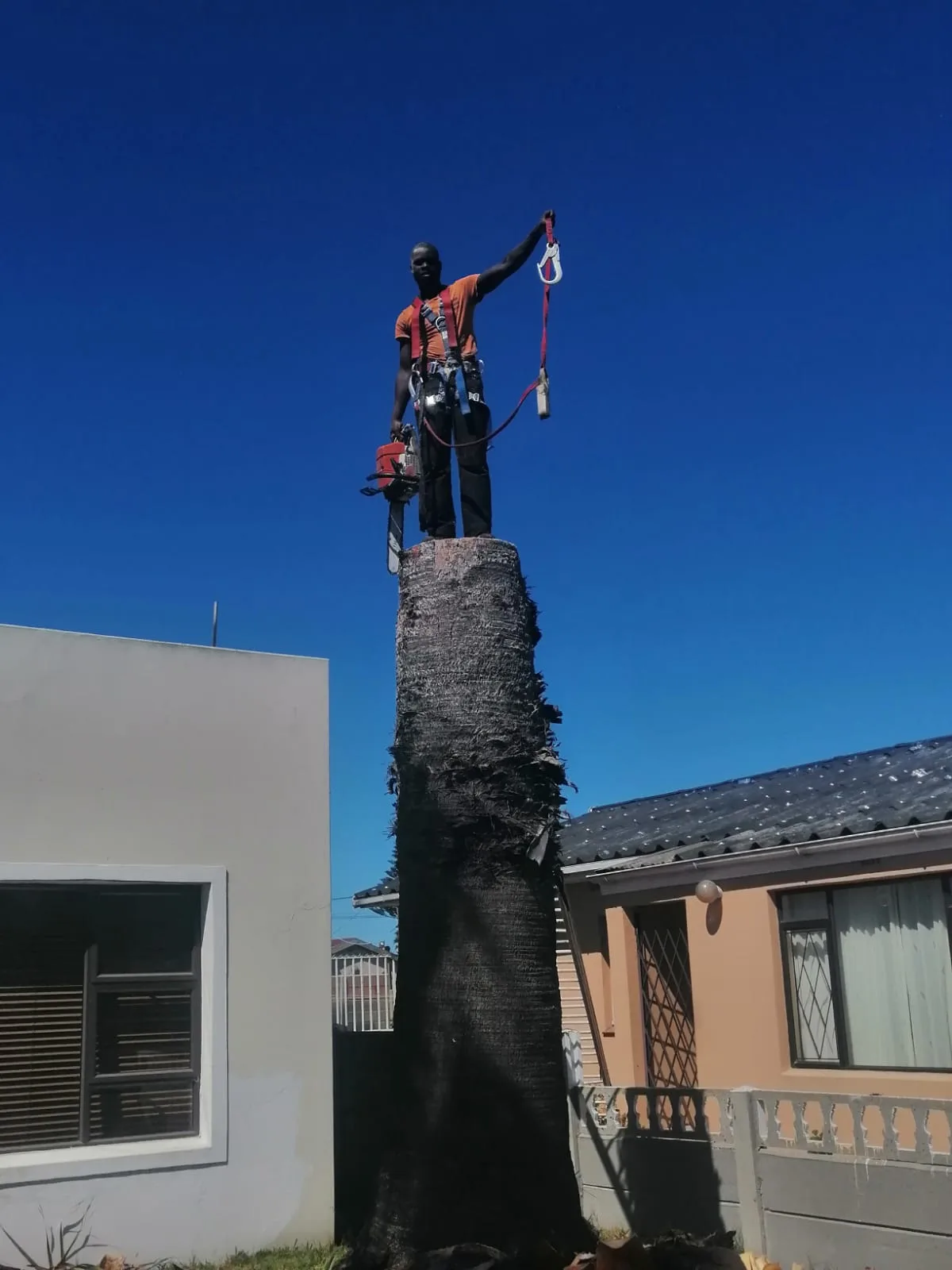
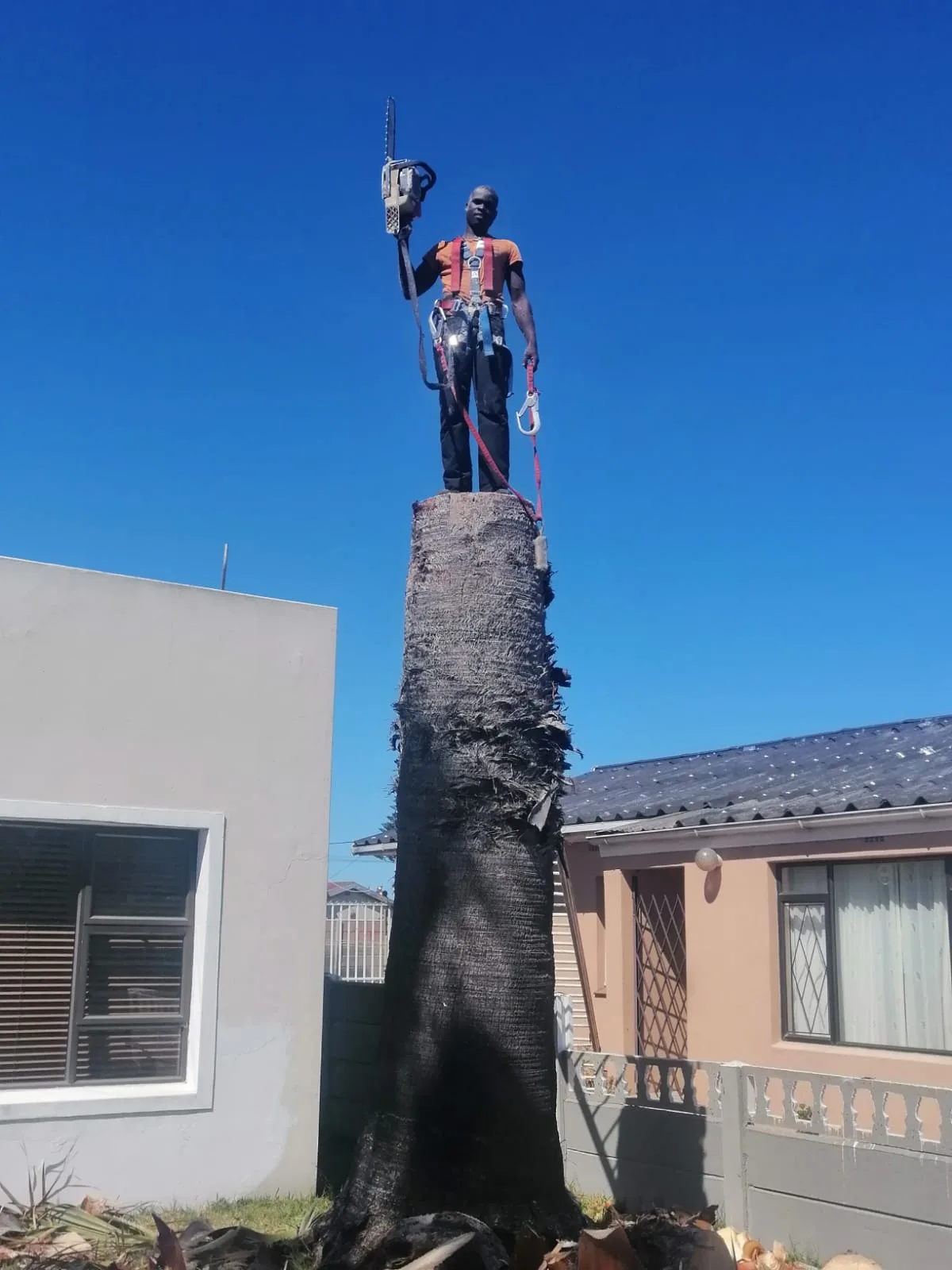
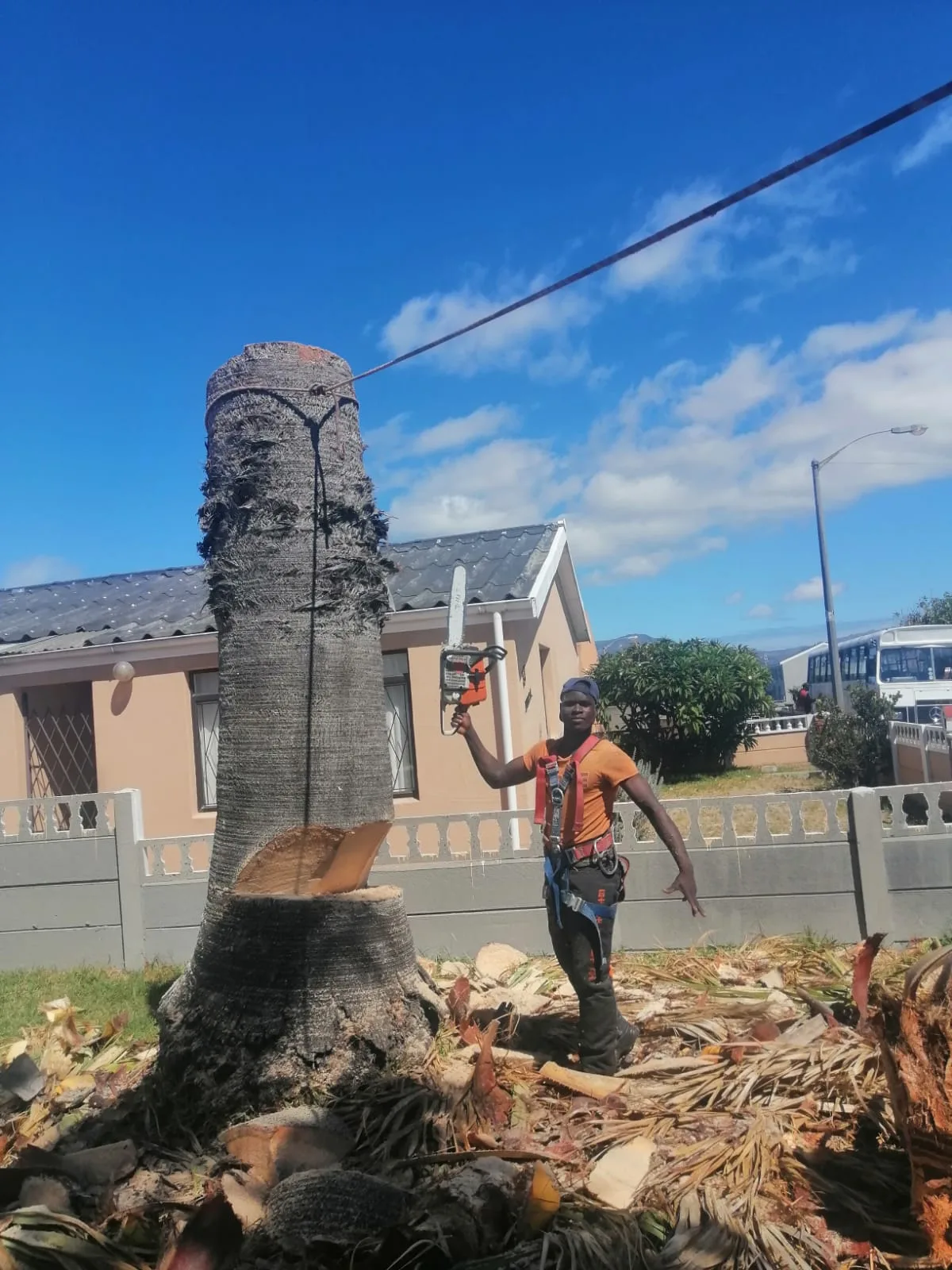
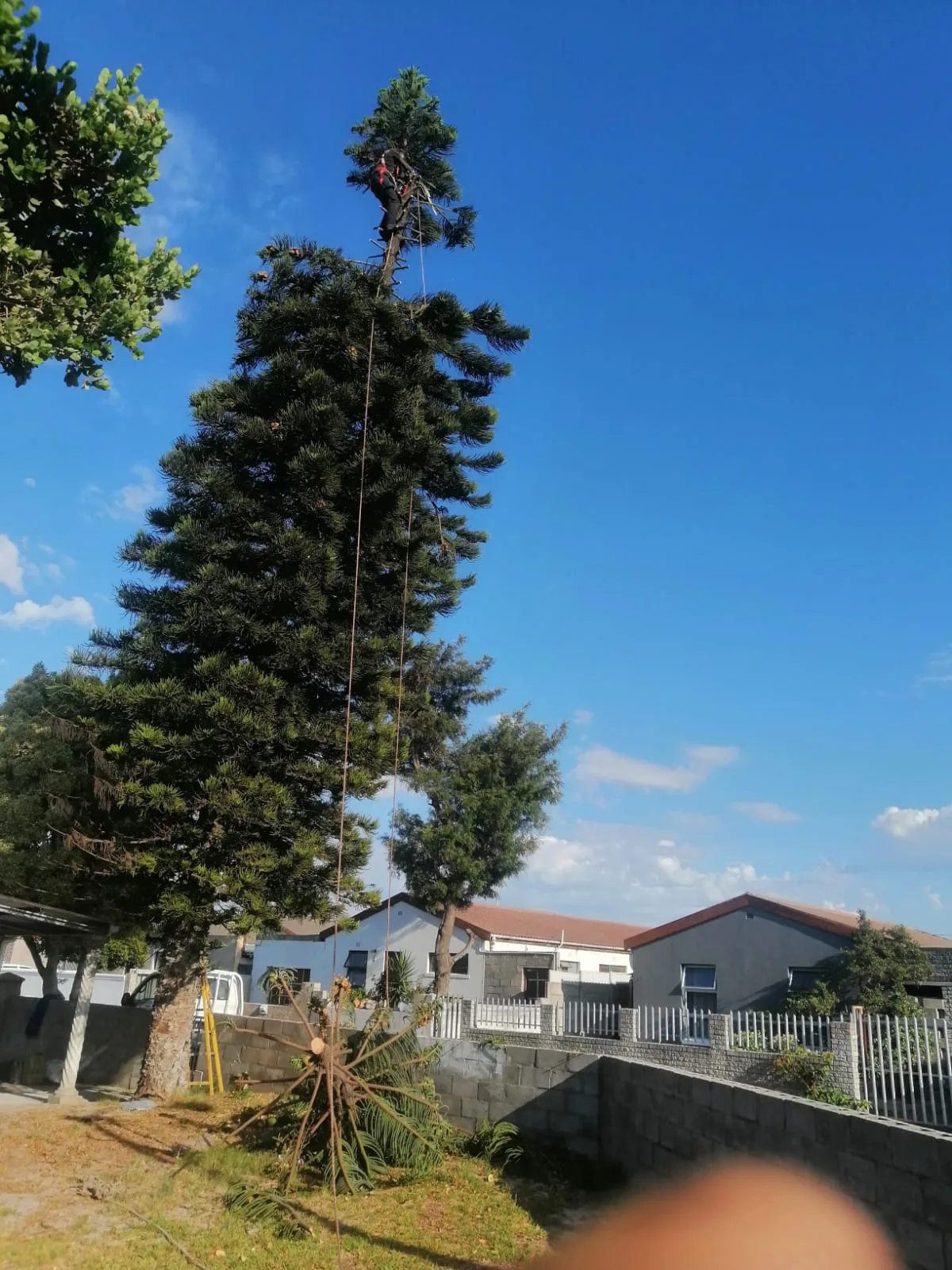
This is the single reason a borer job costs more than a normal felling. The wood cannot be loaded up and sold as firewood, so the machine has to come to the tree and everything gets processed in the driveway. When we take the tree down and chip it where it stands, the chip stays with the property owner or goes to a proper disposal point, and nothing leaves in a form the beetle can live in.
Where the law actually stands
People are often surprised that this is regulated at all. In 2020 two ministers, one for the environment and one for agriculture, issued emergency notifications that made the beetle and its fungus notifiable pests in South Africa. The agriculture side was finalised in a notice gazetted on 12 August 2021 under the Agricultural Pests Act, 1983.
What you must do
Report a suspected infestation. Landowners in affected areas are expected to report the presence of shot hole borer, and in Cape Town that means the City's invasive species unit. Treatment or removal on private land is the landowner's own responsibility.
What you must not do
Sell wood that is infested with shot hole borer, or move targeted tree species, firewood included, into a protected area. And you may not go and cut down a municipal street tree yourself, however sick it looks.
The South African Landscapers Institute keeps a plain-language summary of the legislation that's worth a read if you manage a complex, an estate or a body corporate, because the reporting duty falls on the owner or occupier of the land.
The thing to hold on to is that there is no treatment that saves a heavily infested breeding host, and no law that requires you to try one. What the rules actually ask of you is to report it, and to make sure the wood dies where the tree died.
What it costs in Cape Town
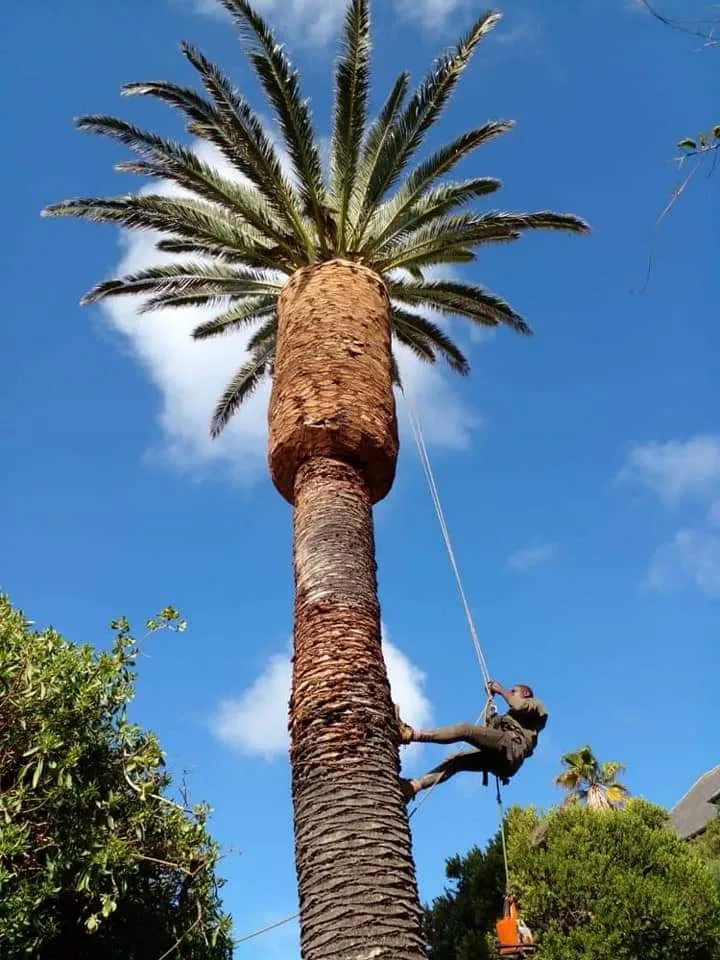
Price on a borer job is driven by the same things as any felling. Size of the tree, how close it is to a roof or a boundary wall, whether a climber has to take it down in sections, and how much material has to be processed. The borer adds one specific cost: the chipping has to happen on site, which means the machine and the crew stay until every last branch is through it.
What pushes the price up
Height, brittleness, tight access down a side passage, overhead power lines, a pool or glass roof under the drop zone, and the sheer volume of chip a mature box elder or oak produces.
What brings it down
Doing several trees in one visit, going ahead before the tree gets so brittle that it has to be rigged piece by piece, and letting the crew keep the chip on site rather than haul it.
Get the quote in writing, with the disposal method spelled out on it. A quote that says "remove tree" and nothing about what happens to the wood is an incomplete quote for a borer job. Ours are fixed and written before anyone starts, clean-up and waste removal included, and it costs nothing to get a free on-site quote and a straight answer about whether the tree is worth trying to save.
After the tree is gone
Replanting matters more than it sounds. Cape Town lost thousands of trees to this beetle, and in May 2025 the City began its first reforestation push in Newlands, planting water oaks along streets that were once lined with box elders. The City has also published a list of recommended replacement species for gardens, made up of indigenous trees and non-invasive exotics that the beetle doesn't breed in.
The one thing not to do is replant the same species that just died. If a box elder came out, another box elder is a beetle nursery with a two-year head start.
Frequently asked questions
Is there a treatment that cures shot hole borer?
No. No product is registered for PSHB in South Africa, and FABI's position is that chemical control of a heavily infested tree seems unattainable. Injection may help a lightly infested tree, but it is off-label and nobody can guarantee it.
Should I inject my tree or just fell it?
It depends on the species and how far it has gone. A lightly affected non-breeding host is worth watching. A reproductive host with holes through the main stem and dieback in the canopy is generally not expected to survive.
What must I do with the wood after felling?
Destroy it on the property. Chip it finer than 5 cm and compost the chips wet, solarise the material under sealed clear plastic, or burn it on site where fire is allowed. The City requires infested trees to be chipped on site.
Can I take the logs for firewood?
No. Moving firewood is the main way the beetle jumps between suburbs, selling infested wood is prohibited, and targeted species may not be moved into protected areas even as firewood.
Who deals with an infested tree on the pavement?
The City. Trees on municipal land such as streets and parks are the municipality's responsibility and may not be removed by residents. Report it on 021 444 2357 or to [email protected].
Do I need a permit to fell an infested tree in my garden?
Usually not for an ordinary garden tree on private land, but protected species and street trees are a separate matter. Check before you cut, because being infested does not override protection rules.
If you're weighing this up right now, the useful first step is simply an honest look at the tree by someone who cuts them for a living, alongside the basics of the beetle so you know what you're looking at. We'll tell you whether we think it's a breeding host, whether the stem is gone, and what it would take to deal with it properly. If the tree can be left standing, that's what we'll say.
Keep reading
Tree Roots Damaging Your House, Paving or Drains? What to Do
Lifted paving, a blocked drain or a crack in the boundary wall, and a big tree nearby. Here is what tree roots actually do to a property, what they almost never do, what the law says when the tree is your neighbour's or the City's, and how to decide between cutting a root, fixing a pipe and taking the tree out.
How to Cut Down a Tree Safely (And When to Stop)
Most people searching for how to cut down a tree are really asking a different question: can I do this one myself? Here is the sequence a trained feller works through, what the hinge actually does, and the situations where the honest answer is to put the saw down and phone someone.
Blue Gum Tree Removal in Cape Town
A mature blue gum in a Cape Town garden sits in an odd legal spot: the species is listed as an invasive, but a big urban trunk is often specifically exempt from the duty to remove it. Here is which gums are actually listed, the tape-measure test that decides it, why cutting one down never finishes the job, and what a safe take-down in a suburb actually involves.